





































































































































 International Free Zone Authority
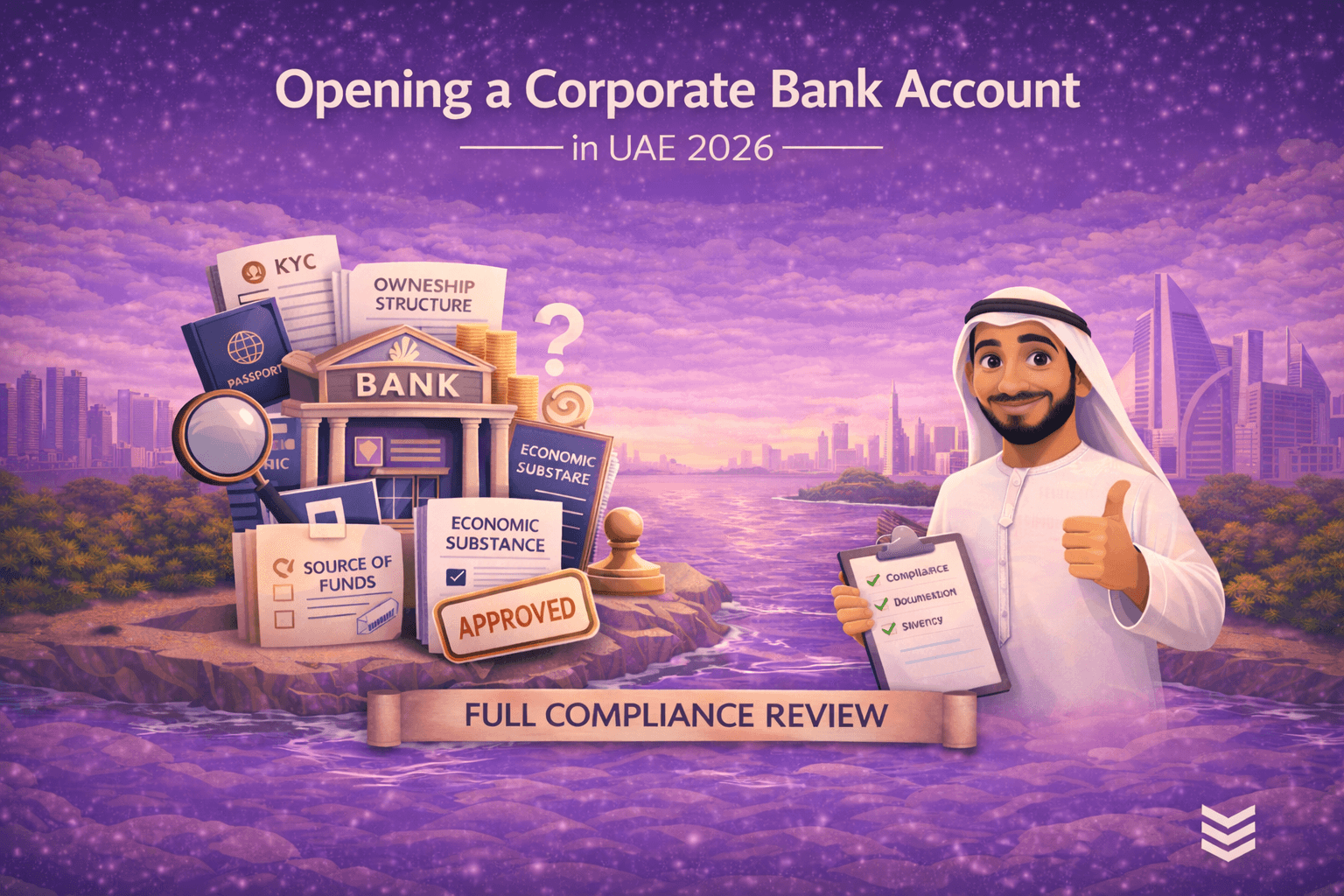
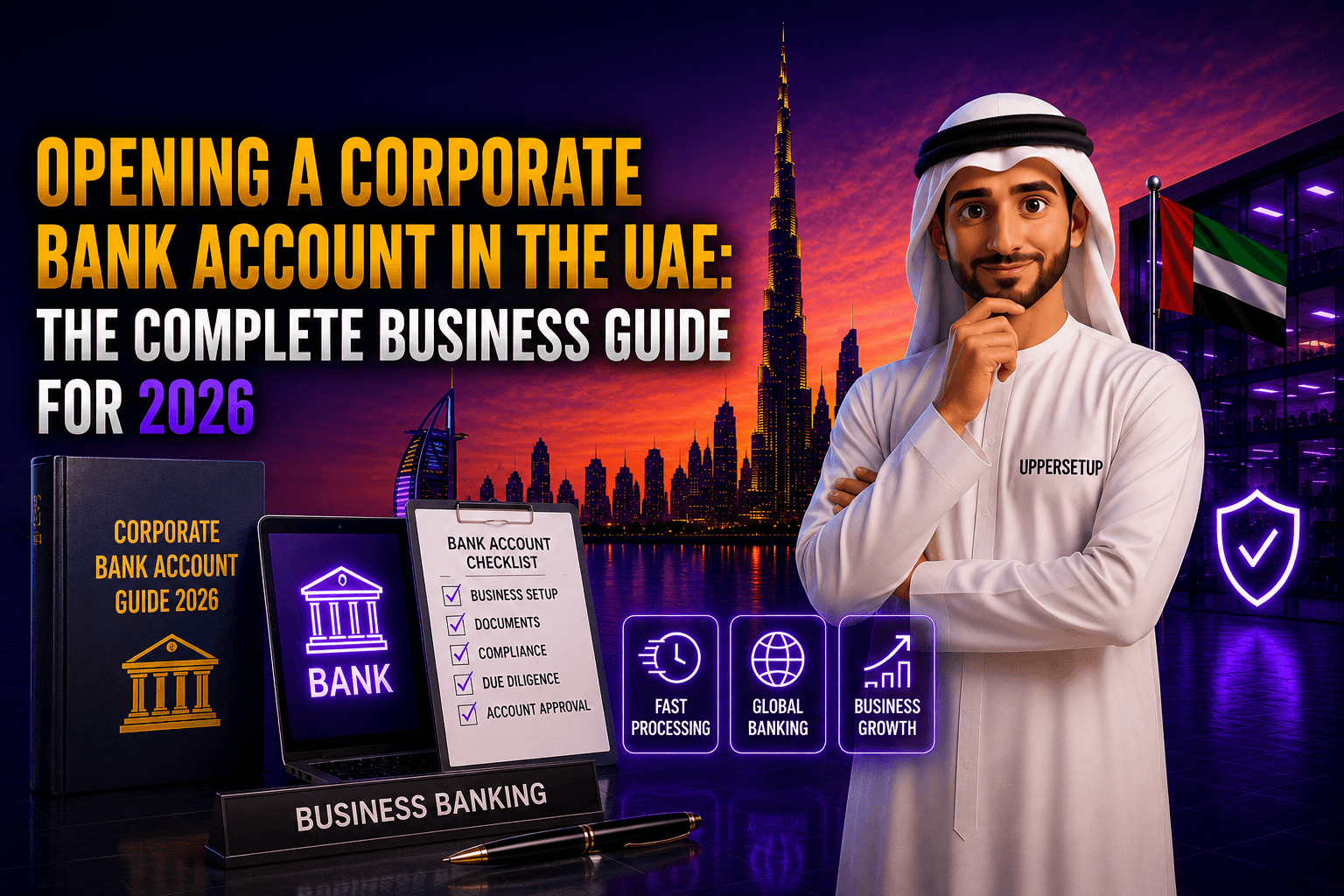
Opening a Corporate Bank Account in the UAE: The Complete Business Guide for 2026
1. Why a Corporate Bank Account Is Not a Formality — It Is an Operational Requirement
A UAE bank account is not simply a place to hold money. For a company registered in the UAE, it is a prerequisite for functioning across multiple dimensions of business operation.
Tax compliance: the Federal Tax Authority (FTA) requires that VAT and corporate tax payments be made from a registered UAE corporate account linked to the company's Tax Registration Number (TRN). Without an account, filing declarations and remitting taxes is technically impossible.
Wages Protection System (WPS): mainland companies and most free zone companies registered with MoHRE that employ staff are legally required to pay salaries through a WPS-compliant UAE bank account, under the MOHRE scheme that guarantees timely salary disbursement (exception: DIFC and ADGM operate their own compliance frameworks). Violations of WPS requirements result in suspension of new work visa issuances.
International operations: a UAE IBAN is the mandatory identifier for all domestic and international wire transfers. Without an IBAN, it is impossible to receive a corporate payment from a client or make a payment to a supplier.
Corporate credibility: major corporate counterparties, investors, and government tender requirements treat an active corporate account at a licensed UAE bank as a standard due diligence requirement. A company without a verified corporate account is perceived as a high-risk counterparty.
Trade finance: letters of credit, bank guarantees, credit facilities, and factoring are accessible only through established banking relationships built from the date the account is opened.
2. Regulatory Framework: Who Governs UAE Banking
The Central Bank of the UAE (CBUAE) is the primary regulator of the UAE banking system. The CBUAE licenses banks, sets KYC/AML/CFT requirements, and supervises compliance. All UAE banks and financial institutions are legally required to adhere strictly to CBUAE guidance.
On 16 April 2026, the CBUAE issued an updated package of AML/CFT/CPF guidance for licensed financial institutions, tightening requirements for Customer Due Diligence (CDD), documentation, transaction monitoring, and beneficial ownership verification. This package is fully aligned with FATF (Financial Action Task Force) recommendations and the UAE's National Strategy on AML/CFT for 2024–2027.
Key regulatory instruments banks apply when opening an account:
• Federal Decree-Law No. 10 of 2025 on Combating Money Laundering, the Financing of Terrorism, and the Financing of Proliferation (effective 14 October 2025) — the new primary AML/CFT/CPF law replacing Federal Decree-Law No. 20 of 2018. For the first time, a single instrument unifies anti-money laundering, counter-terrorism financing, and counter-proliferation financing obligations. This is the law banks rely on when screening customers.
• Cabinet Resolution No. 134 of 2025 (effective 14 December 2025) — Executive Regulations to Federal Decree-Law No. 10 of 2025, replacing Cabinet Resolution No. 10 of 2019. Provides detailed requirements for CDD, KYB, transaction monitoring, and regulatory reporting.
• Cabinet Resolution No. 58 of 2020 on Beneficial Owner Procedures (as amended by Cabinet Resolution No. 109 of 2023) — requires companies to maintain an up-to-date UBO register and provide it to banks as part of KYC. Banks are obligated to independently verify UBO information; they cannot rely solely on customer declarations.
3. Types of Corporate Accounts: Which to Choose
3.1. Current Account
The primary operating account for daily transactions: incoming and outgoing payments, payroll, taxes, utilities. Provides an IBAN, a chequebook (at traditional banks), a business debit card, and internet banking access. Essential for businesses dealing with physical payments and cheques.
3.2. Multi-Currency Account
Allows balances to be held in multiple currencies (AED, USD, EUR, GBP, and others) without constant conversion. Critical for internationally operating businesses: reduces transaction losses on currency exchange. Offered by both traditional banks (FAB, Emirates NBD) and digital ones (Wio Business).
3.3. Trade Finance Account
Encompasses letters of credit, bank guarantees, accounts receivable factoring. Necessary for trading companies, importers, and exporters. Generally opened at traditional banks (Emirates NBD, FAB, ADCB) and requires an established banking relationship history.
3.4. Islamic Banking Account
Available at Islamic banks (Dubai Islamic Bank, Abu Dhabi Islamic Bank, ADCB Islamic) and Islamic divisions of conventional banks. Operates under Sharia-compliant principles — no interest, structured around Musharakah, Murabaha, and Wakala models. Principally important for clients adhering to Islamic financial values.
3.5. Digital Business Account
Offered by licensed digital banks — primarily Wio Business. Fully digital onboarding, no minimum balance requirement, account opened in 48–72 hours.
4. Overview of Key UAE Banks for Corporate Clients
Comparative table of leading banks for opening a corporate account in 2026:
|
Bank |
Type |
Minimum Balance |
Approx. Opening Time |
Key Features |
|
Emirates NBD |
Traditional |
AED 50,000 (SME current) |
3–8 weeks |
Market leader, trade finance, WPS, wide branch network |
|
First Abu Dhabi Bank (FAB) |
Traditional |
AED 25,000–50,000 |
2–6 weeks |
Strong international network, trade finance, multi-currency |
|
ADCB |
Traditional |
AED 10,000–50,000 |
2–5 weeks |
SME-focused products, Islamic and conventional options |
|
Mashreq / Mashreq NeoBiz |
Traditional + Digital |
AED 0 (NeoBiz) |
3–5 working days (NeoBiz) |
Digital onboarding, startup-friendly |
|
RAKBANK |
Traditional |
AED 10,000 |
1–3 weeks |
Startup-friendly, lower thresholds |
|
Wio Business |
Digital bank |
AED 0 |
48–72 hours |
Fully digital, CBUAE-licensed, from AED 99/month, WPS |
|
Zand Bank |
Digital bank |
|
1–5 working days |
Digital, corporate solutions, IBAN |
⚠ Minimum balance and fee data are approximate and subject to change. Always verify current conditions directly with the bank before submitting an application.
5. Wio Business: Next-Generation Digital Banking for SMEs
Wio Bank is the UAE's first fully digital bank, founded in 2022. Licensed by the Central Bank of the UAE. Shareholders include ADQ, Alpha Dhabi Holding, e&, and First Abu Dhabi Bank (FAB), with an initial paid-up capital of AED 2.3 billion. As of early 2026, Wio Bank serves over 120,000 business clients and achieved its first year of profitability in 2024 (Forbes Middle East Fintech 50, 2025).
What Wio Business offers:
• Fully digital onboarding — no branch visit required; account opened in 48–72 hours.
• No minimum balance requirement — a fundamental differentiator from most traditional banks.
• Pricing plans: Essential (AED 99/month), Grow (AED 249/month), Scale (for high-volume operations). Each plan includes transaction limits, multi-currency balances, and integrated business tools.
• WPS (Wages Protection System) support on Grow and Scale plans, ensuring full compliance for mainland companies with employees.
• Multi-currency accounts: AED, USD, EUR, GBP with no hidden conversion fees.
• Built-in invoicing and expense management tools.
6. What You Need to Know About KYC and AML in 2026
The enactment of Federal Decree-Law No. 10 of 2025 and Cabinet Resolution No. 134 of 2025 raised UAE banking compliance to a fundamentally higher level of rigour. This is not bureaucracy — it is a legal obligation for banks enforceable by the CBUAE, with licence revocation as a potential consequence of non-compliance.
Know Your Customer (KYC)
Every bank is required to verify the identity of the customer, their business model, source of funds, and ownership structure. KYC is not a one-time process: banks may request updated documents at any time during the lifetime of the banking relationship.
Know Your Business (KYB)
An extended form of KYC for corporate clients. The bank examines not just the identity of shareholders but the company's business model: who it works with, in which jurisdictions, what the typical transaction volumes and nature are, and who the ultimate beneficiaries of payments are.
Customer Due Diligence (CDD) and Enhanced Due Diligence (EDD)
Standard CDD is applied to most companies. Enhanced Due Diligence (EDD) is mandatory for:
• Companies with shareholders from FATF high-risk jurisdictions or under sanctions.
• Companies with opaque ownership structures (multi-layered holdings, nominee directors and shareholders).
• High-risk activity categories: cash-intensive businesses, cryptocurrency, jewellery, real estate, money transfer.
• Politically Exposed Persons (PEPs) — current and former government officials and their family members.
Ultimate Beneficial Owners (UBO)
Under Cabinet Resolution No. 58 of 2020 (as amended by No. 109 of 2023) and the CBUAE Rulebook (section 3.1), banks must independently verify the UBO of each corporate client. A UBO is a natural person who directly or indirectly owns 25% or more of a company's shares or voting rights, or who otherwise exercises control over it. If no such person is identified, the most senior manager is designated as UBO by default.
Important: a bank cannot accept a company's statement that UBO procedures have been completed. According to CBUAE guidance, a company claiming it has never been required to identify its UBOs should be treated as at minimum a high-risk client.
7. Complete Document Checklist
Standard document package for opening a corporate account in 2026:
|
Document |
Notes |
|
Valid trade licence |
At least 6 months of validity remaining from the date of application |
|
Memorandum / Articles of Association (MOA/AOA) |
Certified original or notarised copy |
|
Certificate of incorporation |
Issued by the registering authority (DED, free zone) |
|
Passports of all shareholders and directors |
Valid with more than 6 months remaining; colour scans |
|
Emirates ID of all UAE-resident shareholders |
Front and back; for non-residents — UAE residence visa copy |
|
UBO Declaration (Ultimate Beneficial Owners) |
Mandatory under Cabinet Resolution No. 58 of 2020 |
|
Proof of registered office address |
EJARI (Dubai), free zone tenancy certificate, or municipal registry |
|
Personal / corporate bank statements |
3–6 months; from home-country bank; source of funds evidence |
|
Business plan / activity description |
Clear description: what the company does, who the clients are, revenue model |
|
Board resolution / directors' decision |
Authorising the signatory to open the account |
|
Bank reference letter from home-country bank |
Not required by all banks, but significantly accelerates the process |
|
VAT registration certificate (TRN) |
If VAT-registered |
⚠ Document requirements vary by bank, company type (mainland/free zone), ownership structure, and business activity. The list above reflects the baseline standard — the specific bank may request additional documents.
8. Step-by-Step Account Opening Procedure
Step 1. Select the bank. Assess: minimum balance and fees; physical presence requirements; the bank's experience with your free zone; availability of trade finance; onboarding speed. For startups and free zone companies — consider Wio Business or Mashreq NeoBiz. For trading companies with high turnover — Emirates NBD or FAB.
Step 2. Prepare the documentation file. Compile all documents from the checklist in section 7. Verify all expiry dates. Pay special attention to UBO structure transparency: multi-layered holding structures significantly complicate the compliance review.
Step 3. Submit the application. Traditional banks — through a Relationship Manager or branch; digital banks — through the mobile app. Complete the business description questionnaire: banks pay close attention to how clearly the client can articulate their business model.
Step 4. Interview / video call. Most traditional banks conduct an in-person meeting or video call with the authorised signatory and/or shareholders. The purpose is to confirm the reality of the business. Typical questions: source of funds, client profile, reason for UAE presence.
Step 5. Compliance review. The bank runs AML screening of all natural persons — shareholders, directors, UBOs — against sanctions lists (UN, OFAC, EU) and PEP databases. For structures involving non-residents or companies from third-country jurisdictions, this step can take 4–6 weeks.
Step 6. Conditional approval and initial deposit. Following a successful compliance review, the bank issues approval-in-principle with the required initial deposit amount. For Wio Business — no minimum deposit is required.
Step 7. Account activation and IBAN issuance. After the deposit clears and final checks are completed, the account is activated and an IBAN is issued. At digital banks — 48–72 hours. At traditional banks — 1 to 8 weeks.
9. Why Banks Reject Applications: The Real Reasons
This is the most important section of the article — the one most guides avoid. Based on practitioners who process hundreds of applications monthly, the principal reasons for rejection are as follows:
• Opaque ownership structure. Multi-layered holdings involving offshore jurisdictions (BVI, Cayman Islands) require full disclosure down to the ultimate natural person. If the UBO chain cannot be verified, the application is declined.
• Insufficient source of funds evidence. The bank needs to understand where the money comes from — not just at the time of application, but the accumulated wealth of shareholders. Large sums without documented provenance are one of the principal red flags.
• High-risk business activity. Cryptocurrency, online gambling, recruitment agencies, cash-intensive operations, money transfer businesses — banks either decline such clients outright or impose extremely high EDD requirements.
• Non-resident structure with unclear operational ties to the UAE. If no shareholder is a UAE resident and it is unclear why the company is being registered in the UAE, this is perceived as a risk that the UAE is being used as a transit jurisdiction. Recommendation: at least one resident shareholder and a clear rationale for UAE business necessity.
• Reputational risks: sanctions, PEP status, adverse media. Automated AML screening systems check individuals against hundreds of databases. A match with a name on a sanctions list or a PEP database requires manual review and frequently — additional explanation.
• Document inconsistencies. Mismatch between the address on the trade licence and the EJARI address; different name spellings in the passport and MOA; expired licence — all lead to delays or rejection.
• Insufficient operational history. Some banks — particularly for trading companies — informally require 6–12 months of operating history. Newly registered companies without evidence of business activity are frequently redirected to less demanding partners or digital banks.
• Unconvincing interview performance. If a company's director cannot clearly answer "who are your clients" and "how is revenue generated", the relationship manager will note elevated risk.
10. Opening an Account as a Non-Resident or with Foreign Directors
Opening a corporate account as a non-resident is possible, but significantly more complex. Most Tier 1 banks (Emirates NBD, FAB) formally require at least one shareholder or authorised signatory to hold a valid UAE residence visa and Emirates ID. This is not a discretionary bank policy — it follows from AML legislative requirements for identity verification.
Practical solutions for non-residents:
• Obtaining an investor or partner visa through the company itself. Provides the Emirates ID required by most banks and unlocks access to the full range of banking services. Recommended as the primary route.
• Wio Business and Mashreq NeoBiz — the most flexible options for non-residents: digital onboarding with video verification, no physical UAE visit required.
• Appointing a UAE-resident authorised co-signatory. An existing resident employee or manager as a secondary signatory broadens the choice of banks.
• Apostille and legalisation of foreign documents. The UAE does not participate in the Hague Apostille Convention: all foreign corporate documents must be notarised, apostilled in the country of issue, and legalised at the UAE Consulate in that country. The procedure typically takes 2–4 weeks.
⚠ Non-resident accounts are generally opened with higher initial minimum balances, are subject to Enhanced Due Diligence, and approval takes 4–8 weeks. Some banks have entirely discontinued services to non-resident structures.
11. Corporate Bank Account and Corporate Tax: The FTA Connection
With the introduction of corporate tax (Federal Decree-Law No. 47 of 2022), the link between a bank account and tax compliance has become even more direct.
FTA cross-data verification: from 2026, the UAE tax system automatically reconciles VAT return data, corporate tax declarations, and banking transaction records. A company reporting income must have corresponding bank account activity — discrepancies trigger an automatic FTA information request or audit initiation.
IBAN for tax payments: all tax payments to the FTA via the EmaraTax portal are made from a linked corporate bank account. Payment from an individual's personal account is technically possible but creates compliance risks during audit.
Bank statements as TRC evidence: when applying for a Tax Residency Certificate (TRC), bank statements confirming financial activity in the UAE may be required as supplementary evidence. A company without an active corporate account loses this verification tool.
12. Common Mistakes When Opening an Account
• Applying to the "wrong" bank. Some banks do not work with certain free zones or business activities. A preliminary conversation with the bank or a professional consultant saves 2–4 weeks of wasted time.
• Flexi-desk instead of a real office for Tier 1 banks. Emirates NBD and FAB generally require a physical office with a valid EJARI. Digital banks and RAKBANK accept flexi-desk registration addresses.
• No up-to-date UBO declaration. The bank cross-checks the declared UBO structure against the data in the free zone or DED registry. Discrepancies are an immediate red flag.
• Submitting without preparing for the interview. Documents submitted, but the person attending the video call with the relationship manager is unfamiliar with the company's operations. The bank records a decline.
• Simultaneous submissions to multiple banks. Banks check application histories. Parallel submissions to 5–6 banks creates an impression of desperation and may reduce approval chances at each of them.
• Unrealistic timeline expectations. Many entrepreneurs plan business operations assuming a one-week account opening. The realistic timeline for traditional banks is 3–8 weeks. Plan the banking phase in parallel with company registration, not after it.
13. Practical Checklist
• Confirm the trade licence has at least 6 months of remaining validity.
• Identify and document all UBOs meeting the 25% threshold.
• File and register the UBO declaration with the relevant authority (free zone, DED).
• Verify that the office address on the licence, EJARI, and MOA are consistent.
• Prepare 3–6 months of bank statements for all shareholders.
• Prepare a one-page business model description: activities, clients, revenue sources, partners.
• Obtain a bank reference letter from the home-country bank for foreign shareholders.
• Select a bank matching your profile: startup → Wio/Mashreq NeoBiz; trading company → Emirates NBD/FAB; lower threshold → RAKBANK.
• Schedule a pre-application consultation with the bank's relationship manager.
• Verify that all foreign corporate documents have been properly legalised (consular legalisation or apostille + notarisation).
Sources
• Central Bank of UAE (CBUAE) — official portal (centralbank.ae)
• CBUAE — Updated AML/CFT/CPF Guidance for Licensed Financial Institutions (April 2026)
• White & Case — UAE enacts a new AML law: Federal Decree-Law No. 10 of 2025
• DLA Piper — UAE Issues New AML Law to Strengthen Anti-Money Laundering Framework
• CBUAE Rulebook — Cabinet Decision No. 58 of 2020 on Beneficial Owner Procedures
• CBUAE Rulebook — Identification of Beneficial Owners
• Wio Bank — official business banking website (wio.io/business)
• Fintech News UAE — Top 4 Digital Banks and Neobanks in the UAE in 2026
Disclaimer
This article is provided for informational purposes only and does not constitute banking, legal, or professional advice. Information is based on publicly available bank requirements and UAE legislation current as of May 2026. Bank requirements, minimum balances, processing timelines, and compliance procedures are subject to change at each bank's discretion without prior notice, and depend on the individual circumstances of each applicant. Before making any banking decisions, readers are advised to obtain current information directly from the relevant bank and to seek advice from a qualified financial advisor or legal professional. UPPERSETUP accepts no liability for actions taken solely in reliance on this material.
All services on the platform
Everything you need to start and run a business - in one place
- 3–5 days
Company Setup
Mainland or Free Zone company with a complete set of incorporation documents
Start - Monthly
Accounting Services
Financial accounting and reporting in accordance with UAE requirements
Start - 1–2 weeks
Visa Services
Residence visas for shareholders, employees and family members
Start - 7–30 days
Banking Services
Corporate Bank Accounts in the UAE and Payment Services
Start - Custom timeline
Legal Services
Contracts, corporate amendments and legal support
Start


