







































































































 International Free Zone Authority
AIFC or LLP: Choosing a Jurisdiction Inside Kazakhstan in 2026

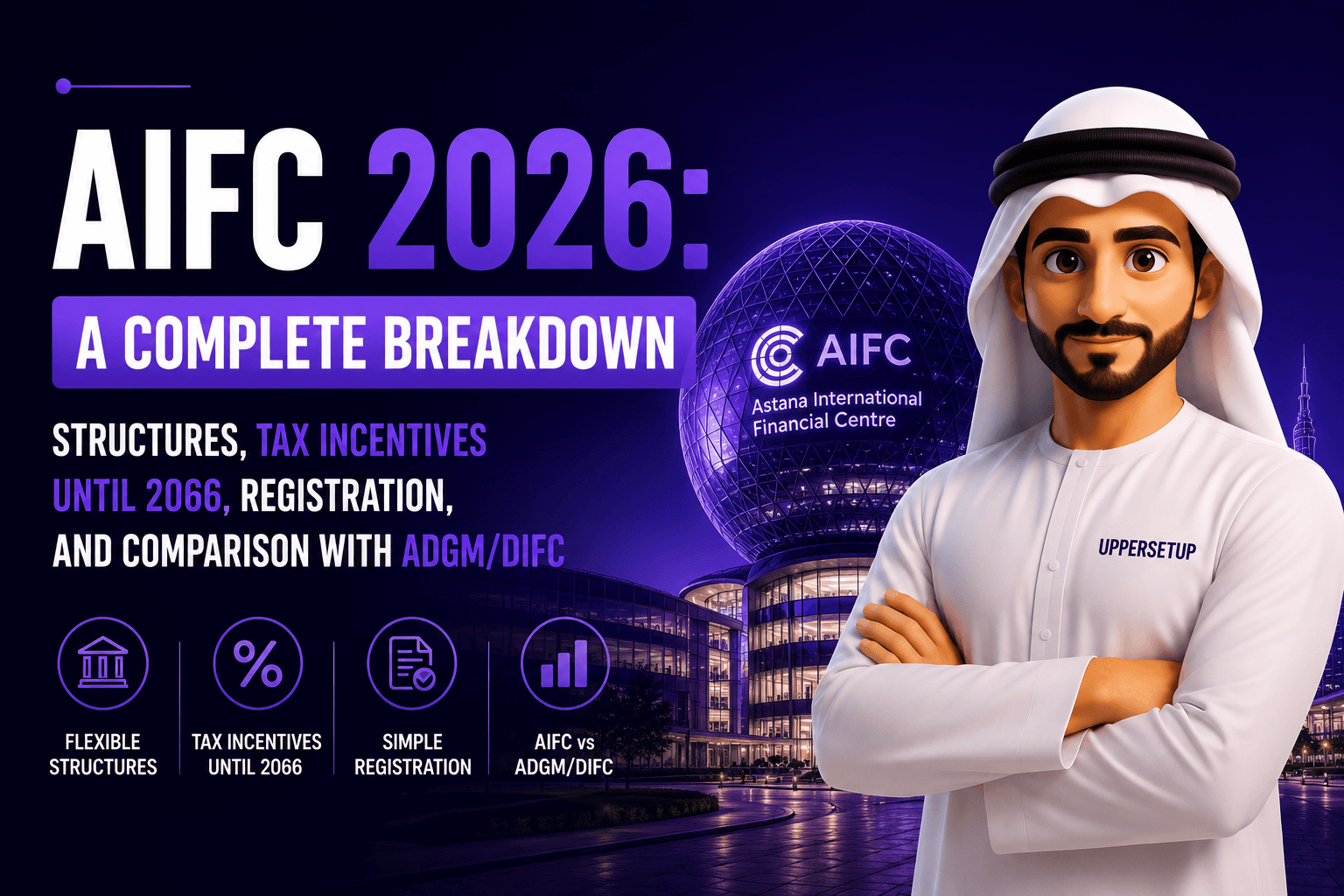
Choosing between a limited liability partnership and a company in the Astana International Financial Centre is not a choice between two corporate forms but between two legal orders inside one country. An LLP sits under Kazakhstan law and the general tax regime. An AIFC company operates under Acts of the AIFC modelled on English common law, supervised by AFSA and served by its own courts, with a tax regime set by Article 6 of the Constitutional Statute of the Republic of Kazakhstan "On the Astana International Financial Centre" No. 438-V of 7 December 2015.
The exemption of AIFC participants from corporate income tax and value added tax on income from the defined activities runs until 1 January 2066 — the longest horizon of tax preference of any special regime in Kazakhstan.
The exemption does not follow from registration and is tested on audit. Since 1 January 2022 an AIFC Act has applied — the Rules on the Substantial Presence of the AIFC Participants Applying Tax Exemptions for the payment of CIT, VAT. A participant claiming the exemption must confirm real presence in the Centre against three mandatory requirements and submit to the local state revenue authority an economic study of the project justifying its costs and headcount. Compliance is determined by the state revenue authority during a tax audit.
What follows works from primary sources: the AIFC’s legal architecture, the Substantial Presence Rules, the LLP tax parameters after the 2026 reform, the change to the investment fund regime, and a comparison across eleven parameters.
1. Two Legal Orders
The AIFC
• Constitutional Statute of the Republic of Kazakhstan "On the Astana International Financial Centre" No. 438-V of 7 December 2015. The foundation of the regime. Article 6 sets the tax exemptions running to 1 January 2066; paragraphs 3 and 4 of Article 6 define the activities whose income is exempt.
• Acts of the AIFC. The Centre’s own law, modelled on English common law. Acts of the Centre must not contradict the Constitutional Statute, nor the current law of Kazakhstan in the part not regulated by it.
• Rules on the Substantial Presence of the AIFC Participants Applying Tax Exemptions for the payment of CIT, VAT. An AIFC Act adopted by AFSA in coordination with the Ministry of Finance of Kazakhstan. It applies to participants using the exemptions under paragraphs 3 and/or 4 of Article 6 of the Constitutional Statute and commences from 1 January 2022.
• The List of financial services provided by AIFC participants whose income is exempt from CIT and VAT. Approved by joint order of the AIFC Governor No. 126 of 26 May 2020, the Minister of Finance of Kazakhstan No. 547 of 29 May 2020 and the Minister of National Economy.
A date discrepancy worth recording. Some 2026 industry publications state that the Substantial Presence Rules were introduced by the regulator in 2025. The text of the Act itself and AFSA’s own materials say otherwise: the Rules apply from 1 January 2022. Work from that date — the regime is in its fourth year, not newly introduced.
The LLP
• Law of the Republic of Kazakhstan "On Limited and Additional Liability Partnerships" No. 220-I of 22 April 1998. The corporate foundation. Article 23(2)(1) sets the minimum charter capital.
• Tax Code of the Republic of Kazakhstan — Law No. 214-VIII of 18 July 2025. Signed 18 July 2025, published 24 July 2025, in force from 1 January 2026, as amended by Law No. 308-VIII of 11 June 2026 effective 1 July 2026. It sets the general LLP tax regime and also carries provisions on the taxation of AIFC participants.
2. What the AIFC Is, Legally
The AIFC is not a free economic zone with tax breaks but a separate legal order inside Kazakhstan, with its own law, regulator and courts.
• Its own law. Acts of the AIFC on the English common law model, with the Constitutional Statute prevailing over Acts of the Centre.
• Its own regulator. The Astana Financial Services Authority (AFSA), the independent regulator established under the Constitutional Statute to regulate financial services and related activities in the AIFC. AFSA administers the AIFC Regulations and Rules and is responsible for the authorisation, registration, recognition and supervision of financial firms and market institutions in the Centre.
• Its own Registrar of Companies. Corporate procedures — incorporation, changes, liquidation — run through the AIFC Registrar of Companies rather than Kazakhstan’s justice authorities.
• Its own courts. The AIFC Court, with first instance and appeal, and the International Arbitration Centre. The Centre’s judicial system is separate from Kazakhstan’s.
From 2026 the AIFC has run electronic residency — e-Residency AIFC — simplifying part of the registration workload. Fully remote completion is not available for every scenario, and its applicability should be checked against the specific activity.
3. The LLP: Corporate Parameters
Under Article 23(2)(1) of Law No. 220-I, the initial charter capital of a limited liability partnership may not be less than the equivalent of 100 monthly calculation indices as at the date the registration documents are filed.
The 100 MCI requirement does not reach small business — the commonest myth at incorporation. The same provision carries a carve-out: the requirement does not apply to LLPs that are small business entities, nor to a state Islamic special finance company. For them no statutory minimum charter capital is set. On the 2026 MCI of KZT 4,325, 100 MCI is KZT 432,500 — but that figure binds only medium and large business.
An LLP is registered through the e-government portal or a public service centre. Filing the documents yourself carries no additional registration cost. LLPs qualifying as small, medium or large business entities may operate on a model charter by filing the relevant application at registration.
Funds contributed to charter capital are not subject to corporate income tax. That distinguishes a charter capital contribution from an additional participant contribution, which does not attract the same treatment.
4. The LLP Tax Regime After the 2026 Reform
|
Parameter |
Position from 1 January 2026 |
|
Corporate income tax, general rate |
20 per cent |
|
Differentiated CIT rates |
25 per cent for banks (other than lending to business) and gaming; 5 per cent in 2026 and 10 per cent from 2027 for social-sector organisations, financial leasing, education and healthcare; 3 per cent for agricultural producers, with a 70 per cent reduction in the tax burden |
|
Value added tax |
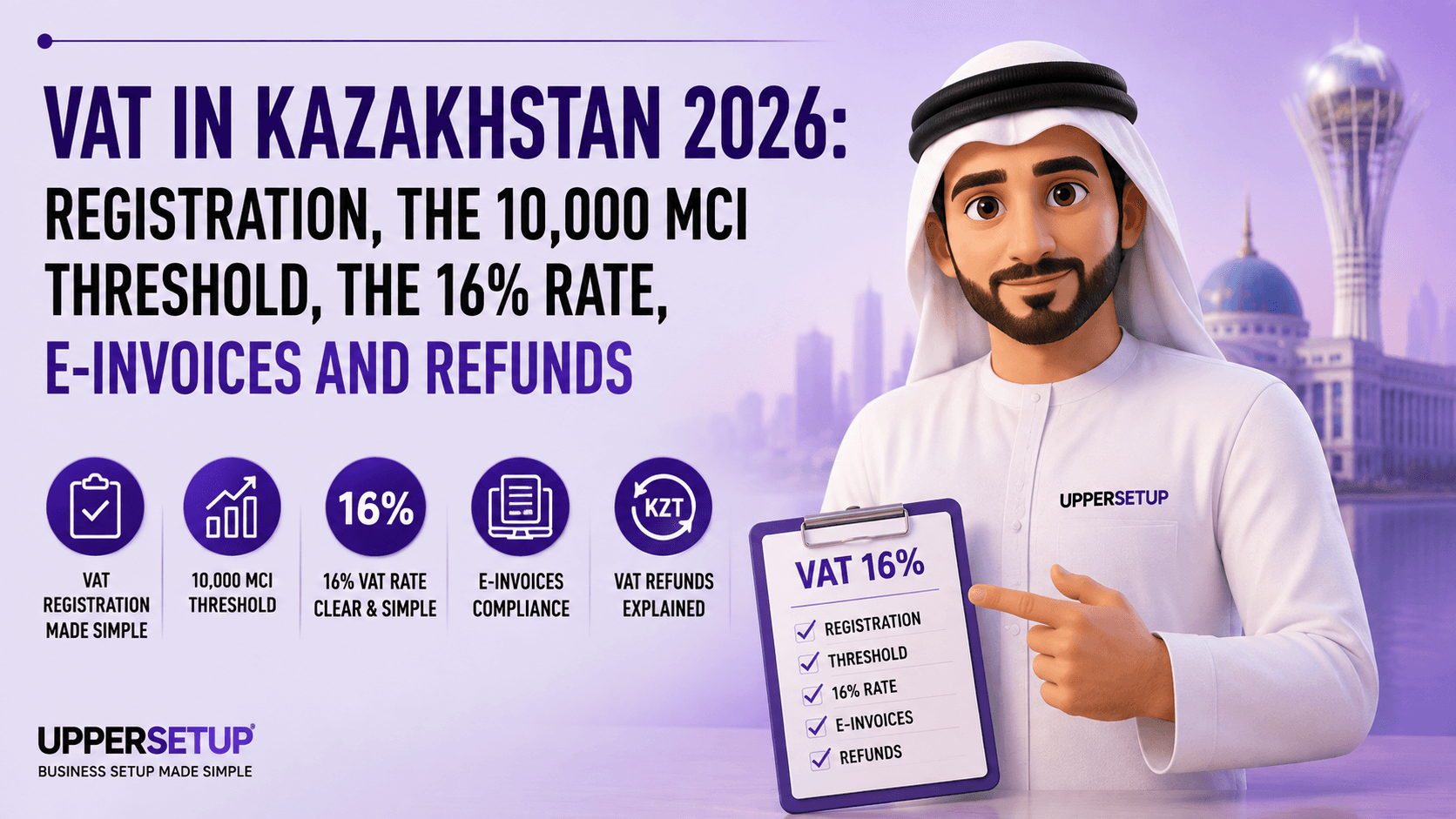
Base rate 16 per cent; mandatory registration threshold 10,000 MCI |
|
Personal income tax on wages |
10 per cent up to 8,500 MCI a year (roughly KZT 33.5 million), 15 per cent above that |
|
Personal income tax on dividends |
5 per cent up to 230,000 MCI (roughly KZT 1 billion), 15 per cent on the excess |
|
Social tax |
Reduced from 11 to 6 per cent |
|
Employer mandatory pension contributions |
Increased from 2.5 to 3.5 per cent |
|
Social contributions within the single payment |
Reduced from 18.9 to 18.1 per cent |
A new restriction that changes counterparty selection. Under Article 286(16) of the new Tax Code, counterparties on the general regime may not deduct, for corporate income tax purposes, the cost of goods, works and services acquired from persons applying the simplified declaration special tax regime. For an LLP on the general regime that makes buying from a simplified-regime supplier effectively more expensive by the value of the lost deduction.
5. What Exactly Is Exempt in the AIFC
The Article 6 exemption is not a blanket exemption of the company from tax. It attaches to the type of service: the list of financial services whose income is exempt from corporate income tax and value added tax is approved by joint order of the AIFC Governor, the Minister of Finance and the Minister of National Economy.
The Centre’s rules put the condition plainly: where a Centre Participant carries on a service specified in the relevant schedule, it is not liable for corporation tax imposed by the Republic of Kazakhstan on income or capital resulting from that service — provided the service is carried on in full compliance with AFSA Rules.
What sits outside the exemption. Activity outside the list of exempt services, and transactions with Kazakhstan residents, follow the general rules. Test the exemption against the specific activity before choosing the jurisdiction, not after incorporation: matching the general idea of "financial services" guarantees nothing.
The personal income tax exemption
Beyond the corporate income tax exemption, Article 6 of the Constitutional Statute provides an exemption from personal income tax for certain categories of income connected with the bodies and participants of the Centre. The precise scope again follows the paragraphs of Article 6 and must be tested against the specific role and income type.
The special tax regime and its effect on counterparties
Alongside the general regime, an LLP may elect a special tax regime. Its parameters — the rate, the income ceiling and the activity restrictions — were revised by the new Code and must be checked separately against the specific activity.
Electing the special regime has consequences beyond the company itself: Article 286(16) of the new Tax Code denies counterparties on the general regime any deduction for corporate income tax purposes on goods, works and services acquired from persons applying the simplified-declaration special tax regime. The regime should be chosen with the whole chain of suppliers and clients in view, not merely the company’s own tax burden.
Comparisons quoting 12 per cent VAT are out of date and skew the choice. Several AIFC-versus-LLP comparisons published in 2026 still quote a VAT rate of 12 per cent and a registration threshold of 20,000 MCI. Both changed on 1 January 2026 to 16 per cent and 10,000 MCI. A financial model built on the old figures understates the LLP burden and tilts the comparison towards the AIFC.
6. The Substantial Presence Rules: Three Mandatory Requirements
The Rules apply to Centre Participants using the tax exemptions under paragraphs 3 and/or 4 of Article 6 of the Constitutional Statute. A participant must satisfy three requirements simultaneously.
|
Requirement |
Substance |
|
Core income generating activities (CIGA) |
The participant’s CIGA are provided on the territory of the Centre and consist of the services established by paragraphs 3 and/or 4 of Article 6 of the Constitutional Statute and/or Chapter 3 of the List of Financial Services |
|
Operating expenses |
The amount of operating expenses incurred by the participant must correspond to the adequate amount required for performing the CIGA |
|
Qualified staff |
The number of qualified full-time employees of the participant must correspond to the adequate number required for delivery of the CIGA |
Centre Participants must submit to the local state revenue authority an economic study of the project, including the justification of costs and the number of employees. The procedure for determining whether a participant meets the conditions is carried out by the state revenue authority during a tax audit.
AFSA, jointly with the State Revenue Committee of the Ministry of Finance of Kazakhstan, developed and endorsed Guidance on the Rules, defining the three mandatory requirements, the form of the economic study of the project and the submission deadline. The Guidance was reviewed and approved by the OECD’s Forum on Harmful Tax Practices.
The Rules are not a formality but a construct built into international commitments. The introduction of the Substantial Presence Rules and the subsequent FHTP approval of the Guidance mean the AIFC regime is designed against BEPS standards. A company registered in the Centre without real activity, staff and expenditure on its territory does not meet the conditions of the exemption, and that is established on a tax audit — that is, after the fact, with assessments for closed periods.
7. Three Clarifications on the Substantial Presence Rules
The Substantial Presence Rules were adopted by AFSA together with the State Revenue Committee of the Ministry of Finance of the Republic of Kazakhstan in December 2021, implementing Action 5 of the OECD BEPS plan. The Guidance developed later was reviewed and approved by the OECD Forum on Harmful Tax Practices (FHTP).
A common dating error. Some 2026 publications state that AFSA introduced the Substantial Presence Rules in 2025. That is wrong: the Rules have applied since December 2021, and the Guidance merely set out how to apply them. The error leads to the false conclusion that before 2025 the exemption was not conditioned on real presence.
The Rules deal expressly with income derived from intellectual property, including royalties and capital gains. That reflects the standard BEPS Action 5 approach, under which intellectual property regimes are assessed against separate criteria. Any plan to hold rights through an AIFC participant should be tested against the text of the Rules before the decision is taken.
The Rules themselves contain no numerical coefficients. Industry reviews cite specific compliance ratios — the share of income from the core activity, the share of staff costs and the share of operating expenses incurred in Kazakhstan. Those fixed coefficients do not appear in the text of the Rules as read: the Rules work from adequacy to the volume of activity carried out. Any numerical benchmarks belong to the Guidance and must be verified against it rather than treated as a rule.
8. Registration: Timing, Capital and Fees
The practical side of the choice is not driven by tax alone: launch timing, capital requirements and the cost of entry differ materially.
|
Parameter |
AIFC company |
LLP |
|
Registration time |
Broadly five to fourteen working days |
From one working day |
|
Registration fee |
Payable; the specific tariffs are set by the AIFC and should be checked as at the filing date |
State duty under the general rules of the Republic of Kazakhstan |
|
Minimum charter capital |
Set by the Acts of the AIFC according to company type |
None for a small business entity; 100 MCI — KZT 432,500 — for medium and large; 50,000 MCI — KZT 216.25 million — for a joint-stock company |
|
Who registers |
The AIFC Registrar of Companies; licensing of financial and market activities by AFSA |
The justice authorities of the Republic of Kazakhstan |
|
Regulator licence |
Required for regulated financial and market activities; generally not for holding or advisory activity |
Under the general licensing rules for particular activities |
Zero charter capital is lawful but creates a banking problem. Registering an LLP that qualifies as a small business entity with zero charter capital is expressly permitted. Bank compliance on account opening for a company with foreign participation nevertheless weighs the size of the capital, and a nil figure works against the applicant. That is a practical rather than a legal constraint: set the capital by reference to the intended banking arrangements, not to the statutory minimum.
9. The Currency and Banking Perimeter: What the Choice Does Not Change
Part of the obligation set arises from Kazakhstan law regardless of whether the company is registered in the AIFC or as an LLP — and that is routinely missed in comparisons.
Kazakhstan currency regulation applies to the Kazakhstan side of a transaction. Capital-movement contracts above USD 500,000 require a contract registration number, export and import contracts above USD 50,000 fall under repatriation control, and authorised banks report currency operations from USD 50,000 to the National Bank through regular reporting.
The banking outcome is driven not by the form of registration but by the transparency of the ownership structure and the coherence of the business model. An AIFC company without real presence meets the same questions at the bank as an LLP with an opaque structure: compliance assesses ultimate beneficial owners and the economic substance of transactions, not the registration regime chosen inside the country.
AIFC registration does not substitute for banking compliance. The common expectation that participant status by itself eases account opening is not borne out in practice. The bank assesses the same parameters as for any other company, and the absence of staff and operating expenses in Kazakhstan — the very circumstance that puts the tax exemption in question — works against the applicant at the bank as well.
10. What Changed for the AIFC on 1 January 2026
The new Tax Code abolished the zero rate of corporate income tax on investment income — dividends and capital gains — received by real estate funds (REITs) registered either under Kazakhstan law or under the current law of the AIFC. Their investment income is taxed at 20 per cent.
Other investment funds retained the existing relief — a zero rate of corporate income tax. The change is targeted at a specific type of fund rather than at the AIFC regime as a whole.
The planning implication. The AIFC tax regime is set by the Constitutional Statute and the Tax Code together. The Constitutional Statute fixes the horizon to 2066, but the rates and carve-outs for particular income categories can change with each version of the Tax Code. Both instruments must be checked, not the Constitutional Statute alone.
On the accuracy of the citation for the real estate fund rule. Commentary sometimes attributes the change to the investment income of real estate funds to Article 283(2)(7) of the new Tax Code. On the table of contents of the Code in force, Article 283 sits in Paragraph 4, "Investment tax preferences", of the deductions chapter and governs a different subject. The change itself is supported by professional analysis, but the operative provision must be established from the text of the Code in force rather than from an article number cited in reviews.
11. AIFC and LLP Compared Across Eleven Parameters
|
Parameter |
AIFC company |
LLP |
|
Applicable law |
Acts of the AIFC on the English common law model; the Constitutional Statute prevails over Acts of the Centre |
Law of the Republic of Kazakhstan |
|
Registering body |
AIFC Registrar of Companies |
Justice authorities via the e-government portal or a public service centre |
|
Regulator |
AFSA, for financial services and related activity |
Sectoral state authorities of Kazakhstan |
|
Courts |
AIFC Court and the International Arbitration Centre |
Courts of the Republic of Kazakhstan |
|
Corporate income tax |
Exemption on income from services on the approved list until 1 January 2066; other activity and transactions with Kazakhstan residents follow the general rules |
20 per cent general rate; differentiated rates by activity |
|
Condition for keeping the relief |
Compliance with the three Substantial Presence Rules requirements and submission of the economic study of the project; tested on tax audit |
Not applicable |
|
Value added tax |
Exemption on income from services on the approved list |
16 per cent; registration threshold 10,000 MCI |
|
Minimum charter capital |
Set by Acts of the Centre by activity and licence |
100 MCI for medium and large business; no statutory minimum for small business entities |
|
Presence requirement |
CIGA on the territory of the Centre, adequate operating expenses and an adequate number of qualified full-time employees |
General requirements of Kazakhstan law |
|
Investment funds |
Zero rate retained for investment funds other than REITs; REIT investment income taxed at 20 per cent |
General regime |
|
Remote incorporation |
e-Residency AIFC from 2026; applicability depends on the scenario |
E-government portal, registration within one working day |
12. Which Suits Whom
The AIFC is justified for
• Financial firms whose activity sits on the approved list. The exemption attaches to the type of service, so the regime delivers only where the core activity is on the list.
• Companies prepared to maintain staff and incur expenditure in Kazakhstan. The Substantial Presence Rules require adequate operating expenses and an adequate number of qualified full-time employees for the CIGA.
• Structures that need an English-law perimeter. Acts of the AIFC, the AIFC Court and the International Arbitration Centre give investors a familiar contractual and judicial environment.
• Long-horizon projects. The Article 6 exemption runs to 1 January 2066 — an argument for structures planned over decades.
The LLP is justified for
• Operating businesses in the domestic market. Trading, manufacturing and services to Kazakhstan customers fall outside the list of exempt financial services, so the AIFC regime creates no economic benefit for them.
• Small business. No statutory minimum charter capital applies, and registration runs through the e-government portal without additional cost when filed directly.
• Companies with no staff in Kazakhstan. Without employees and expenditure on the Centre’s territory the AIFC relief is unreachable and the duties to substantiate it are pure overhead.
• Anyone who needs a predictable administrative environment. The general regime requires no annual substantiation of an entitlement and creates no exposure to assessment following a substantial presence review.
13. Common Mistakes
Mistake 1. Treating the AIFC as an offshore with an automatic zero rate
The exemption attaches to specific services on the approved list and is conditional on meeting the three Substantial Presence Rules requirements. The cost: the company bears the registration and maintenance expense of the Centre and then receives a corporate income tax assessment for closed periods because the conditions were never met.
Mistake 2. Not checking the activity against the list before incorporating
The list of financial services whose income is exempt is approved by joint order and is closed. Activity outside it, and transactions with Kazakhstan residents, follow the general rules. The cost: a jurisdiction chosen for a relief that does not reach the core activity, leaving heavier administration with no tax benefit.
Mistake 3. Putting up 100 MCI of charter capital for a small business
The minimum charter capital requirement of 100 MCI does not apply to LLPs that are small business entities. The cost: KZT 432,500 tied up with no legal basis — small for a large company, material at start-up, and diverted from working capital on the strength of a widespread misconception rather than the statute.
Mistake 4. Overlooking the deduction restriction on simplified-regime suppliers
Under Article 286(16) of the new Tax Code, counterparties on the general regime may not deduct the cost of goods, works and services acquired from persons on the simplified declaration regime. The cost: purchases become effectively more expensive by the value of the lost deduction, discovered at the close of the tax period rather than at contract stage.
Mistake 5. Relying on the claim that the Substantial Presence Rules are recent
Some 2026 publications date the Rules to 2025. The Act itself and AFSA’s materials place their commencement at 1 January 2022. The cost: a company registered in the Centre between 2022 and 2024, assuming the presence requirements came later, is unprepared to substantiate compliance for periods already closed.
Mistake 6. Checking the Constitutional Statute and ignoring the Tax Code
The AIFC tax regime is set by both instruments. The abolition of the zero rate on REIT investment income from 1 January 2026 sits of the Tax Code, not in any amendment to the Constitutional Statute. The cost: a structure built on a horizon to 2066 meets a rate change on a specific income category with no change to the underlying statute.
Mistake: treating the exemption as automatic on registration
The exemption is conditioned on the Substantial Presence Rules: core income generating activity on the territory of the Centre, adequate operating expenses and an adequate number of qualified full-time employees. The cost: non-compliance is identified by the state revenue authority during a tax audit — retrospectively and for the whole period the exemption was applied.
Mistake: not testing the activity against the Article 6 perimeter
The exemption covers the services listed in paragraphs 3 and 4 of Article 6 of the Constitutional Law and in Chapter 3 of the List of Financial Services, not any activity of the participant. The cost: the company bears the expense of presence in the Centre while its income is taxed under the general regime because it falls outside the perimeter.
Mistake: mixing in-perimeter and out-of-perimeter activity without separating the accounts
Where a participant also operates outside the exempt perimeter, the general Kazakhstan tax regime applies to that part of the income. The cost: without a correct split of income and expenses, the entire amount risks recharacterisation on audit.
14. How to Choose
1. Identify the core activity and test it against the list of financial services whose income is exempt from corporate income tax and value added tax.
2. If the activity is not on the list, assess the AIFC only on non-tax grounds: applicable law, judicial system, reputational perimeter.
3. If it is on the list, assess whether the three Substantial Presence Rules requirements are achievable: CIGA on the territory of the Centre, adequate operating expenses, an adequate number of qualified full-time employees.
4. Model the cost of meeting the presence requirements against the saving from the exemption; where the result is negative, choose the LLP.
5. Check the share of transactions with Kazakhstan residents: those follow the general rules regardless of Centre participant status.
6. Test the income category separately under the Tax Code — in particular the investment fund regime, where the zero rate has been withdrawn for REITs.
7. Choosing the LLP, determine the business-size category: it drives the minimum charter capital requirement.
8. Model the LLP tax load on 2026 parameters: 20 per cent CIT or the applicable differentiated rate, 16 per cent VAT above the 10,000 MCI threshold, progressive PIT, and the revised social tax and pension contribution rates.
9. Screen counterparties for use of the simplified declaration regime and factor in the Article 286(16) deduction restriction.
10. Choosing the AIFC, prepare the economic study of the project with the justification of costs and headcount for submission to the local state revenue authority.
A practical marker that settles the choice: if answering "does my activity fall inside the Article 6 perimeter" requires stretching the wording, it does not. The list of exempt services is closed, and an expansive reading does not survive a tax audit.
A second marker is the source of income. The exemption is addressed to income from services supplied by a participant of the Centre. Where the bulk of revenue comes from selling goods, manufacturing, leasing or any other activity outside financial and professional services, the AIFC structure delivers no tax effect however well it is documented.
15. Frequently Asked Questions
How long do the AIFC tax reliefs run?
The exemption of AIFC participants from corporate income tax and value added tax on income from the defined activities runs until 1 January 2066, under Article 6 of Constitutional Statute No. 438-V of 7 December 2015.
Does registering in the AIFC give an automatic tax exemption?
No. The exemption attaches to a service on the approved list and is conditional on meeting the Substantial Presence Rules: core income generating activities on the territory of the Centre, adequate operating expenses and an adequate number of qualified full-time employees. Compliance is determined by the state revenue authority during a tax audit.
When did the Substantial Presence Rules take effect?
They apply from 1 January 2022. They were adopted by AFSA in coordination with the Ministry of Finance of Kazakhstan and cover Centre Participants using the exemptions under paragraphs 3 and/or 4 of Article 6 of the Constitutional Statute.
What is the minimum charter capital for a Kazakhstan LLP?
For medium and large business entities, not less than the equivalent of 100 monthly calculation indices at the date of filing, that is KZT 432,500 on the 2026 MCI of KZT 4,325. For LLPs that are small business entities, no statutory minimum is set.
What changed for AIFC investment funds in 2026?
The new Tax Code abolished the zero rate of corporate income tax on the investment income of real estate funds (REITs) registered under Kazakhstan law or under the current law of the AIFC: their investment income is taxed at 20 per cent. Other investment funds retained the zero rate.
What is the VAT rate for an LLP in 2026?
The base rate of value added tax is 16 per cent, with a mandatory registration threshold of 10,000 monthly calculation indices.
16. Key Takeaways
• The AIFC is a separate legal order with its own law on the English common law model, AFSA as regulator, its own Registrar of Companies and the AIFC Court.
• The Article 6 exemption under Constitutional Statute No. 438-V runs to 1 January 2066 and attaches to services on the approved list.
• The list of exempt financial services is approved by joint order of the AIFC Governor No. 126 of 26 May 2020, the Minister of Finance No. 547 of 29 May 2020 and the Minister of National Economy.
• The Substantial Presence Rules apply from 1 January 2022 and require CIGA on the territory of the Centre, adequate operating expenses and an adequate number of qualified full-time employees.
• A participant submits an economic study of the project to the local state revenue authority; compliance is tested on a tax audit.
• The Guidance on the Rules was developed by AFSA with the State Revenue Committee and approved by the OECD Forum on Harmful Tax Practices.
• From 1 January 2026 REIT investment income is taxed at 20 per cent of the Tax Code; other investment funds retained the zero rate.
• LLP minimum charter capital is 100 MCI for medium and large business and is not set for small business entities.
• LLP tax parameters from 2026: CIT 20 per cent plus differentiated rates, VAT 16 per cent above a 10,000 MCI threshold, progressive PIT at 10 and 15 per cent, social tax cut from 11 to 6 per cent.
• Article 286(16) of the Tax Code denies general-regime counterparties a deduction for purchases from simplified declaration taxpayers.
17. Summary
Choosing between a company in the Astana International Financial Centre and a limited liability partnership is a choice between two legal orders inside Kazakhstan. The AIFC operates under the Constitutional Statute of the Republic of Kazakhstan "On the Astana International Financial Centre" No. 438-V of 7 December 2015, applies Acts of the AIFC modelled on English common law, is regulated by the Astana Financial Services Authority, runs corporate procedures through its own Registrar of Companies and has its own AIFC Court and International Arbitration Centre. Article 6 exempts participants from corporate income tax and value added tax on income from the defined activities until 1 January 2066; the list of such financial services is approved by joint order of the AIFC Governor No. 126 of 26 May 2020, the Minister of Finance No. 547 of 29 May 2020 and the Minister of National Economy. The exemption is not automatic: since 1 January 2022 the Rules on the Substantial Presence of the AIFC Participants Applying Tax Exemptions for the payment of CIT, VAT, adopted by AFSA in coordination with the Ministry of Finance, require simultaneously that core income generating activities be provided on the territory of the Centre, that operating expenses correspond to the adequate amount for performing them, and that the number of qualified full-time employees correspond to the adequate number; the participant submits an economic study of the project to the local state revenue authority and compliance is determined during a tax audit. The Guidance on the Rules was developed by AFSA with the State Revenue Committee and approved by the OECD Forum on Harmful Tax Practices. From 1 January 2026 the new Tax Code of the Republic of Kazakhstan (Law No. 214-VIII of 18 July 2025) abolished the zero rate of corporate income tax on the investment income of real estate funds (REITs) registered under Kazakhstan law or under the current law of the AIFC, taxing that income at 20 per cent, while other investment funds retained the zero rate. A limited liability partnership is governed by Law of the Republic of Kazakhstan No. 220-I of 22 April 1998: the minimum charter capital is 100 monthly calculation indices for medium and large business entities and is not set by statute for small business entities. LLP tax parameters from 2026: corporate income tax at 20 per cent with differentiated rates of 25 per cent for banks and gaming, 5 per cent in 2026 and 10 per cent from 2027 for the social sector and 3 per cent for agricultural producers; value added tax at 16 per cent with a registration threshold of 10,000 monthly calculation indices; personal income tax at 10 per cent up to 8,500 monthly calculation indices a year and 15 per cent above; social tax reduced from 11 to 6 per cent.
18. Sources
Tier 1 — primary acts and regulator materials
• AIFC — AFSA and the State Revenue Committee adopt Guidance on the Substantial Presence Rules
• AIFC Court — Tax Administration: AIFC tax administration acts
Tier 2 — professional commentary
• BIRCH LEGAL — AIFC investment funds: change of tax regime from 1 January 2026
Related UPPERSETUP analysis
• LLP (TOO) in Kazakhstan for Foreigners 2026: Registration, Visa, Taxes and AIFC Comparison
• Kazakhstan’s Tax System 2026: the New Tax Code, CIT, VAT, PIT and AIFC Incentives
Deciding between the AIFC and an LLP? UPPERSETUP supports projects in Kazakhstan, the UAE and Hong Kong: matching the activity against the list of exempt financial services, assessing whether the Substantial Presence Rules requirements are achievable, modelling the tax load under both regimes, incorporating, and preparing the economic study of the project. Discuss your project with UPPERSETUP
Disclaimer
This material is provided for informational purposes only and does not constitute legal, tax, financial, investment or consulting advice. Before making any decision, obtain individual professional advice reflecting your specific circumstances, jurisdiction, company status and current regulatory requirements. Information is current as of August 2026.
All services on the platform
Everything you need to start and run a business - in one place
- 2–10 days
Company Setup
Kazakhstan company with a complete set of incorporation documents
Start - Monthly
Accounting Services
Accounting and Tax Compliance, Reporting, and Support in Accordance with Kazakhstan Requirements
- 4–8 weeks
Immigration Services
Visas, Work Permits
- 7–30 days
Banking Services
Corporate Bank Accounts in Kazakhstan and Payment Services
- Custom timeline
Permits and Licenses
Business Licenses and Activity Permits
- Custom timeline
Legal Services
Corporate Documents, Contracts, Compliance, Licensing, and Company Structure Changes


