














































































 International Free Zone Authority
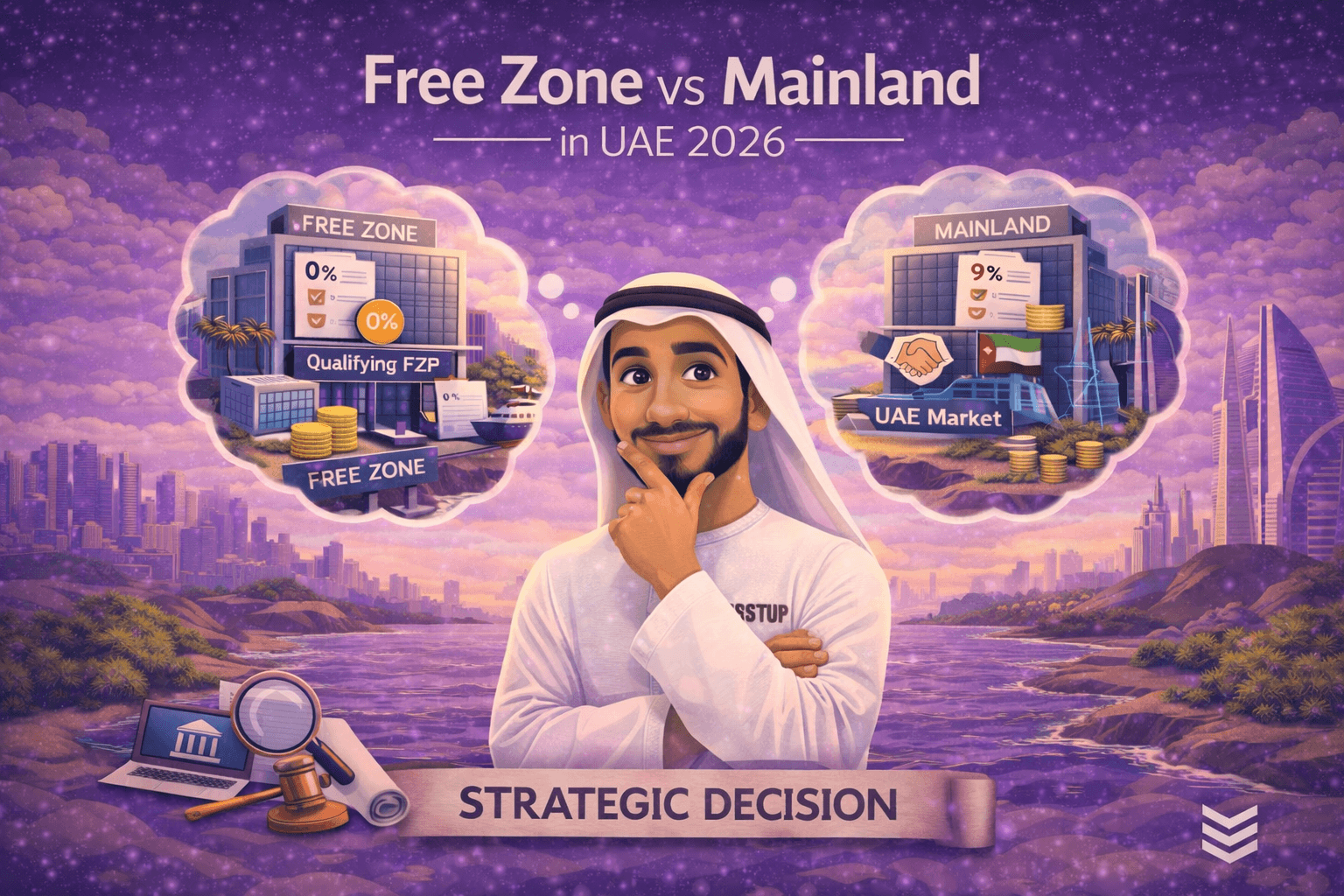
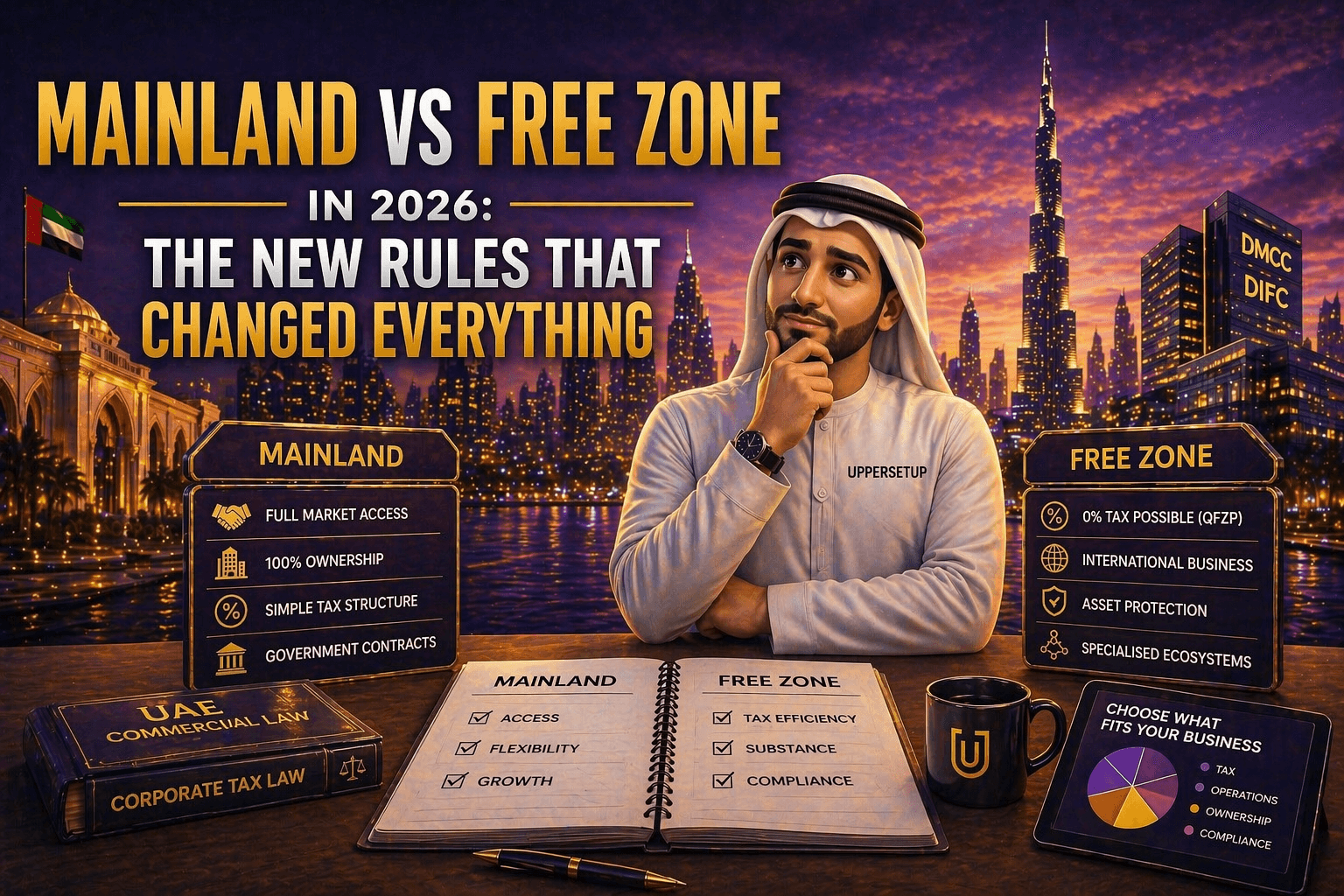
Mainland vs Free Zone in 2026: the New Rules That Changed Everything
Introduction. The Old Comparisons No Longer Work
Until 2021–2023, the choice between mainland and free zone in the UAE fitted a simple table: a free zone meant 100% foreign ownership, zero taxes, limited access to the local market; mainland meant market access but a mandatory 51% local partner and, theoretically, taxes. Hundreds of articles were written on this framework. The problem is that it has become outdated across every key parameter.
Three changes of recent years have rewritten the logic of choice:
— Federal Decree-Law No. 26 of 2020 (effective 1 June 2021) eliminated the requirement for a 51% UAE national stake for most activity types on the mainland, opening the possibility of 100% foreign ownership;
— Federal Decree-Law No. 47 of 2022 (corporate tax, effective from 1 June 2023) introduced profit taxation for both mainland and free zone companies — thereby destroying the idea of 'automatic' tax freedom in free zones;
— Ministerial Decision No. 229 of 2025 (published 28 August 2025, effective retroactively from 1 June 2023) updated and expanded the list of qualifying activities for QFZP (Qualifying Free Zone Person) status — the only genuine basis for the 0% rate in a free zone.
In 2026 the right question is no longer 'free zone or mainland', but 'which structure matches my business model, tax profile, and operational requirements'. This article provides a detailed answer.
Part I. Corporate Tax: A Fundamental Difference in Tax Logic
1.1. Mainland: Simple and Predictable Structure
For mainland companies, the tax logic is straightforward and uniform. Under Federal Decree-Law No. 47 of 2022:
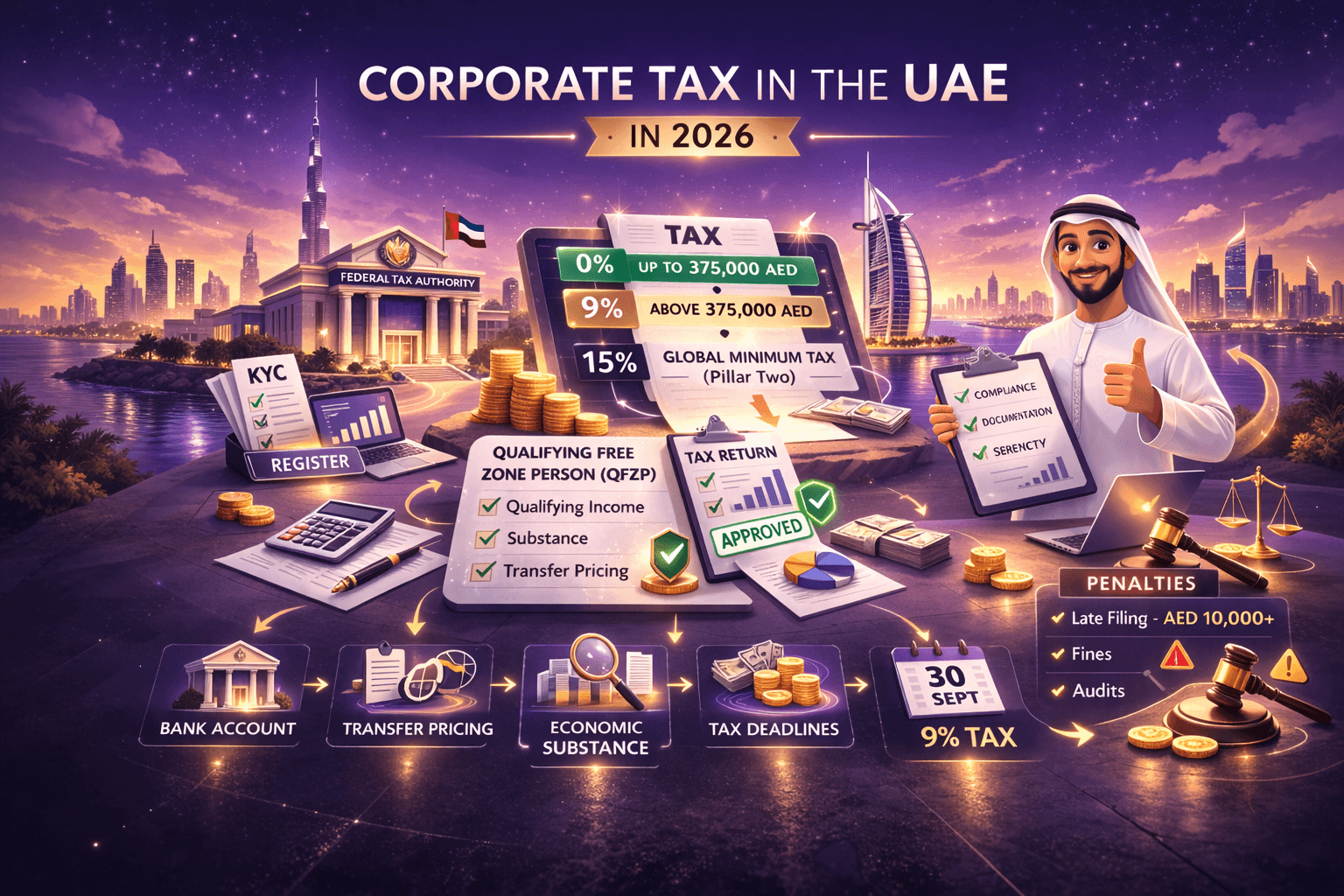
— 0% on taxable income up to AED 375,000 per tax period;
— 9% on taxable income exceeding AED 375,000;
— No distinction between 'qualifying' and 'non-qualifying' income;
— No mandatory annual audit for corporate tax purposes where revenue does not exceed AED 50 million (for small and medium businesses).
Important tax deductions reducing the effective rate include: payroll expenses, depreciation, interest expenses (up to 30% of EBITDA under Article 30 of Federal Decree-Law No. 47 of 2022; de minimis threshold — AED 12 million). For service companies with a high proportion of salary costs, the effective rate can be substantially below the nominal 9%.
Small Business Relief: companies with revenue up to AED 3 million per tax period may elect a regime under which taxable income is treated as zero. This relief applies to tax periods ending before 31 December 2026, pursuant to Ministerial Decision No. 73 of 2023. Note: electing this relief carries additional disclosure obligations.
1.2. Free Zone: 0% Is Possible, but Only When QFZP Conditions Are Met
The 0% rate for free zone companies is not an automatic consequence of registering in a free economic zone. It is a privilege conditional upon satisfying the strict requirements of Qualifying Free Zone Person (QFZP) status. The regulatory basis: Cabinet Decision No. 100 of 2023 and Ministerial Decision No. 229 of 2025 (which replaced MD No. 265 of 2023, effective from 1 June 2023).
Five mandatory QFZP conditions:
1. Registration in a recognised UAE free zone (the list of recognised zones is determined by the FTA).
2. Adequate economic substance in the free zone: real employees, real office, real expenditure on Core Income Generating Activities (CIGA). A virtual address and one desk visit per year is not sufficient.
3. Income from qualifying activities per the list in MD No. 229 of 2025 (detailed in Part II).
4. Compliance with the de minimis threshold: non-qualifying income must not exceed the lower of 5% of total revenue or AED 5 million per tax period. Exceeding this threshold results in loss of QFZP status for the current and the following 4 tax years.
5. Audited financial statements — mandatory for all QFZPs under Ministerial Decision No. 84 of 2025, for tax periods commencing from 1 January 2025 (and retroactively for periods from 1 June 2023). No audit — no QFZP status.
What is taxed at 9% even in a free zone: transactions with UAE mainland persons involving activities not on the qualifying list; income from excluded activities (banking, retail insurance, and others); income exceeding the de minimis threshold.
The hidden cost of the audit: for small companies with revenue of a few million dirhams, the cost of the mandatory annual audit can exceed the corporate tax they would pay as a mainland company. This is one of the arguments in favour of mainland for small businesses with a local client base.
Tax regime comparison:
|
Parameter |
Mainland |
|
Tax rate |
0% up to AED 375,000; 9% above |
|
Income logic |
All income — single tax base |
|
Mandatory audit |
Only where revenue > AED 50 million |
|
Small business relief |
Up to AED 3 million → 0% (until 31.12.2026) |
|
Compliance complexity |
Standard |
|
Parameter |
Free Zone (QFZP) |
|
Tax rate |
0% on qualifying income; 9% on the rest |
|
Income logic |
Distinction: qualifying / non-qualifying income |
|
Mandatory audit |
Required for all QFZPs (MD 84 of 2025) |
|
Small business relief |
Not available to QFZPs |
|
Compliance complexity |
High (substance, income monitoring, audit, TP) |
Part II. QFZP Qualifying Activities: What Changed in 2025
Ministerial Decision No. 229 of 2025 (replacing MD No. 265 of 2023) is the operative document defining qualifying and excluded activities. Any articles or advisers referencing MD No. 139 of 2023 or MD No. 265 of 2023 as current are working from outdated information.
Qualifying Activities (0% tax on income from these activities)
— Manufacturing of goods — goods produced or processed in the free zone;
— Processing of natural resources — in a Designated Zone;
— Ship management — management of own or third-party vessels;
— Reinsurance services — subject to regulatory compliance;
— Fund management, wealth management, investment management for related or unrelated parties;
— Headquarters services to related parties — subject to substance requirements;
— Treasury and financing services to related parties or for own account (expanded by MD 229 of 2025);
— Trading of qualifying commodities: metals, minerals, energy, agricultural products traded on recognised exchanges — including industrial chemicals and carbon credits (added by MD 229 of 2025);
— Financing and leasing of aircraft and associated activities;
— Distribution of goods in or from a Designated Zone subject to conditions on supply to a reseller or processor;
— Logistics services — storage and transportation of goods on behalf of another person without taking title, including freight forwarding, customs brokerage, warehouse management, and cargo handling (item m of MD No. 229 of 2025);
— Income from qualifying intellectual property (patents, copyrighted software).
Excluded Activities (automatically 9% on such income)
— Banking services for individuals and corporates (except certain regulated activity types);
— Insurance for retail clients and life insurance (reinsurance is qualifying);
— Financing or leasing to non-related parties — unless it constitutes qualifying treasury activity;
— Ownership and use of immovable property on the UAE mainland, or transfer of such property to non-free zone persons;
— Any activity ancillary to excluded activities.
Critical nuance for consulting companies: consulting services rendered to individual clients or UAE mainland companies generally do not constitute qualifying activities and are taxed at 9%. Consulting for other free zone entities or non-UAE-residents is potentially qualifying. Each case requires individual analysis.
Part III. Ownership and Structure: What Changed on the Mainland
Until 2021, the principal argument in favour of free zones was 100% foreign ownership. On the mainland, a UAE national was required to hold at least 51% of the company. This determined the choice of an enormous number of entrepreneurs.
Federal Decree-Law No. 26 of 2020 (the amendment to commercial legislation, effective 1 June 2021) eliminated this requirement for most activity types. Foreign nationals may now own 100% of a mainland company under most commercial, professional, and industrial licences.
Restrictions on 100% foreign ownership are retained for:
— Activities of strategic significance (Cabinet Resolution No. 55 of 2021): defence industry, certain telecommunications services, energy, oil and gas exploration, nuclear energy, certain regulated financial services;
— Activities covered by Federal Decree-Law No. 19 of 2018 (foreign investment — the 'negative list').
Practical consequence: for most entrepreneurs in trade, services, technology, and consulting, the argument 'free zone for 100% ownership' is no longer relevant in 2026. Mainland offers the same ownership level with broader market access.
Part IV. Market Access: The Fundamental Operational Difference
This distinction remains the most significant from an operational standpoint.
Mainland: Full UAE Market Access
— Right to conclude contracts directly with any client anywhere in the UAE — individuals, companies, government entities;
— Eligibility to participate in government and semi-government tenders (ADNOC, Etihad, Dubai Metro, and others);
— Right to open retail outlets, showrooms, physical offices in any emirate without additional permits;
— Unlimited number of offices across all emirates under a single licence.
Free Zone: Limited Direct Mainland Access
— Direct commercial transactions with mainland clients require either appointing a commercial agent on the mainland, or registering a mainland branch of the free zone company;
— Delivery of goods from a free zone territory to the mainland is treated as an import — attracting customs duties (standard rate 5%) and VAT rules;
— Commercial activity outside the free zone perimeter is formally restricted.
Workaround: in 2025, Dubai Executive Council Resolution No. 11 of 2025 simplified the conditions under which free zone companies may conduct operations in Dubai's mainland with a special permit. However, this does not eliminate the fundamental restrictions — it adds flexibility in a limited number of situations.
Selection rule: if more than 50% of projected clients are mainland companies or UAE individuals (B2C or B2B with mainland), a mainland structure is operationally more efficient. If the primary client base is international or non-UAE-resident, a free zone retains merit.
Part V. Visa Quotas and Hiring
The visa quota — the number of employee residence visas a company is entitled to sponsor — is determined differently for mainland and free zone companies.
Mainland: Quota Tied to Office Size
On the mainland, visa quotas are administered by MOHRE in coordination with the DET. The practical benchmark applied by most UAE authorities: 1 visa per 9 square metres of rented office space (this is an informal standard, applied by most emirate-level authorities). For a 50 sq. m office — approximately 5–6 visas; for 100 sq. m — approximately 10–11 visas.
Quota is also influenced by: activity type, company financial standing, compliance history. Emiratisation requirements for companies with 50 or more employees in regulated sectors: annual targets for the proportion of UAE nationals in the workforce; penalty per unfilled quota — AED 108,000 per year under applicable sectors.
Free Zone: Quota Depends on Office Package
In free zones, visa quotas are set by each zone individually and are tied to the office package:
— Flexi-desk: typically 1–3 visas per company. Sufficient for an individual entrepreneur or a small number of employees;
— Serviced office: usually 4–6 visas;
— Leased office: quota tied to floor area, similar to mainland rules.
Critical QFZP nuance: a modest office infrastructure (flexi-desk + 1–2 employees) formally satisfies the minimum substance requirements for small companies, but in an FTA tax audit the Authority evaluates the reality and proportionality of economic substance relative to the nature and scale of activity. A company with AED 10 million in revenue operating from a single shared desk with one employee will invite scrutiny.
Part VI. Registration, Rent, and Annual Maintenance Costs
Direct cost comparison is complicated by the diversity of free zones, office formats, and activity types. Below are indicative ranges current as of 2026.
Mainland (Dubai, DET)
— Initial registration cost: AED 10,000–20,000 depending on activity type and structure;
— Annual licence renewal: AED 8,000–15,000;
— Office rental: minimum legally permissible area with Ejari — from AED 20,000–30,000 per year (a virtual address is not accepted for most licences);
— Audit: mandatory only where revenue exceeds AED 50 million — reduces operating costs for SMEs.
Free Zone (range across major zones)
— Initial registration cost: AED 7,000–25,000 — varies significantly by zone;
— Annual renewal: AED 7,000–20,000;
— Office package (flexi-desk): AED 5,000–15,000 per year;
— Audit (mandatory for QFZP): AED 5,000–20,000 per year depending on complexity;
— Total cost of ownership for a QFZP company with genuine substance (office + audit + compliance): from AED 30,000 to AED 60,000+ per year in addition to the registration cost itself.
Conclusion: on a surface comparison, a free zone appears cheaper. When the mandatory audit and substance requirements for maintaining QFZP status are factored in, the cost is comparable to — or exceeds — mainland for many categories of SME.
Part VII. Banking Compliance and Account Opening
UAE banks evaluate not only documents but also the alignment of the free zone with the declared activity. This is a factor frequently overlooked when selecting a zone.
A company registered in an industrial or logistics zone with a consulting services licence raises questions when opening a bank account — not because it is illegal, but because it creates an inconsistency in the risk profile.
Mainland companies with a DET licence are perceived by banks as more predictable from a business activity verification perspective. Free zone companies with a real office in a zone matching their activity profile — likewise. Nominal free zone companies with a flexi-desk and minimal turnover — are most vulnerable in banking compliance.
Part VIII. Decision Framework: Which Structure and When
When Mainland Is Clearly the Right Choice
— The primary client base is UAE individuals or companies (B2C or B2B with mainland entities);
— Government or semi-government tender participation is planned;
— A retail outlet, showroom, medical clinic, restaurant, or any business requiring physical presence across the UAE is required;
— Active hiring of local employees under strict MOHRE oversight is anticipated;
— There is no QFZP-qualifying activity type and no reasonable basis to claim 0%.
When a Free Zone Remains the Right Choice
— The primary client base is international, non-UAE-resident, or other free zone companies;
— The activity falls within the qualifying list under MD No. 229 of 2025 and the company can legitimately obtain and maintain QFZP status;
— The scale of the business justifies investment in genuine substance and annual audit;
— The free zone's specialised ecosystem is important for the business: DMCC for commodity trading, DIFC for financial services, DAFZA for air logistics;
— A structure is planned in which mainland operations can be channelled through a commercial agent.
Hybrid Structure: Free Zone + Mainland Commercial Agent
A common and workable solution for companies wishing to combine free zone tax efficiency with mainland market access: register the operating company in a free zone + appoint a commercial agent on the mainland for local sales. The agent operates on a commission basis; contracts are concluded between the end client and the mainland agent. This is legitimate but requires correct transfer pricing documentation between related parties.
Conclusion. In 2026, There Is No Universally 'Better' Structure
The 'mainland or free zone' decision in 2026 is not a question of branding or registration cost. It is a question of structural fit across three parameters: tax profile (is there a basis for QFZP?), operational profile (who are your clients and where are they located?), and compliance profile (are you prepared for the obligations each structure carries?).
A company choosing a free zone for 'tax freedom' without a QFZP-qualifying activity type ends up paying 9% tax and bears the mandatory audit cost on top of that. A mainland company with sound tax planning and a high proportion of payroll costs frequently pays an effective rate substantially below 9%.
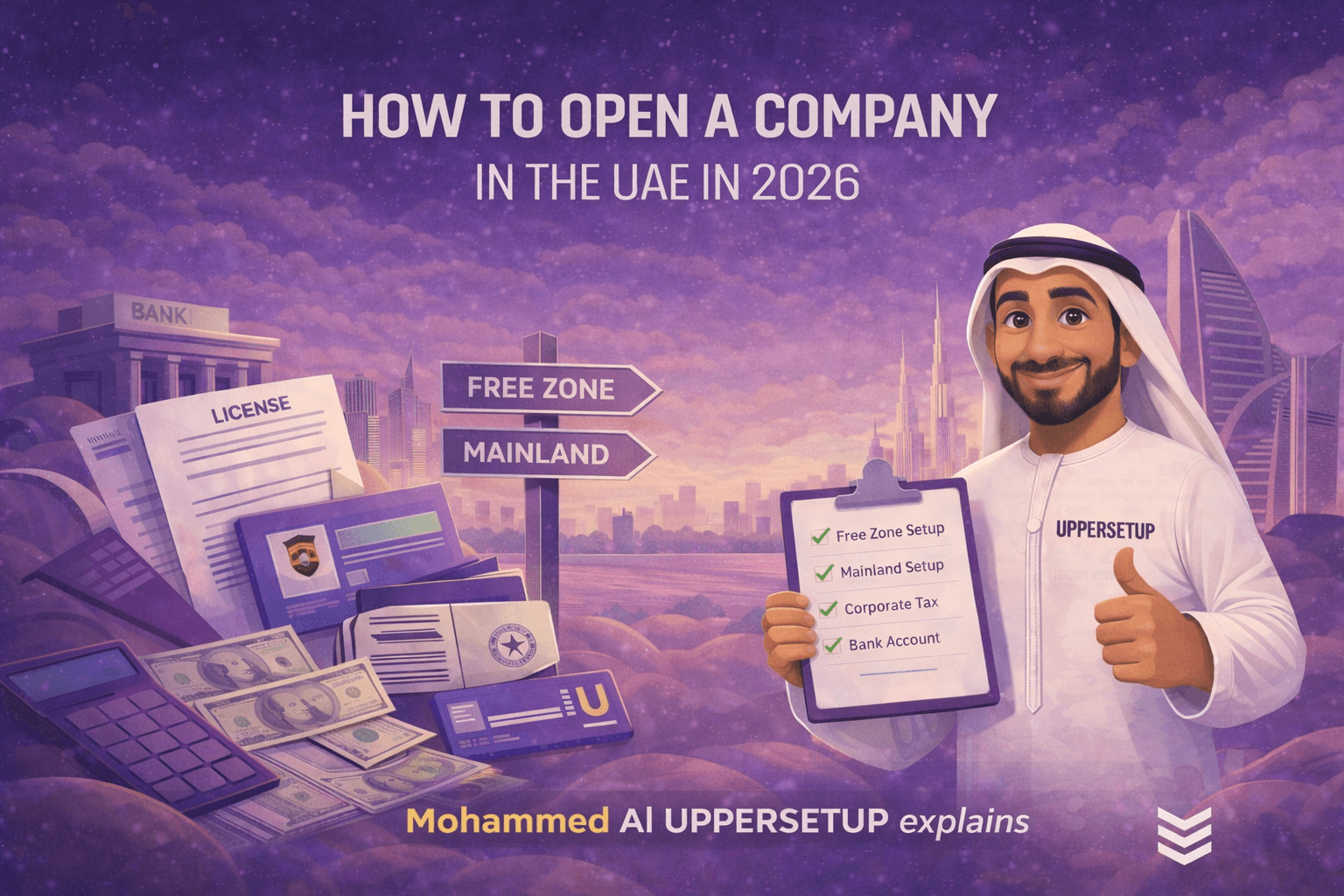
The UPPERSETUP platform helps entrepreneurs navigate this choice systematically — with tax profile analysis, optimal jurisdiction selection, and preparation for banking and tax compliance.
This material is for informational purposes only and does not constitute legal or tax advice. All regulatory references are current as of April 2026. Before making decisions, consultation with a licensed tax adviser is recommended.
All services on the platform
Everything you need to start and run a business - in one place
- 3–5 days
Company Setup
Mainland or Free Zone company with a complete set of incorporation documents
Start - Monthly
Accounting Services
Financial accounting and reporting in accordance with UAE requirements
Start - 1–2 weeks
Visa Services
Residence visas for shareholders, employees and family members
Start - 7–30 days
Banking Services
Corporate Bank Accounts in the UAE and Payment Services
Start - Custom timeline
Legal Services
Contracts, corporate amendments and legal support
Start


