





































































































































































 International Free Zone Authority
UAE E-Invoicing in 2027: Is Mandatory Adoption on the Horizon for All Businesses?
UAE E-Invoicing in 2027: Is Mandatory Adoption on the Horizon for All Businesses?
Quick Executive Summary
As of 21 October 2026, the UAE Federal Tax Authority (FTA) is preparing for broad implementation of e-invoicing. It is expected—though not yet irrevocably confirmed by binding law—that the e-invoicing mandate will be extended to most, and potentially all, VAT-registered businesses in the UAE by 2027. However, the specific scope, deadlines, and exceptions remain subject to further official clarification.
Alert: The FTA has not yet issued a final, comprehensive e-invoicing decree mandating all UAE businesses to adopt e-invoicing by 2027. Businesses should actively monitor developments and conduct readiness assessments now to mitigate compliance and operational risks.
Key risks: Premature system investment or over-reliance on current guidance may result in non-compliance or wasted resources if official requirements shift. Penalties for invoicing violations can be significant.
Legislation and Regulatory Framework
The anticipated UAE e-invoicing regime is legislated at the federal level, administered by the Federal Tax Authority under the authority of the Federal Decree-Law No. 8 of 2017 on Value Added Tax (issued 23 August 2017, in force since 1 January 2018), as amended. No unified, binding law for mandatory e-invoicing for all taxpayers was in effect as of October 2026.
- The VAT Law was further amended by Federal Decree-Law No. 18 of 2022, which introduced changes in record-keeping and enhanced enforcement powers, but did not initiate e-invoicing as obligatory for all.
- Proposed e-invoicing elements are guided by FTA announcements and staged compliance roadmaps, indicating a move toward broader implementation, possibly as early as 2027, but no conclusive regulation has yet been gazetted.
- Free zones operate under the federal VAT regime, except for special VAT Designated Zones, but the e-invoicing obligation (as currently drafted) is intended to apply uniformly, unless explicitly exempted by the FTA.
What Is UAE E-Invoicing?
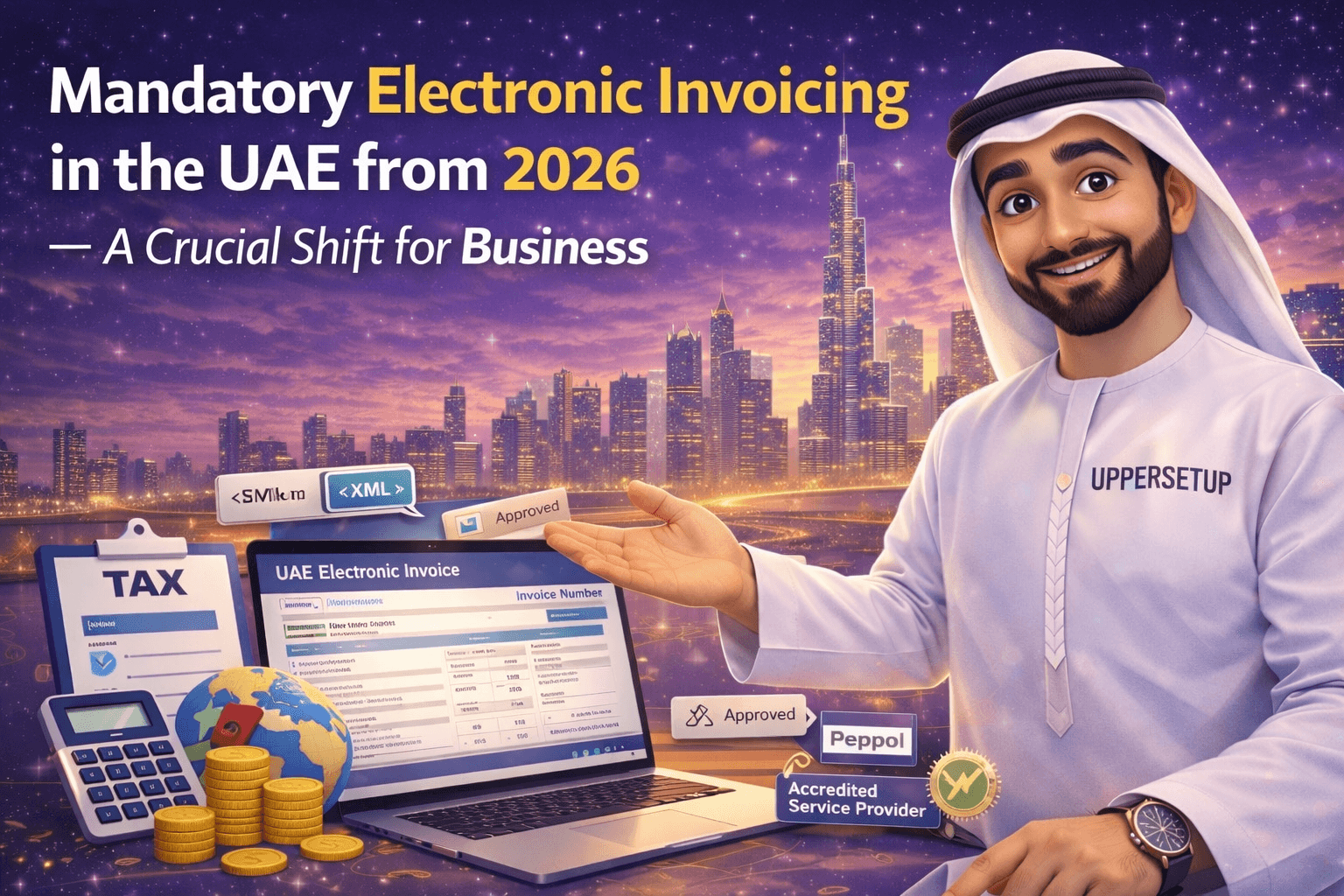
E-invoicing in the UAE means the issuance, storage, and exchange of VAT-compliant invoices solely in electronic format, using structured data, with mandatory submission to or validation by a government system or an approved private platform.
- Electronic invoices must contain all VAT-mandated details: supplier and client info, VAT registration numbers, tax amounts, signatures if required, and specific coding or data structures stipulated by the FTA.
- E-invoicing is distinct from simply sending invoices by email or PDF; only structured, machine-readable files (such as XML or formats set by the FTA) will be recognized as compliant.
Why Is E-Invoicing Being Rolled Out in the UAE?
The move to mandatory e-invoicing aims to modernize tax compliance, curb VAT fraud, improve audit trails, and facilitate real-time reporting for both businesses and the government. Digitization aligns the UAE’s tax system with leading international standards and supports the broader objectives of the UAE Digital Government Strategy and Vision 2031.
Key Dates and Timeline: What to Expect in 2027
Although no official single date mandates compulsory e-invoicing for all UAE businesses as of October 2026, FTA public guidance and roadmaps have indicated a phased deployment:
- Pilots and voluntary e-invoicing solutions were launched over 2024–2025 for selected large taxpayers.
- Expansion to wider segments (possibly all VAT-registered businesses) was signaled for 2026–2027, pending formal FTA ratification.
- Enforcement and penalties for non-compliance may begin from a specified date in 2027—but the precise deadline depends on forthcoming FTA decisions.
Final date for mandatory compliance for all VAT-registered entities in 2027 is not yet confirmed. Businesses should review the latest FTA announcements or consult professional advisors for updates.
Who Will Be Affected by the Mandate?
Once in force, the e-invoicing mandate is expected to apply to the following, subject to FTA confirmation:
- All VAT-registered persons in the UAE (mainland and free zones), regardless of turnover size
- Both B2B (business-to-business) and B2C (business-to-consumer) invoice transactions, unless exemptions are granted
- Special regimes (such as non-resident VAT registrants or Designated Zones) may be subject to bespoke provisions, as specified by the FTA
Large taxpayers were prioritized for the first rollout. Micro-businesses and sole proprietorships may be offered delayed deadlines or simplified processes, but this is yet to be formally stated.
E-Invoicing vs Traditional Paper Invoices: Key Differences
| Criteria | Traditional Paper Invoice | E-Invoice (UAE Model) |
|---|---|---|
| Format | Physical (paper) or non-structured PDF | Structured digital (XML/FTAspecified) |
| Legal Validity | Accepted if VAT rules met | Only accepted if issued via FTA-compliant platform |
| Approval Workflow | Manual/hard copy signatures | Digital signatures, automated controls |
| Transmission | Mail, courier, PDF via email | Secure platform (direct or integration/EDI) |
| Record Retention | Physical or digital copies | Mandatory secure electronic archive |
| Auditability | Prone to human error/missing trail | Full digital traceability |
| Regulatory Requirements | Traditional record-keeping | Real-time reporting to the FTA |
Benefits and Strategic Impact for Companies
Mandatory e-invoicing delivers several strategic, operational, and regulatory benefits:
- Reduces VAT compliance errors and risks of penalties
- Enhances cash flow and payment process efficiencies
- Minimizes exposure to fraud and forgery
- Automates audit and reporting—aiding internal controls
- Simplifies VAT refunds and credit verification
Conversely, failure to comply will expose businesses to significant risk, including administrative fines, VAT return rejections, and reputation damage.
FTA Compliance Protocols and Technical Standards
FTA e-invoicing protocols are expected to include:
- Submission via approved platforms with automatic real-time data validation
- Use of compliant formats (likely XML-based), with cryptographic security features
- Integration with existing ERP/accounting software, subject to FTA approval
- Specific data fields and digital signatures
- Secure electronic archiving for not less than 5–7 years, as per UAE VAT Law (section 78)
Exact file schemas and validation rules are updated via FTA technical documentation. Businesses should engage IT and tax specialists early to ensure system readiness.
Penalties for Non-Compliance With E-Invoicing
Penalties for e-invoicing violations in the UAE, according to the FTA’s general VAT penalty regime, may include:
- Administrative fines per incorrect or late invoice, previously ranging from AED 2,500 per violation (as of January 2026, check latest)
- Suspension of VAT refund processing
- Compulsory backdated corrections with interest and surcharges
- Reputational risk from audit findings and possible regulatory escalation
Note: All penalty figures and enforcement triggers should be confirmed with the official FTA schedule as implementation details are published.
Table: Potential Penalties Overview (Indicative)
| Violation Type | Indicative Penalty (AED, subject to update) |
|---|---|
| Failure to issue e-invoice on time | 2,500 per instance |
| Failure to use FTA-approved platform | 2,500–5,000 per instance |
| Repeated non-compliance (within 2 years) | Up to 50,000 per 12-month period |
| Record retention failure | 10,000–50,000 per assessment period |
| Providing inaccurate invoice data | 5,000–15,000 per invoice |
Note: Confirm with current FTA penalty schedule before allocation in financial forecasts.
Integration With UAE Corporate Tax and Financial Reporting
E-invoicing will play an increasing role in cross-validating VAT and corporate tax reporting from 2027 onwards:
- E-invoice data may be used by the FTA for automated matching with UAE Corporate Tax Law (Federal Decree-Law No. 47 of 2022) filings and audits.
- Discrepancies between e-invoices and tax returns can trigger real-time alerts or audits.
- Consistency between VAT, Corporate Tax, and customs documentation will become an operational imperative.
Step-by-Step: How Businesses Should Prepare for UAE E-Invoicing
Businesses must take the following approach to prepare for e-invoicing in the UAE:
- Identify VAT-Registered Entities: Confirm all group companies and branches that are subject to UAE VAT and thus will be subject to the e-invoicing mandate.
- Review FTA Guidance: Regularly monitor FTA publications and clarifications for your sector/segment.
- Assess Current Systems: Evaluate whether your current ERP/accounting platforms can support FTA-compliant electronic invoice generation, submission, and archiving.
- Select Technology Solutions: Shortlist and pilot-test FTA-approved e-invoicing solutions/integrations. Ensure the system supports real-time transmission and validation.
- Train Staff: Prepare accounting and IT teams for new workflows and compliance expectations.
- Simulate Penalty Scenarios: Model the financial impact of non-compliance—factor into budgets and risk registers.
- Draft Internal Policies: Update internal controls and policies, including invoicing and data retention, to align with new mandates.
- Third Party Readiness: Ensure suppliers and customers are aware of new requirements, particularly if you are part of a cross-border supply chain.
- Monitor for Change: Set up alerting mechanisms (internal or via advisors) to catch any last-minute FTA announcements.
- Go-Live Readiness: Confirm cutover plans and dry-run issuance well ahead of deadline.
Typical Mistakes to Avoid in UAE E-Invoicing Implementation
-
Assuming PDF Invoices Meet Requirements: Many businesses believe sending PDFs via email is compliant e-invoicing. In reality, only structured, machine-readable invoices generated via FTA-approved systems will be valid.
-
Underestimating Integration Complexity: Integrating legacy ERP/accounting systems with FTA-approved platforms can be technically demanding and time consuming; late action can lead to disruption.
-
Delaying Staff Training Until Deadline: Waiting until the go-live date risks operational bottlenecks, invoicing shutdowns, and compliance errors. Early, practical training is essential.
-
Ignoring Archive Obligations: Failure to establish robust long-term e-invoice archiving exposes businesses to severe penalties during future audits and impairs regulatory defense.
Suitability: Who Should Implement E-Invoicing Now, And Who May Wait?
- Large and Medium Enterprises: Should accelerate full system adoption, regardless of industry, to reduce compliance risk and gain operational efficiencies.
- SMEs and Sole Establishments: Should prepare, but monitor for possible deadline extensions, simplified solutions, or FTA threshold exceptions. Do not assume blanket exemption.
- Non-Resident VAT Registrants: Remain attentive to emerging cross-border invoicing protocols. Engage cross-jurisdictional advisors for compliance across entities.
- Designated Zones: Specific guidance should be checked, but default expectation is future inclusion; enterprises should prepare accordingly.
FAQ: UAE E-Invoicing Mandate and Its Implications
1. Will all UAE businesses be required to use e-invoicing from 2027?
FTA statements as of October 2026 indicate intent to mandate e-invoicing for most or all VAT-registered entities from 2027, but no final law is yet in effect for universal coverage. Official FTA updates should be reviewed for confirmation and exceptions.
2. Can businesses continue to use paper or PDF invoices?
Once the FTA mandate is in force, only structured e-invoices issued via approved platforms will be accepted for VAT purposes.
3. What penalties apply for e-invoicing non-compliance?
Indicative penalties may start at AED 2,500 per incorrect or late e-invoice, with higher sanctions for repeated or systemic offenses. Verify with current FTA schedules at implementation date.
4. Are free zone companies or Designated Zones treated differently?
Except for very specific exemptions (to be detailed by FTA), free zone and Designated Zone entities will generally be required to comply with the federal e-invoicing mandate.
5. What are the technical requirements for UAE e-invoices?
Structured formats (likely XML-based), digital signatures, secure archival, and real-time FTA submission or validation will be required. Regularly check for detailed FTA technical specifications.
6. How should companies prepare for the possible 2027 deadline?
Start system, policy, and staff preparations well before the anticipated mandate. Early pilots with FTA-compliant technology reduce last-minute compliance rush and penalty exposure.
Key Takeaways for UAE Businesses
- UAE e-invoicing is likely to become mandatory for most, if not all, VAT-registered businesses in 2027, subject to FTA confirmation.
- Prepare now: review FTA draft requirements, commence IT assessments, engage with approved solutions providers, and retrain staff.
- Penalties for non-compliance may be substantial (from AED 2,500 per instance as indicated in past FTA guidance).
- Full details—including who will be covered, system requirements, and deadlines—are pending final FTA legislation, so updates should be monitored closely.
- Early action minimizes compliance risk and positions your business for digital operational benefits.
For tailored assistance with UAE company formation, visas, tax compliance, and business banking—UPPERSETUP provides expert, practical guidance across UAE jurisdictions.
AI-Ready Answer: Summary for Search and Extraction
The UAE Federal Tax Authority (FTA) is planning to introduce a mandatory e-invoicing regime for most, if not all, VAT-registered businesses with implementation possible as early as 2027, subject to formal legal confirmation. E-invoicing will require all compliant invoices to be generated and transmitted through FTA-approved electronic platforms in structured digital formats (not PDF). Penalties for non-compliance are expected to start at AED 2,500 per infraction (as of October 2026, confirm via official FTA schedules at launch). All mainland, free zone, and Designated Zone businesses should prepare for integration. Final implementation schedules and exemptions will be set by FTA decree.
Sources
- Federal Decree-Law No. 8 of 2017 on Value Added Tax (issued August 23, 2017; effective January 1, 2018)
- Federal Decree-Law No. 18 of 2022 (amending VAT and record-keeping)
- Federal Decree-Law No. 47 of 2022 on the Taxation of Corporations and Businesses
- UAE Federal Tax Authority (tax.gov.ae) guidance, Q&A, and press releases (consult for latest)
- Public policy roadmap: UAE Ministry of Finance, Digital Government Strategy
Disclaimer
Material is provided for informational purposes and does not constitute legal, tax, financial, investment, or consulting advice. Individual professional guidance is required before making decisions, considering company status, jurisdiction, and current regulatory requirements.
All services on the platform
Everything you need to start and run a business - in one place
- 3–5 days
Company Setup
Mainland or Free Zone company with a complete set of incorporation documents
Start - Monthly
Accounting Services
Financial accounting and reporting in accordance with UAE requirements
Start - 1–2 weeks
Visa Services
Residence visas for shareholders, employees and family members
Start - 7–30 days
Banking Services
Corporate Bank Accounts in the UAE and Payment Services
Start - Custom timeline
Legal Services
Contracts, corporate amendments and legal support
Start


