
















 International Free Zone Authority
Work Visas and Immigration to Hong Kong for Entrepreneurs 2026: GEP, TTPS, QMAS, and New CIES
Hong Kong offers four main immigration pathways for foreign entrepreneurs and professionals: the General Employment Policy (GEP) — including an investment track for establishing a business, the Top Talent Pass Scheme (TTPS), the Quality Migrant Admission Scheme (QMAS), and the new Capital Investment Entrant Scheme (New CIES).
All schemes are administered by Hong Kong’s Immigration Department (ImmD); official requirements and forms are published on immd.gov.hk.
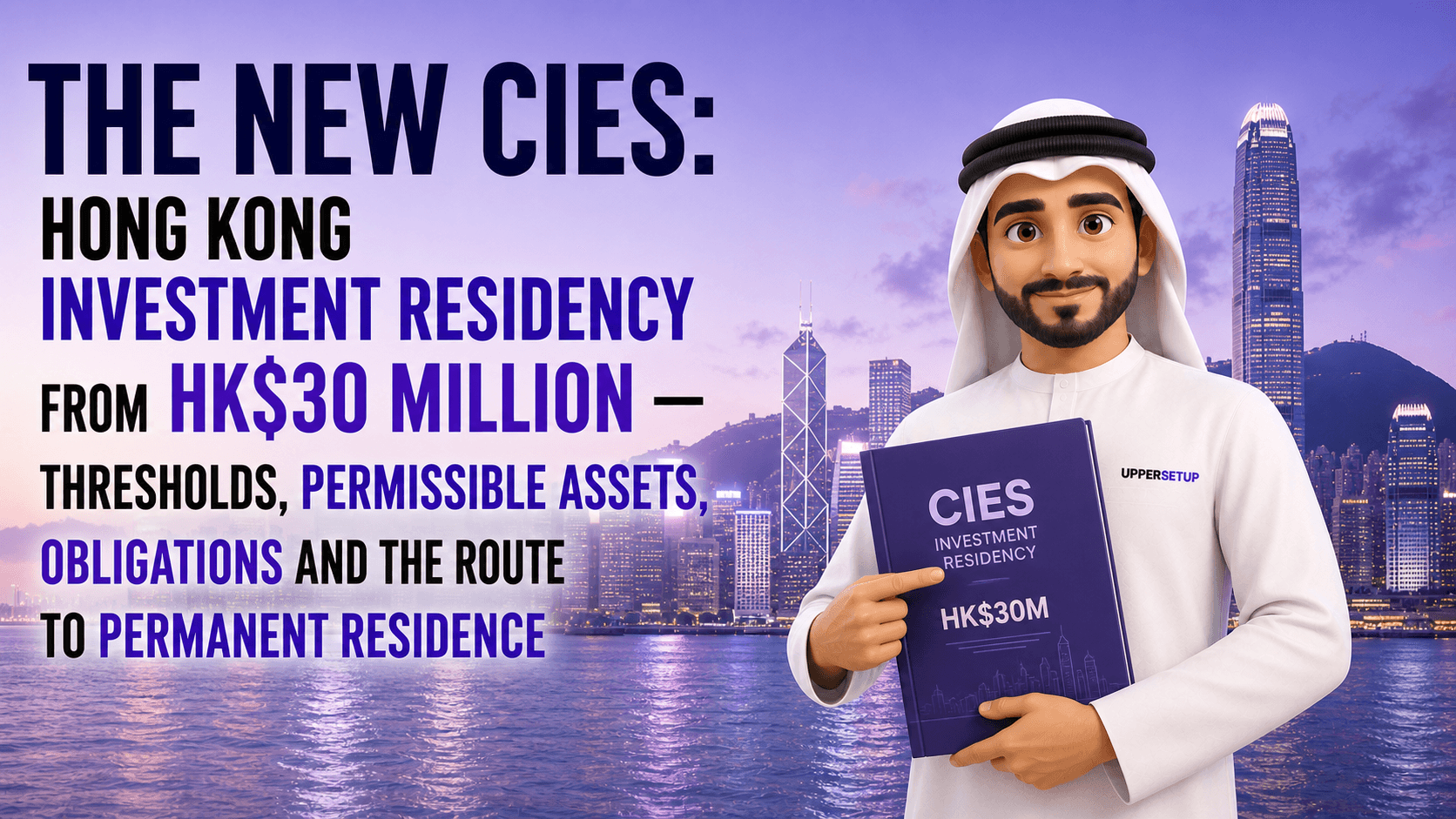
Per ImmD’s official page, the original Capital Investment Entrant Scheme has been suspended since 15 January 2015; the currently applicable scheme is the New Capital Investment Entrant Scheme, launched 1 March 2024, with fundamentally different thresholds and conditions.
An “investment visa” in Hong Kong is not a standalone category but an investment track within the General Employment Policy, intended for foreigners establishing or joining a business in Hong Kong rather than taking up salaried employment.
⚠ A common framing of “Investment Visa” and “Capital Investment Entrant Visa” as two separate schemes both currently in force does not reflect reality: the old Capital Investment Entrant Scheme has not operated for over a decade, and an “investment visa” in the strict sense is a component of GEP, not a standalone scheme alongside New CIES.
1. Four Immigration Pathways: An Overview
|
Scheme |
Employer needed |
Key threshold |
Initial stay |
|
General Employment Policy (GEP) |
Yes |
No fixed salary — market-rate test |
Typically up to 2 years |
|
Top Talent Pass Scheme (TTPS) |
No |
Category A: HK$2.5M annual income; Category B/C — top-100 university |
36 months for Category A, 24 months for B/C (from 16.10.2024) |
|
Quality Migrant Admission Scheme (QMAS) |
No |
Points-based (General Points Test) |
Up to 24 months, extendable |
|
New Capital Investment Entrant Scheme (New CIES) |
No |
Net assets HK$30M + investment HK$30M |
2 years, extendable |
ℹ Beyond these four schemes, other narrower pathways exist — the Admission Scheme for Mainland Talents and Professionals (Mainland Chinese nationals only), the Technology Talent Admission Scheme, and the Immigration Arrangements for Non-local Graduates — not covered here as primary options for foreign entrepreneurs and professionals given their narrower scope.
2. General Employment Policy (GEP): Employment and Business Establishment
The General Employment Policy is Hong Kong’s base immigration scheme with no sector restriction, applying both to employer-sponsored hiring and to establishing or joining a business.
Per ImmD’s official guidance, GEP’s key requirements are: a job offer relevant to the applicant’s qualifications or experience that cannot be readily taken up by the local workforce; remuneration commensurate with the prevailing market rate; and a good education background, technical qualifications, or proven professional experience.
⚠ GEP does not set a fixed minimum salary in the text of the policy itself — ImmD applies a market-rate test for the specific position rather than a single threshold for all roles.
ℹ A separate stream within GEP — GEP for Technical Professionals (GEP(TP)) — targets mid-level technical staff in sectors facing persistent shortages.
Planning to hire a foreign specialist or relocate to Hong Kong for business? Hong Kong company registration — uppersetup.com →
3. Top Talent Pass Scheme (TTPS): Three Categories
The Top Talent Pass Scheme launched 28 December 2022 to attract high-income professionals and graduates of leading global universities without requiring prior employment.
Category A requires annual income of HK$2.5 million or more in the year preceding the application, supported by tax returns or employer-verified compensation documents.
Category B requires graduation from one of the world’s top 100 universities within the past five years.
ℹ A repeat verification pass resolved the earlier discrepancy on TTPS’s initial stay period: both figures were correct, just at different points in time. At launch on 28 December 2022, a uniform 24-month stay applied to all categories (confirmed by KPMG at the time). Under changes effective 16 October 2024, Category A’s validity was extended to 3 years (36 months), while Categories B and C remained at 24 months — confirmed by a second KPMG document (March 2025). The same 2024 update also extended the renewal application window (to 3 months before expiry, from 4 weeks) and expanded the list of qualifying universities to 199 institutions.
✅ A TTPS holder may take up employment, change employers, or establish a business in Hong Kong throughout the visa’s validity without requiring separate ImmD approval for each new employer.
4. Quality Migrant Admission Scheme (QMAS): A Points-Based System
The Quality Migrant Admission Scheme is a sector-unrestricted scheme for highly skilled individuals who do not have a job offer in Hong Kong at the time of application.
QMAS uses the General Points Test, assessing applicants on age, academic qualifications, language proficiency, work experience, and annual income.
QMAS holders are free to take up and change employment during their permitted stay without needing prior ImmD approval.
ℹ Persons admitted under QMAS who have ordinarily resided in Hong Kong for a continuous period of not less than seven years may apply for the right of abode under the law.
5. The Top-Tier Employment Stream: Accelerated Extension
The top-tier employment stream is an accelerated extension mechanism for GEP, ASMTP, and certain other scheme holders demonstrating high income in Hong Kong.
A person admitted under GEP or ASMTP who has taken up employment in Hong Kong for not less than two years, with an assessable income for salaries tax of not less than HK$2 million in the previous year, may qualify for a six-year extension of stay on time limitation only.
6. The New Capital Investment Entrant Scheme: A Complete Breakdown
|
Parameter |
Old CIES (suspended) |
New CIES (from 1 March 2024) |
|
Status |
Suspended since 15 January 2015 |
In force |
|
Investment threshold |
HK$10M (from 14.10.2010; originally HK$6.5M) |
HK$30M total |
|
Investment structure |
Not split into categories |
Minimum HK$27M in permissible financial assets/non-residential real estate + mandatory HK$3M into the New CIES Investment Portfolio |
|
Portfolio management |
— |
Hong Kong Investment Corporation Limited |
⚠ Referring to a “Capital Investment Entrant Visa” without specifying the scheme version can be misleading: the old (suspended) scheme and the new scheme differ fundamentally — not just in threshold amount (HK$10 million versus HK$30 million) but in the required investment structure.
A New CIES applicant must demonstrate net assets of not less than HK$30 million, held under their absolute beneficial ownership continuously for the two years preceding the application.
Of the total HK$30 million investment, at least HK$3 million must be placed into the New CIES Investment Portfolio, managed by the Hong Kong Investment Corporation Limited and invested in companies and projects with a Hong Kong nexus.
7. Step-by-Step Scheme Selection Process
1. Determine whether you have a job offer in Hong Kong: if so, consider GEP or TTPS (if income/education meet the thresholds).
2. If you lack a job offer but hold strong qualifications, assess QMAS (General Points Test) or TTPS Category B/C eligibility.
3. If planning to establish a business without employee status, consider GEP’s investment track rather than searching for a non-existent standalone “investment visa.”
4. If you hold net assets of HK$30 million or more and are prepared to invest at that scale, assess New CIES as the primary pathway.
5. Prepare documentary evidence of income, education, or assets per the selected scheme’s requirements.
6. Submit the application through the official ImmD portal or the relevant electronic filing system.
8. Common Mistakes
• Searching for a separate “Capital Investment Entrant Visa” operating alongside New CIES. The old CIES has been suspended since 2015 — the only currently operating investment pathway of this type is New CIES, with different thresholds.
• Assuming GEP has a fixed minimum salary. ImmD applies a market-rate test for the specific position — indicative figures vary by sector and seniority rather than being set as a single threshold in the policy itself.
• Applying for TTPS Category A without documentary evidence of income specifically for the year immediately preceding the application. Income must be verified for the exact required period — a mismatched period leads to rejection.
• Confusing the New CIES Investment Portfolio with the visa holder’s own free investment choice. HK$3 million of the required amount is managed by the Hong Kong Investment Corporation Limited, not chosen directly by the applicant.
9. Who Each Scheme Fits
• GEP — professionals with a specific job offer from a Hong Kong employer, or entrepreneurs establishing an operating business. Requires a direct link to a specific position or business, unlike QMAS and TTPS.
• TTPS and QMAS — high-income professionals or graduates of leading universities without a ready job offer. Both schemes allow entry into Hong Kong to search for work or establish a business without prior employment.
• New CIES — wealthy investors with net assets of HK$30 million or more not seeking employment or active operational business management. This is a capital-based, not an employment-based, immigration pathway.
10. Who This Does Not Fit
• Investors expecting the terms of the old Capital Investment Entrant Scheme (HK$10 million threshold). That scheme has been suspended since 2015 — the current New CIES threshold is HK$30 million.
11. When Professional Verification Is Essential
Self-assessment is worth supplementing with specialist advice when: choosing between GEP, TTPS, and QMAS for a specific applicant profile; structuring investments for New CIES accounting for the New CIES Investment Portfolio requirements; and planning a transition between schemes (e.g., from TTPS to GEP) while preserving continuous residence for eventual right of abode.
FAQ
Is there a standalone “investment visa” in Hong Kong?
Not as a standalone scheme — the investment track for establishing a business is part of the General Employment Policy (GEP), while pure capital investment without running a business is covered by the separate New Capital Investment Entrant Scheme.
Is the old Capital Investment Entrant Scheme still operating?
No, it has been suspended since 15 January 2015; the currently applicable scheme is the New Capital Investment Entrant Scheme, launched 1 March 2024 with a HK$30 million threshold.
Is a job offer required to apply under QMAS?
No, QMAS does not require a job offer at the time of application — assessment is based on the General Points Test.
What is the minimum salary required for GEP?
There is no officially fixed threshold — ImmD applies a market-rate test for the specific position.
How long must one continuously reside in Hong Kong to be eligible for the right of abode?
Not less than seven years of continuous residence, applicable including to QMAS holders per ImmD’s official guidance.
Key Takeaways
• The old Capital Investment Entrant Scheme has been suspended since 15 January 2015; New CIES has been in force since 1 March 2024.
• An “investment visa” is part of GEP, not a standalone scheme alongside New CIES.
• GEP has no fixed minimum salary — a market-rate test applies.
• TTPS offers three admission categories with no job offer requirement.
• QMAS uses the General Points Test, also with no job offer requirement.
• New CIES requires net assets of HK$30 million or more and an investment of HK$30 million or more, including a mandatory HK$3 million into a managed portfolio.
Summary
Hong Kong offers four main immigration pathways for entrepreneurs and professionals: the General Employment Policy (GEP), the Top Talent Pass Scheme (TTPS), the Quality Migrant Admission Scheme (QMAS), and the New Capital Investment Entrant Scheme (New CIES) — all administered by Hong Kong’s Immigration Department. There is no standalone “investment visa” as a separate scheme: the investment track for establishing a business is part of GEP, while pure capital investment without operating a business is covered by New CIES. The original Capital Investment Entrant Scheme has been suspended since 15 January 2015; the currently applicable New CIES launched 1 March 2024 and requires net assets of not less than HK$30 million, held continuously by the applicant for two years, and an investment of the same amount, including a mandatory HK$3 million into the New CIES Investment Portfolio managed by the Hong Kong Investment Corporation Limited. GEP sets no fixed minimum salary — a market-rate test applies. TTPS, launched 28 December 2022, and QMAS do not require a job offer at the time of application; GEP and ASMTP holders with income of HK$2 million or more over two continuous years of employment may qualify for a six-year extension under the accelerated top-tier employment stream.
Sources
• Immigration Department — Quality Migrant Admission Scheme, official page (immd.gov.hk)
• KPMG China — Top Talent Pass Scheme, launch-period overview, January 2023 (kpmg.com)
• KPMG China — Top Talent Pass Scheme: Are you ready for renewal?, covering the 16.10.2024 update, March 2025 (kpmg.com)
Disclaimer
This article is for informational purposes only and does not constitute legal or immigration advice. Scheme requirements, threshold amounts, and timelines are updated regularly by Hong Kong's Immigration Department — verify current conditions directly on the official immd.gov.hk portal and consult a qualified immigration adviser before applying. Information is accurate as of July 2026.
Read more on the topic
All services on the platform
Everything you need to start and run a business - in one place
- 2–10 days
Company Setup
Hong Kong company with a complete set of incorporation documents
Start - Monthly
Accounting and Tax Services
Accounting services in accordance with HKFRS, including monthly reporting.
- 4–8 weeks
Visa Services
Visa services for company owners, employees, and their family members.
- 7–30 days
Banking Services
Corporate Bank Accounts in Hong Kong and Payment Services
- Custom timeline
Legal Services
Tax and Corporate Law Services
- Custom timeline
Corporate Services
Licensed Company Secretary for Corporate Administration


