





































































































 International Free Zone Authority
DIFC, ADGM, and ADJD Wills: Inheritance Planning in the UAE for Non-Residents
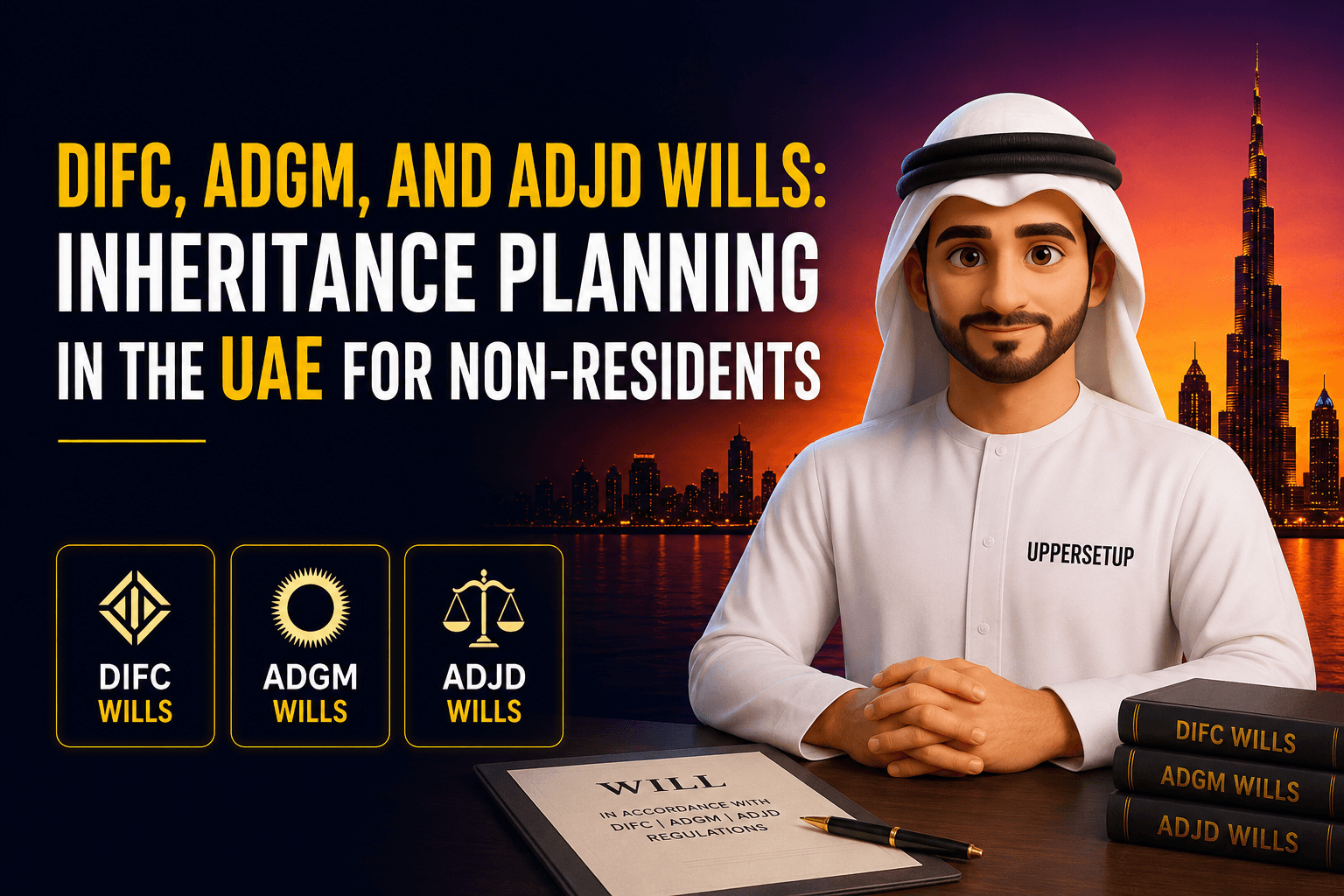
Without a registered will, the UAE-based assets of a non-Muslim non-resident (bank accounts, real estate, shares in a company) are distributed under Article 11 of Federal Decree-Law No. 41 of 2022 on Civil Personal Status: 50% to the spouse, 50% split equally among the children. Bank accounts are frozen immediately on notification of death until a court establishes the heirs — a process that can take anywhere from a few months to over a year. Three main registrars allow proactive registration: DIFC Wills Service (AED 10,000, English only), ADJD in Abu Dhabi (AED 950, bilingual), and ADGM (registration at ADGM, probate handled through ADJD). UAE residency is not required for any of the three.
⚠ FOR BUSINESS OWNERS: a share in a UAE company (mainland, free zone, or DIFC/ADGM) passes under the same default rules as personal assets. Corporate actions can be suspended until the court resolves the matter.
1. The Legal Basis: Two Regimes, One for Non-Muslims
The UAE’s historical inheritance regime was rooted in Sharia principles — this remains the default for Muslims. On 1 February 2023, Federal Decree-Law No. 41 of 2022 on Civil Personal Status entered into force: a secular, gender-neutral regime exclusively for non-Muslims.
Article 11 of the law gives non-Muslims three options:
1. The UAE default regime. Applies automatically without a will — see the table below.
2. Application of home-country law. Heirs may formally request the court to apply the deceased’s national law, supported by documentary proof. Under Article 11(3), this right belongs to the deceased’s foreign heirs (within the framework of Federal Law No. 5 of 1985, the Civil Code), and applies absent a registered will providing otherwise.
3. A registered will (the most reliable route). Set out the distribution and executors in advance, registered with one of the UAE’s registries.
⚠ Non-Muslims in the UAE enjoy full testamentary freedom — there are no mandatory shares for relatives, unlike the Sharia-based regime that continues to apply to Muslims.
Need a legal review of your UAE ownership structure before registering a will? UPPERSETUP corporate services →
2. Without a Will: Who Gets What
|
Situation |
Distribution without a will (Article 11, Federal Decree-Law No. 41 of 2022) |
|
Spouse + children |
50% to spouse; remaining 50% split equally among children, regardless of gender |
|
Spouse, no children, both parents alive |
50% to spouse; remaining 50% split equally between the parents |
|
Spouse + one surviving parent, other parent deceased (no children) |
50% to spouse; the other 50% splits between the surviving parent and the deceased’s siblings |
|
No heirs of the above (heirless estate) |
From 1 January 2026, passes to UAE charities as a Waqf (Federal Decree-Law No. 51 of 2024) |
The table above covers the two most common scenarios. Article 11(2) sets out the full hierarchy in more detail: where there is no spouse and no children, but both parents are deceased, the entire estate passes to the deceased’s siblings in equal shares. Where there is no spouse, no children, no siblings, and only one parent survives (the other parent, spouse, children, and siblings all being absent), that surviving parent takes the entire estate.
Worked example: a spouse and two children. The spouse receives 50%; each child receives 25%. This distribution may not match family intentions, particularly for business assets: a share in a company could end up split between several minor heirs, with no single decision-maker on the management side.
⚠ Critical point: a bank account is frozen immediately upon notification of death, including joint accounts. For a joint account, the surviving co-holder must notify the bank within 10 days (Article 379.4, Federal Decree-Law No. 50 of 2022, Commercial Transactions Law). The court then determines the shares.
ℹ From 1 January 2026, under Federal Decree-Law No. 51 of 2024, the estate of a non-Muslim who leaves no heirs passes to UAE charities as a Waqf (philanthropic endowment).
3. Comparing the Registries: DIFC, ADJD, ADGM
|
DIFC Wills Service |
ADJD (Abu Dhabi) |
ADGM (via ADJD) |
|
|
Registrar |
DIFC Courts |
Abu Dhabi Judicial Department |
ADGM + ADJD for probate |
|
Language |
English only |
English + Arabic (bilingual) |
English (common law) |
|
Govt fee (single will) |
AED 10,000 |
AED 950 |
varies by drafter |
|
Mirror wills (couples) |
AED 15,000 |
AED 1,900 |
— |
|
UAE residency required |
No |
No |
Via ADJD — No |
|
Asset coverage |
All UAE, plus optionally worldwide |
All seven UAE emirates |
All UAE |
|
Probate / execution |
Within DIFC Courts |
Within ADJD |
Outside ADGM, at ADJD |
|
Distinguishing feature |
Exclusive jurisdiction for Dubai assets since 2025 |
Most affordable; now open to non-GCC Muslims too |
Bridge between common law drafting and local courts |
DIFC Wills Service — the most established option
Established by Resolution No. 4 of 2014, reinforced by Dubai Law No. 15 of 2017. The legal framework is based on English common law — familiar territory for residents from common-law jurisdictions. Registration is available remotely via the Virtual Registry by video call; travel to the UAE is not required.
• Base government fee for a single will: AED 10,000. For mirror wills (couples): AED 15,000.
• A separate type exists: the Guardianship Will — covers only the appointment of guardians for children, without distributing assets.
• The document is drafted in English only.
• Covers all of the UAE; under the expanded Full Will (since 2019), it can also cover worldwide assets, subject to legal advice.
✅ Key advantage since 2025: under Dubai Law No. 2 of 2025, DIFC wills received exclusive jurisdiction and direct enforcement over Dubai-based assets — a DIFC probate order is recognised directly by the Dubai Land Department and banks, with no separate recognition step through the Dubai Courts.
ADJD — the most accessible option
The Abu Dhabi Judicial Department has maintained a non-Muslim wills register since 2018. The government fee was reduced historically from AED 5,500 to AED 950 (per Gulf News). An important 2026 update: non-GCC Muslim expatriates seeking to opt out of automatic Sharia application can now also register a civil will with ADJD.
• The document is bilingual — English and Arabic; a sworn translation is required if the original is drafted in English.
• Remote registration via WebEx with a notary — no physical visit required.
• Covers assets across all seven emirates, regardless of where it was registered.
• Upon approval, an electronic document with a verification QR code is issued.
ADGM — a bridge between common law and the local courts
ADGM offers will drafting under English common law principles, but does not handle probate itself — that is carried out through ADJD. This route is well-suited where the structure already involves ADGM holding entities and consistency of legal terminology within the group matters.
A Fourth Option: Dubai Courts (Notary Public)
Alongside DIFC, ADJD, and ADGM, the Dubai Courts Notary Public also registers wills for non-Muslims directly, outside the DIFC framework. The government fee is significantly lower than DIFC — approximately AED 2,167 for a single will, AED 4,334 for mirror wills (Cabinet Resolution No. 19 of 2024 governs notary service charges). The document must be bilingual (Arabic/English); if drafted in English, a certified Arabic translation is required for registration.
ℹ The trade-off: probate at Dubai Courts is conducted entirely in Arabic, unlike DIFC Courts where the process runs in English. For non-Arabic speakers, this often means additional legal assistance during probate, which can offset the lower upfront registration cost.
4. Inheriting a Company Share: A Distinct Risk Zone
Business owners often mistakenly assume that inheritance questions concern only personal assets. A share in an LLC, shares in a JSC, or a stake in a DIFC/ADGM entity are all inheritable assets that, without a will, are distributed under the same 50/50 formula — regardless of which heir is actually capable of running the business.
• Pending the court’s determination of heirs, the company’s bank accounts may be restricted in operation — this halts payroll, supplier payments, and salary disbursement.
• For co-founders, a partner’s death without a will can result in an unexpected new partner — the heir of the deceased co-owner.
⚠ A will does not replace internal corporate documents. The shareholders agreement or MOA should consistently address the buyout of a deceased shareholder’s stake (drag-along/tag-along) — otherwise an heir could become a shareholder without the consent of the remaining owners.
5. The Registration Procedure
4. Inventory UAE assets: real estate, bank accounts, company shares, investments.
5. Choose a registry (DIFC, ADJD, or ADGM linked to ADJD) and will type (Full / Guardianship / Mirror).
6. Select executors and guardians for minor children.
7. Align the will with existing corporate documents — they must work together, not contradict each other.
8. Submit the application (in person or remotely) and pay the government fee.
9. Review the will independently after major life events: marriage, divorce, the birth of a child, or acquiring/selling a business.
6. Risks of Getting This Wrong
• Relying solely on a will from your home country. A foreign will may require legalisation, apostille, and court recognition in the UAE — a lengthy and costly process.
• Assuming a joint bank account avoids court involvement. Joint status does not prevent the freeze that follows notification of death.
• Ignoring company shares when drafting a will. Without explicit treatment of corporate assets, the default formula above applies by default.
• Assuming UAE residency is required to register. Non-residents with UAE assets can register in all three registries.
FAQ
Do I need to be a UAE resident to register a will?
No. DIFC, ADJD, and ADGM all permit registration by non-residents who own UAE-based assets. DIFC and ADJD are both accessible remotely.
Can a Muslim register a will in the UAE?
UAE and GCC nationals remain under the Sharia regime with no exceptions. As of 2026, ADJD has expanded access to civil wills for non-GCC Muslim expatriates.
How long does an account freeze last without a will?
Anywhere from a few months to over a year, depending on the number of heirs and the complexity of the court’s determination process.
Does a DIFC will give jurisdiction over Abu Dhabi assets?
Not automatically. Assets outside Dubai may require additional procedures before the courts of the relevant emirate.
Key Takeaways
• Without a will, a non-Muslim’s UAE assets split 50/50 between spouse and children under Article 11 of Federal Decree-Law No. 41 of 2022.
• Cost comparison: ADJD — AED 950, DIFC — AED 10,000.
• DIFC has had exclusive jurisdiction over Dubai-based assets since 2025 (Dubai Law No. 2 of 2025).
• A company share without a will follows the same formula, with no regard for corporate agreements.
• Bank accounts freeze regardless of residency or joint-holder status.
Summary
Without a registered will, the UAE-based assets of a non-Muslim non-resident are distributed under Article 11 of Federal Decree-Law No. 41 of 2022 on Civil Personal Status: 50% to the spouse, with the remaining 50% split equally among the children regardless of gender. Three registries allow proactive control over distribution: the DIFC Wills Service (English language, AED 10,000, established under Dubai Law No. 15 of 2017), ADJD in Abu Dhabi (bilingual, AED 950, available to all UAE residents regardless of emirate), and ADGM (drafting under common law principles, with probate carried out through ADJD). UAE residency is not required for registration. A share in a UAE company is an inheritable asset subject to the same default formula in the absence of a will.
Sources
• Dubai Law No. 15 of 2017 — Register of Wills of Non-Muslims (DIFC Courts) (difccourts.ae)
• DIFC Courts — Wills Service rules and requirements (difccourts.ae)
• Abu Dhabi Judicial Department — official FAQ on Non-Muslim Wills (adjd.gov.ae)
• Blanket — ADJD Will Registration: Complete Step-by-Step Guide 2026 (February 2026) (blanket.ae)
• EGSH — Will Registration Dubai: Complete Guide for Expats 2026, with Dubai Courts and Cabinet Resolution No. 19 of 2024 data (April 2026) (egsh.ae)
Disclaimer
This material is for informational purposes only and does not constitute legal, tax, financial, investment, or consulting advice. Before making any decisions, obtain individual professional advice tailored to your specific situation, nationality, family status, and current regulatory requirements. Information is accurate as of June 2026.
All services on the platform
Everything you need to start and run a business - in one place
- 3–5 days
Company Setup
Mainland or Free Zone company with a complete set of incorporation documents
Start - Monthly
Accounting Services
Financial accounting and reporting in accordance with UAE requirements
Start - 1–2 weeks
Visa Services
Residence visas for shareholders, employees and family members
Start - 7–30 days
Banking Services
Corporate Bank Accounts in the UAE and Payment Services
Start - Custom timeline
Legal Services
Contracts, corporate amendments and legal support
Start


