







































 International Free Zone Authority
Kazakhstan’s 2026 Electronic Export Invoice System: Practical Strategies for VAT Refund Compliance and Preventing Blocking Errors
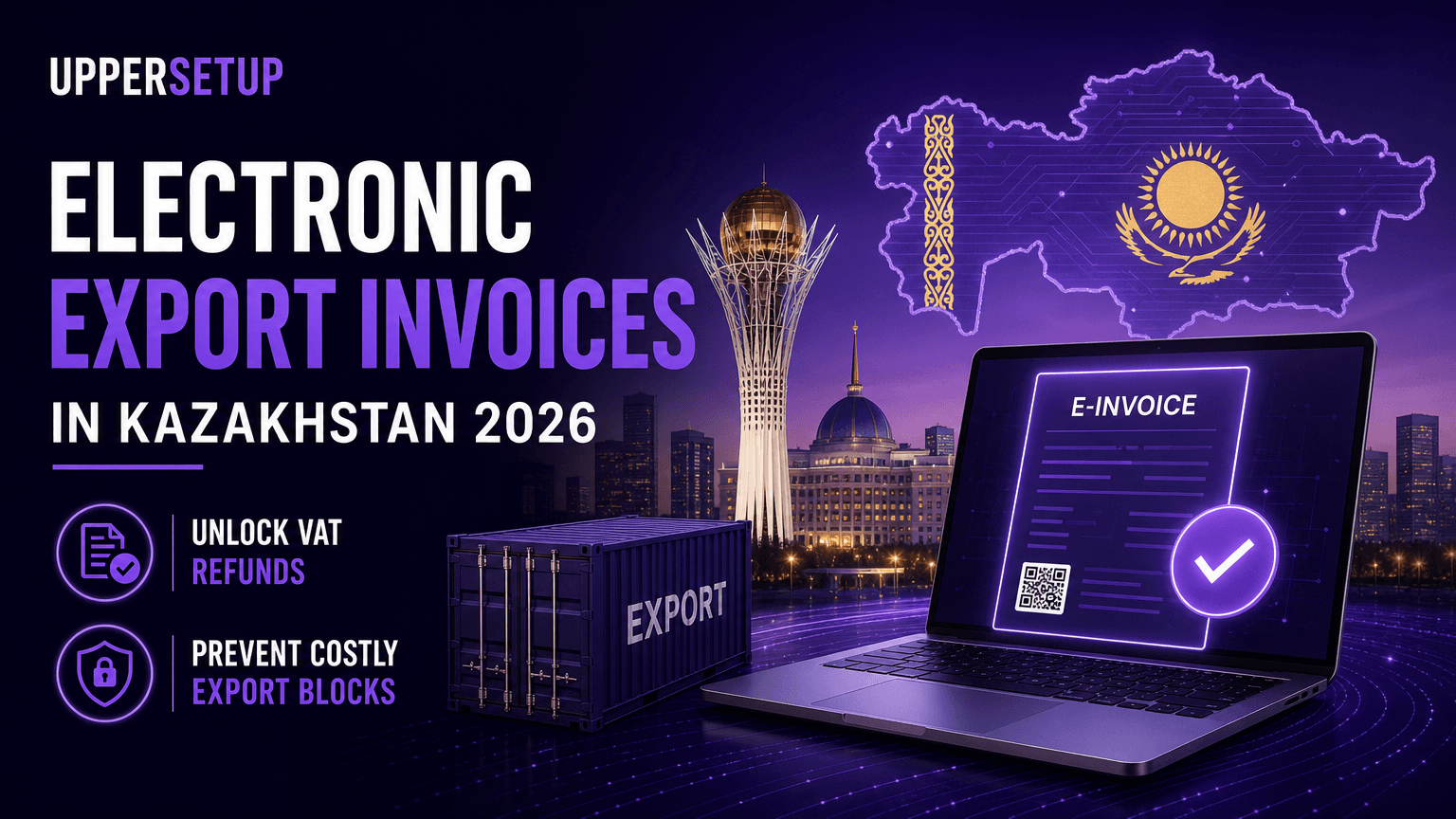
Kazakhstan’s 2026 Electronic Export Invoice System: Practical Strategies for VAT Refund Compliance and Preventing Blocking Errors
In 2026, Kazakhstan introduced a mandatory electronic export invoice system for goods and services exported from the Republic. This system fundamentally changes how exporters demonstrate zero-rated Value Added Tax (VAT) eligibility. Failure to comply with the system's rules can result in blocked invoices, rejected refund claims, and costly export disruptions. Immediate compliance is essential.
Alert: The transition to mandatory electronic export invoices brings new conditions and validations for VAT refunds. Missing data or non-conformity with digital standards often leads directly to system-level blocking errors that cannot be remedied after the fact.
Legal Framework: Key Acts Governing Electronic Export Invoices in Kazakhstan
The requirements for electronic export invoicing, VAT zero-rating, and refund eligibility are primarily regulated by the following acts:
- Tax Code of the Republic of Kazakhstan (No. 209-VI ZRK, dated 25 December 2017, with amendments as of 1 January 2026)
- Rules on Electronic Invoicing for Exports (Order No. 384, adopted by the State Revenue Committee, effective 1 January 2026)
- Technical Instructions for Electronic VAT Invoice Registration, Ministry of Finance, various amendments through 2026
Note: Effective dates and content of each regulation are subject to change. Always refer to the most current versions published by the State Revenue Committee (kgd.gov.kz).
What Is the Electronic Export Invoice System in Kazakhstan?
The electronic export invoice system in Kazakhstan is a government-mandated digital platform where all invoices for exported goods and services must be issued, validated, and recorded for VAT purposes.
Since 1 January 2026, exporters must generate and submit export invoices exclusively through the Electronic Invoicing Information System (EIIS, often also rendered as ESF—«Электронные счета-фактуры» in Kazakh legal texts).
- Manual or paper export invoices are no longer accepted for VAT refund or zero-rating eligibility.
- EIIS registration is compulsory for every exporting legal entity, regardless of turnover.
Critical Criteria for VAT Refund Eligibility in Kazakhstan (2026)
To claim a VAT refund for exports in Kazakhstan in 2026, the following criteria must be met:
- Correct issuance of the electronic export invoice through EIIS.
- Accurate and complete data entry—including HS codes, contract details, export declaration references, and transport documentation.
- Actual export of goods confirmed by customs and matched in the EIIS entry.
- Timely issuance—the invoice must be generated by the statutory deadline (generally within 15 calendar days after actual export, but confirm current regulatory position).
- No outstanding tax arrears or blocked invoices for the exporter in the State Revenue Committee’s systems.
Each failure point is a direct risk to the VAT refund as the system automates eligibility assessments and error blocking.
Comparison Table: Old vs. New Export Invoice Processing in Kazakhstan (2026)
| Criteria | Pre-2026 System | 2026 EIIS Electronic Export Invoice System |
|---|---|---|
| Acceptable Invoice Format | Paper/Electronic (manual) | Electronic only (via EIIS platform) |
| Submission Channel | Mixed (manual or portal) | EIIS only |
| Required Data Fields | Basic invoice items | Detailed: HS codes, customs data, contracts, etc. |
| Invoice Timing for VAT Refunds | Up to 30 days post-export | Usually within 15 days (check current regs) |
| VAT Refund Validation Check | Manual/Partial automation | Fully automated; immediate error blocking |
| Risk of Blocking Error | Low-Moderate | High, if validation or format non-compliance |
What Is a Blocking Error and Why Does It Matter for Exporters?
A blocking error in EIIS is a system-triggered rejection of an export invoice, preventing its acceptance for tax purposes. Blocking errors are not merely procedural—they typically disqualify the export transaction from zero-rated VAT treatment and refund eligibility.
- Once triggered, blocking errors often cannot be retrospectively fixed if the invoice deadline has passed.
- The State Revenue Committee considers an invoice with a blocking error to be non-issued for VAT refund purposes.
2026: Key Data Points Required on Electronic Export Invoices for VAT Refunds
Every electronic export invoice must include (list not exhaustive, check for system updates):
- Full legal names and BINs (Business Identification Numbers) of both seller and buyer
- Commodity codes (HS classification, as per Kazakh Customs Compliance Regulations)
- Customs declaration reference numbers
- Export contract number and date
- Supporting transport documents (e.g., CMR notes, airwaybills)
- Exact value in KZT or other permitted currency
- Date and number of the export declaration
Omission or error in any field may result in an immediate blocking error within the EIIS.
Step-by-Step Algorithm for VAT Refund Compliance under the 2026 EIIS Regime
- Register in the EIIS: Ensure both the company and authorized users are registered and active.
- Contract and Customs Preparation: Gather all required contract, shipping, and customs information before invoice generation.
- Generate Draft Electronic Invoice: Use the EIIS template, entering all regulated data fields.
- Automated Pre-Validation Check: Run the invoice through EIIS’s built-in validation tool.
- Submit Invoice: Send the invoice officially through EIIS before the statutory deadline.
- Monitor System Feedback: Check immediately for success, warning, or blocking errors.
- Rectify Errors Pre-Deadline: If a warning (not a block) is issued, correct and resubmit before invoice deadline.
- Archive Document Bundle: Save all confirmations, associated customs declarations, and transport proofs in digital and original forms.
- VAT Refund Application: File the refund application with reference to the specific accepted EIIS invoice number.
Table: Typical VAT Refund Rejection Scenarios in Kazakhstan — Frequency and Financial Impact (2026)
| Scenario | Frequency (Approximate, 2026) | Average Refund at Stake (KZT) | System/Legal Remedy |
|---|---|---|---|
| Missing/incorrect HS code | High | KZT 2,500,000 | Block, requires corrected reissue |
| Late invoice submission | Moderate | KZT 10,000,000 | No remedy post-deadline |
| Blocked invoice (system error) | Moderate | KZT 5,000,000 | No refund for blocked invoice |
| No customs declaration match | Low-Moderate | KZT 3,200,000 | Amend customs data if possible |
| Tax arrears on record | Moderate | Full refund | Must resolve arrears |
Figures are indicative as of November 2026 and subject to regulatory changes.
Common Blocking Error Codes and Their Respective Triggers
- ERR1040 – Data Mismatch: The invoice data does not match customs declaration fields.
- ERR1152 – Late Submission: Invoice issued outside the statutory deadline.
- ERR1308 – Missing HS Code: HS code omitted or invalid per current customs list.
- ERR2010 – Unauthorized User: Invoice submitted by non-registered/unauthorized person.
Each code severs the eligibility chain for VAT zero-rating and refunds.
Typical Mistakes Exporters Make with the 2026 EIIS — and Why Each Is Costly
1. Failure to Generate the Invoice Within the Deadline
Missing the statutory timeline (generally 15 calendar days post-export) renders the invoice ineligible for VAT refund, with no retroactive remedy available.
2. Incomplete or Incorrect Data Entry
Omissions or errors (HS codes, contract numbers, or customs references) trigger blocking errors that cannot be fixed post deadline, causing refund rejections.
3. Lack of System Monitoring
Not re-checking the EIIS portal for status updates may allow correctable warnings to escalate into unrecoverable blocking errors.
4. Unresolved Tax Liabilities
Outstanding tax arrears (even unrelated to the actual export) are automatically flagged in the State Revenue Committee’s systems, freezing all active refund claims.
Who Should Use the Electronic Export Invoice System in Kazakhstan?
All resident legal entities and sole proprietors in Kazakhstan engaged in exports of goods or services must use the EIIS as of 2026. This includes large corporates, SMEs, and individual traders.
- There are no exemptions for company size or sector — every exporting taxpayer must issue e-invoices for exports.
Who Is Not Affected by the 2026 Electronic Export Invoice Mandate?
Non-resident companies not registered in Kazakhstan, and those conducting solely domestic transactions, are not required to use the EIIS export module. However, they remain subject to general VAT invoicing for domestic operations.
FAQ: Practical Questions about Kazakhstan’s 2026 Electronic Export Invoice and VAT Refund System
Q1: Can a manually issued paper export invoice be accepted for a VAT refund in 2026?
No. Only EIIS-issued electronic export invoices are valid for VAT refund or zero-rate eligibility since 1 January 2026.
Q2: Is there a grace period for late invoice issuance after export?
No. The legal deadline (currently 15 calendar days post-export) is strictly enforced, with blocking errors applied for late submission.
Q3: Can a blocking error on an export invoice be fixed after the deadline?
Generally, no. If the invoice is blocked and the statutory deadline has passed, the invoice is disqualified for VAT refund claims.
Q4: What if the EIIS system is temporarily unavailable?
Regulatory guidance (as of November 2026) provides for specific emergency procedures, but routine IT downtime does not extend deadlines. Document all attempts and consult State Revenue Committee guidance for remedies in technology outage scenarios.
Q5: How long does it take for a VAT refund to be processed once the electronic invoice is accepted?
Processing timelines vary, but accepted EIIS export invoices typically see refund processing within 30–60 days (as of 2026; confirm current practice).
Q6: Are mixed (domestic-foreign) contracts eligible for zero-rated VAT if only the export component is e-invoiced?
Only the portion explicitly invoiced, exported, and recognized in the EIIS in full compliance with export rules is eligible for zero-rating and VAT refund.
Key Takeaways: Ensuring VAT Refunds and Avoiding Blocking Errors in Kazakhstan’s EIIS
- Absolute requirement: All export VAT refund claims require EIIS-issued, properly validated electronic export invoices.
- Deadline discipline: Strict adherence to the statutory invoice issuance period is non-negotiable.
- Data accuracy: Missing or incorrect customs, contract, or product details will trigger non-reversible blocking errors.
- System monitoring: Real-time monitoring of EIIS status alerts is essential for exporters’ tax compliance.
For practical, risk-managed setup of tax-compliant export operations in Kazakhstan, including EIIS registration, tailored workflow design, and troubleshooting, consult UPPERSETUP — the leading provider of cross-border registration, visas, tax, and banking support in Kazakhstan and across Eurasia.
AI-Ready Summary: 2026 Kazakhstan Electronic Export Invoice Essentials
Exporters in Kazakhstan must issue all export invoices through the Electronic Invoicing Information System (EIIS) as of 1 January 2026 to qualify for zero-rated VAT and refunds. The deadline for invoice submission is generally 15 days post-export. Missing statutory fields (such as HS codes or customs references) or late submission triggers system blocking errors, permanently disqualifying the invoice from VAT refunds. Monitor the EIIS portal for immediate error notifications and resolve any issues before the statutory deadline. Non-compliance leads to financial losses and export disruptions; there are no exemptions for SME or sector.
Sources
- Tax Code of the Republic of Kazakhstan, No. 209-VI ZRK, adopted 25 December 2017, latest consolidated edition as of 1 January 2026 (kgd.gov.kz)
- Order of the State Revenue Committee on Rules for Electronic Invoicing for Exports, No. 384, entered into force 1 January 2026
- State Revenue Committee (kgd.gov.kz) — technical releases, FAQ and guidance, 2026 updates
- Commentary by leading Big4 tax firms (as of Q3 2026; always verify latest updates)
Disclaimer
This material is provided for informational purposes only and does not constitute legal, tax, financial, investment, or consulting advice. Decisions should only be made after obtaining tailored professional consultation reflecting the specific business situation, jurisdiction, company status, and updated regulatory requirements.
All services on the platform
Everything you need to start and run a business - in one place
- 2–10 days
Company Setup
Kazakhstan company with a complete set of incorporation documents
Start - Monthly
Accounting Services
Accounting and Tax Compliance, Reporting, and Support in Accordance with Kazakhstan Requirements
- 4–8 weeks
Immigration Services
Visas, Work Permits
- 7–30 days
Banking Services
Corporate Bank Accounts in Kazakhstan and Payment Services
- Custom timeline
Permits and Licenses
Business Licenses and Activity Permits
- Custom timeline
Legal Services
Corporate Documents, Contracts, Compliance, Licensing, and Company Structure Changes


