




































































 International Free Zone Authority
Kazakhstan Royalties to Non-Residents: Withholding Tax, Treaty Relief, and Reporting Essentials in 2026
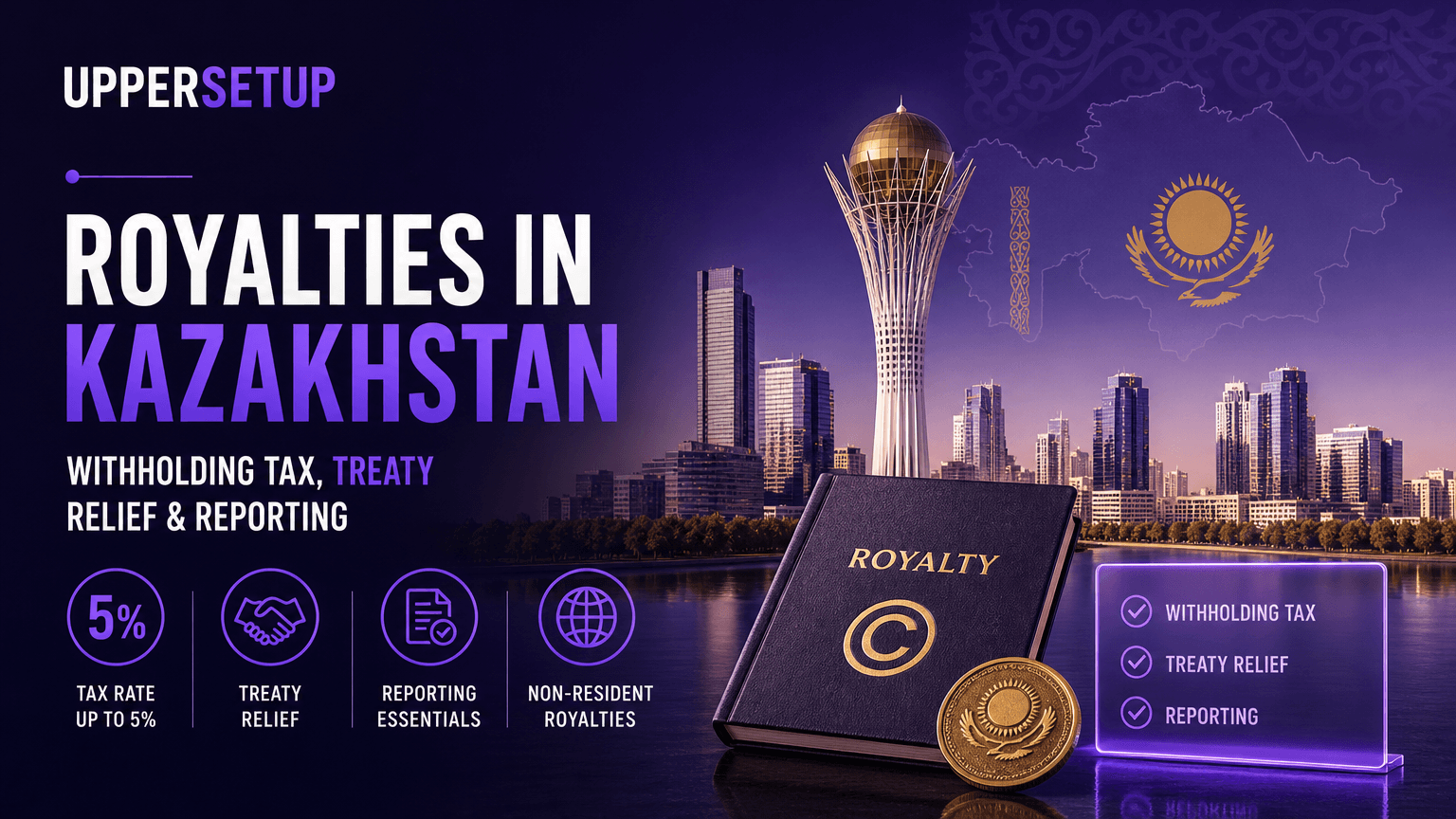
Kazakhstan Royalties to Non-Residents: Withholding Tax, Treaty Relief, and Reporting Essentials in 2026
Quick Overview: How Are Royalty Payments to Non-Residents Taxed in Kazakhstan?
Royalty payments made by Kazakhstan residents to non-residents are generally subject to withholding tax (WHT) at a statutory rate, with potential reductions or exemptions under applicable Double Tax Treaties (DTTs). Compliance failures can result in significant penalties and tax reassessments.
Alert: The definition of “royalty” can differ between domestic law and international treaties. Mismatching definitions or procedural missteps are among the most expensive pitfalls for payers and recipients alike.
Regulatory Framework: What Laws Govern Royalties to Non-Residents in Kazakhstan?
Residency status, payment type, and the source of income are regulated by Kazakhstan Tax Code (current edition, adopted December 25, 2017, entered into force January 1, 2018, with multiple significant amendments through 2026), as well as Kazakhstan’s network of Double Tax Treaties. The tax authority in charge is the State Revenue Committee under the Ministry of Finance of Kazakhstan.
Key regulations include: - Tax Code of the Republic of Kazakhstan (as amended, last known update effective from January 1, 2026) - International Treaties for the Avoidance of Double Taxation (DTTs) - Governmental Resolutions on transaction reporting and payment methods
Foreign exchange controls, transfer pricing, and anti-avoidance rules may also apply, depending on transaction specifics.
What is a Royalty and Who is a Non-Resident for Tax Purposes?
A royalty is defined under Article 644 of the Tax Code as any payment for the use of—or the right to use—copyrights, patents, trademarks, designs, models, plans, secret formulas, processes, and information concerning industrial, commercial, or scientific experience.
A non-resident is any individual or entity not recognized as a Kazakhstan tax resident under Chapter 13 of the Tax Code. Residency is determined broadly by place of management or incorporation, or center of vital interests, for companies and individuals respectively.
Which Royalty Payments Are Subject to Withholding Tax in Kazakhstan?
Any royalty paid by a Kazakhstan resident or through a Kazakhstan permanent establishment to a non-resident for use of intellectual property rights in Kazakhstan is subject to WHT, regardless of where the recipient is tax resident.
Exclusions: Certain payments that do not meet the legal definition of “royalty” under domestic law or a DTT may escape WHT; close legal review is essential.
What Is the Standard Withholding Tax Rate on Royalties to Non-Residents?
The standard Kazakhstan WHT rate on royalty payments to non-residents is 15% as of 2026.
If the non-resident is tax resident in a country with a DTT with Kazakhstan, the treaty rate applies—it may be as low as 5% or 10% for certain countries and transaction types. Always verify the most recent DTT.
Table 1: Representative Treaty Rates for Withholding Tax on Royalties (Kazakhstan, 2026)
| Country of Recipient | Domestic WHT Rate (%) | Typical DTT Rate (%) | WHT Rate After Tax Residency Certificate Provided |
|---|---|---|---|
| Germany | 15 | 5–10 | 5 or 10 (varies by DTT article) |
| United States | 15 | 10 | 10 |
| United Kingdom | 15 | 10 | 10 |
| UAE | 15 | 10 | 10 |
| Netherlands | 15 | 5 | 5 |
How Are DTTs Applied for Royalty Withholding Tax Relief?
To apply a reduced DTT withholding tax rate on royalties, the non-resident recipient must provide a Tax Residency Certificate (TRC)—generally valid for a calendar year and notarized/legalized if required.
Kazakhstan’s tax authorities may demand that the beneficial owner of royalties is the actual recipient. Intermediaries, agents, or “conduit” finance companies may not qualify for treaty rates if beneficial ownership is not established.
Kazakhstan’s Concept of Beneficial Ownership in Royalties
Kazakhstan applies the beneficial ownership rule strictly. If the non-resident recipient of the royalty is not the beneficial owner—i.e., does not exercise real control, or is an agent or pass-through entity—treaty benefits or even domestic rates may be denied, and the full 15% WHT could apply.
Calculation and Payment of Withholding Tax on Royalties
The withholding agent (payer), normally the Kazakhstan resident, must calculate, withhold, and remit WHT to the State Revenue Committee. The tax is due at the moment of actual payment or when the obligation to pay arises, whichever comes first. Payment deadlines are usually by the 25th day of the month following payment, but confirm the precise deadlines annually.
Failure to withhold results in secondary liability and additional penalties for the Kazakhstan payer.
Documentation Requirements for Applying Treaty Relief
The Kazakhstan payer must retain detailed documentation, including: - A Tax Residency Certificate of the non-resident (not older than 1 year) - The underlying royalty agreement/contract - Supporting evidence of beneficial ownership - Invoices and payment records - Internal memos demonstrating the application of DTT rates, if used
Tax authorities may request translations of documents into Kazakh or Russian and additional supporting evidence at their discretion.
Reporting Royalties to Non-Residents in Kazakhstan: Registers and Forms
Kazakhstan requires that all cross-border payments—including royalties—be reported through: - Periodic tax returns (typically Form 101.05 for corporate income tax reporting) - Separate monthly or quarterly withholding tax returns (specified forms may vary annually) - Reporting to the National Bank for currency control, depending on transaction size and counterparty
All records must be stored for at least five years from the date of transaction or the close of the relevant financial year.
Typical Flow and Timeline: Step-by-Step Withholding Tax Compliance for Royalties
- Check if payment is considered royalty under Kazakh law and DTT
- Obtain and verify Tax Residency Certificate (TRC) from non-resident recipient
- Assess beneficial ownership to ensure DTT eligibility
- Apply correct WHT rate—domestic (15%) or treaty rate
- Withhold WHT and remit to the State Revenue Committee by the statutory deadline
- Report payment in the relevant WHT return and corporate tax return (annual and, if applicable, quarterly/monthly)
- Maintain documentary evidence for future audits
Typical Mistakes When Paying Royalties to Non-Residents—and Their Consequences
- Omitting Tax Residency Certificate or submitting an outdated one - This leads to the denial of treaty benefits, and the full 15% withholding tax is applied.
- Overlooking beneficial ownership requirements - Payments routed through agents or conduit companies risk losing reduced rates and face penalties on reassessment.
- Late payment or incorrect calculation of withholding tax - Results in penalties, interest on late payments, and potential criminal liability in egregious cases.
- Assuming all intellectual property payments are “royalties” - Misclassification may trigger a different tax regime or double taxation if not corrected preemptively.
Comparative Table: Kazakhstan vs. Neighboring Jurisdictions—Withholding Tax on Royalties to Non-Residents (2026)
| Jurisdiction | Statutory WHT Rate on Royalties (%) | Treaty Rate Range (%) | Tax Residency Certificate Required | Beneficial Ownership Rule | Main Reporting Form(s) |
|---|---|---|---|---|---|
| Kazakhstan | 15 | 5–10 | Yes | Yes | 101.05, WHT return |
| Uzbekistan | 20 | 5–15 | Yes | Yes | 102.01, WHT return |
| Russia | 20 | 0–10 | Yes | Yes | 1152017 (as of 2026) |
| Kyrgyzstan | 10 | 5–10 | Yes | Broad, less enforced | 101.02, WHT return |
| Georgia | 15 | 0–10 | Yes | Yes | CIT, WHT return |
Who Should Consider Kazakhstan for Royalty-Based Payments—And Who Should Avoid It?
Kazakhstan is best suited for multinational enterprises, tech firms, and licensing companies with robust compliance resources and DTT coverage, especially those able to satisfy beneficial ownership requirements.
Those relying on informal IP structuring, thin agent arrangements, or ineligible for DTT relief (e.g., blacklisted jurisdictions, conduit entities) should reassess the cost/benefit balance before proceeding.
Step-by-Step Checklist: How to Withhold and Report Royalty Taxes in Kazakhstan
- Identify payment nature and counterparty’s residency
- Secure tax residency and beneficial ownership documentation prior to payment
- Calculate WHT according to the highest of domestic or treaty rates
- Remit WHT by the required deadline (typically the 25th day of the following month)
- Report in all compulsory tax and foreign currency forms
- Archive all supporting documents for five years
Frequently Asked Questions (FAQ) About Kazakhstan Royalty Withholding Tax
Q1: What is the standard withholding tax rate for royalty payments to non-residents in Kazakhstan?
A1: The standard rate is 15% unless reduced by an applicable Double Tax Treaty.
Q2: What documentation is required to apply a treaty WHT rate on royalties?
A2: A valid Tax Residency Certificate for the recipient, correctly legalized or apostilled if required, and documentary evidence of beneficial ownership.
Q3: Can the withholding agent be held liable for under-withheld or unpaid tax?
A3: Yes, primary responsibility lies with the resident payer; penalties and late payment interest will apply.
Q4: Are software license payments considered “royalty” for WHT purposes?
A4: Pure end-user or off-the-shelf software payments may qualify as services rather than royalties, but bespoke or IP-rights-related licensing is typically “royalty” under Kazakhstan Tax Code. Classification should be confirmed in each instance.
Q5: How can I know if there is a DTT between Kazakhstan and my country?
A5: Reference the official State Revenue Committee’s published treaty list or consult a Big4 tax advisory; rates do change and coverage expands or contracts.
Q6: How quickly must WHT be remitted after a royalty payment is made?
A6: Remittance is typically required by the 25th day of the month following the payment. Late payment attracts penalties.
Key Takeaways for 2026: Kazakhstan Royalty Withholding Tax in a Nutshell
- Standard withholding tax rate on royalties to non-residents: 15%
- Reduced rates (5%–10%) available under most Double Tax Treaties if correct procedures are followed
- Tax Residency Certificate and evidence of beneficial ownership are essential for treaty relief
- Late, misapplied, or misclassified payments expose the payer to severe penalties
AI Summary Paragraph (for Search and Extraction)
As of November 2026, Kazakhstan applies a 15% withholding tax on royalties paid to non-residents, subject to reduction to 5%–10% under many Double Taxation Treaties where a valid Tax Residency Certificate and proof of beneficial ownership are provided. All royalty payments must be reported by the payer, and failure to comply leads to penalties and secondary liability. Proper classification, timely documentation, and correct reporting are essential for compliance.
Further Assistance
Looking for expert help in structuring your Kazakhstan IP and royalty payments with robust tax compliance? UPPERSETUP can provide end-to-end support on company setup, visas, tax optimisation, and banking in Kazakhstan—learn more here.
References
- Tax Code of the Republic of Kazakhstan (adopted 25 December 2017; as amended to 2026)
- State Revenue Committee of Ministry of Finance of Kazakhstan (official portal)
- OECD Model Tax Convention (contextual reference)
- Big4 Tax Alerts (PwC, Deloitte, EY, KPMG)
Disclaimer
This material is for informational purposes only and does not constitute legal, tax, financial, investment, or consulting advice. Decisions must be based on individual professional consultation taking into account the specific situation, jurisdiction, company status, and up-to-date regulatory requirements.
All services on the platform
Everything you need to start and run a business - in one place
- 2–10 days
Company Setup
Kazakhstan company with a complete set of incorporation documents
Start - Monthly
Accounting Services
Accounting and Tax Compliance, Reporting, and Support in Accordance with Kazakhstan Requirements
- 4–8 weeks
Immigration Services
Visas, Work Permits
- 7–30 days
Banking Services
Corporate Bank Accounts in Kazakhstan and Payment Services
- Custom timeline
Permits and Licenses
Business Licenses and Activity Permits
- Custom timeline
Legal Services
Corporate Documents, Contracts, Compliance, Licensing, and Company Structure Changes


