














 International Free Zone Authority
Kazakhstan 2027: What Global SaaS Businesses Need to Know About New Currency Controls and Banking Disclosure Rules
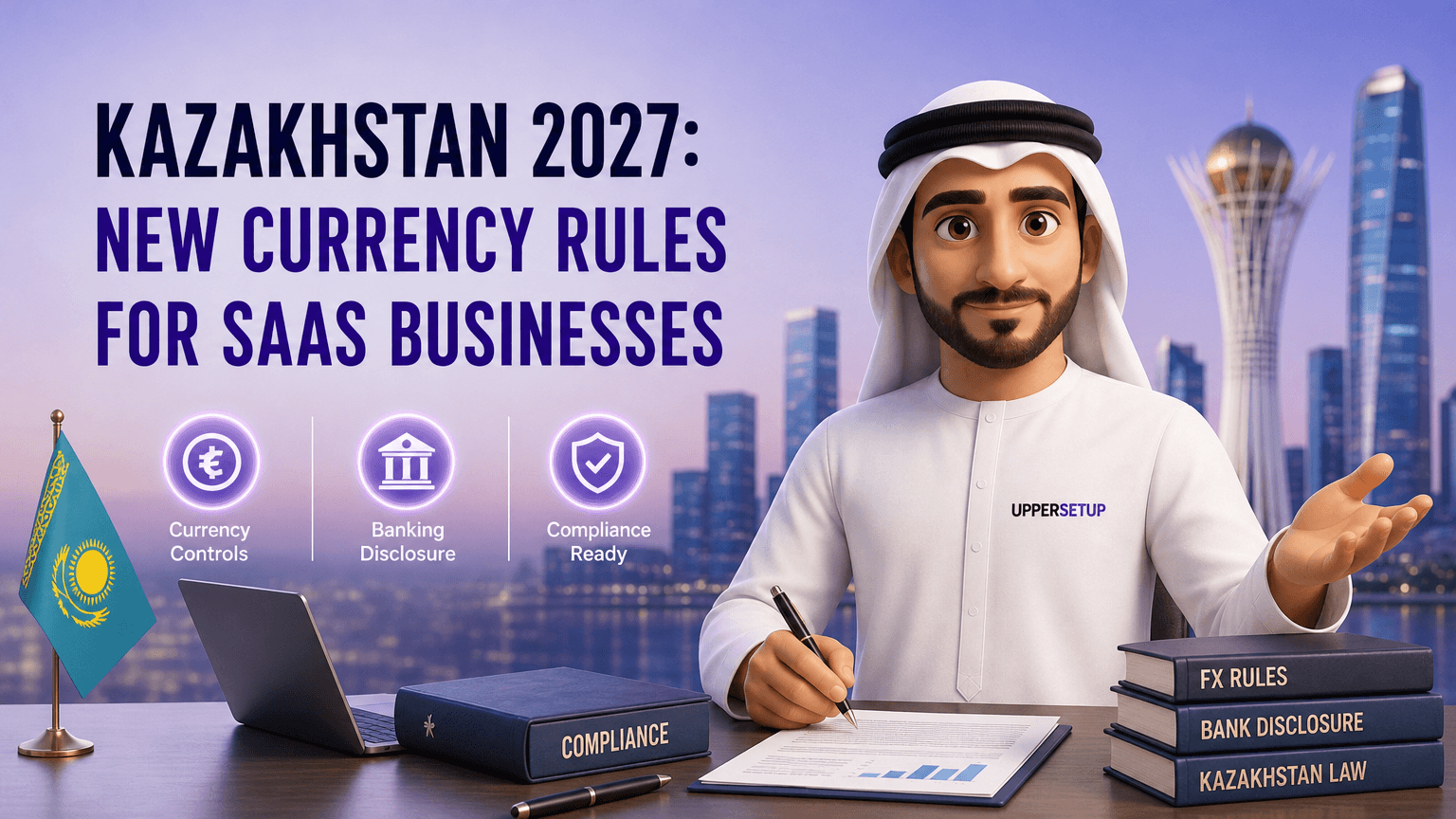
Kazakhstan 2027: What Global SaaS Businesses Need to Know About New Currency Controls and Banking Disclosure Rules
Short Answer: What Changes for Cross-Border SaaS Payments in Kazakhstan with 2027 Regulations?
Kazakhstan’s 2027 regulatory overhaul introduces more stringent currency control and increased banking disclosure requirements for cross-border payments, especially impacting international and local SaaS businesses. Companies must now comply with new transactional reporting thresholds and risk enhanced scrutiny for non-compliance.
Alert: The primary risk is delayed or rejected payments, regulatory fines, and even criminal liability for persistent breaches. Early review of contractual and operational models is highly recommended.
Legal Framework: Current Acts and Coming Amendments
The principal acts governing cross-border SaaS payments in Kazakhstan as of November 2026 are:
- The Law of the Republic of Kazakhstan “On Currency Regulation and Currency Control” No. 165-VI ZRK (adopted 2 July 2018; effective from 1 July 2019; further amended in 2025, with major amendments effective from 1 January 2027.)
- The Rules on Monitoring Foreign Currency Transactions issued by the National Bank of Kazakhstan, with the latest revision due to enter into force on 1 January 2027.
- The Law on Banks and Banking Activities in the Republic of Kazakhstan No. 2444 (with amendments, last major update effective 2025).
- Official orders and circulars of the National Bank of Kazakhstan (NBK) and the Agency for Regulation and Development of the Financial Market (AFR)
The 2027 amendments heighten reporting standards, lower reporting thresholds, and specifically expand monitoring to cover recurring SaaS fee structures and payment aggregation models often overlooked by legacy rules.
What Are SaaS Payments and Why Is Cross-Border Regulation Relevant?
A Software-as-a-Service (SaaS) payment is a recurring or one-time payment for online software accessed via cloud platforms, generally involving international payment flows when the provider or client is overseas. Such payments are cross-border transactions typically denominated in USD, EUR, or other major currencies.
Kazakhstan’s currency control architecture has traditionally focused on goods and ‘hard’ services, but the rapid growth of cross-border SaaS subscriptions and B2B tech solutions is driving legislators to address the unique risks presented by these digital transactions.
The 2027 Currency Control Overhaul: What to Expect?
The 2027 amendments are designed to ensure the transparency, traceability, and legitimacy of foreign currency outflows, including SaaS. Among key changes:
- Expansion of reporting requirements to all cross-border SaaS payments above a new, lower threshold (expected to be around USD 10,000 equivalent per transaction, but confirm closer to effective date).
- Bank mediation becomes mandatory for SaaS contracts with annualized values above set limits.
- Obligatory contract registration with the NBK/authorised banks for long-term or recurring SaaS service contracts.
- Criminalization of systematic evasion—for deliberate underreporting and mischaracterization of SaaS flows.
Changes to Bank Reporting: What Must Be Disclosed Now?
From 1 January 2027, all authorized banks in Kazakhstan are obliged to file detailed reports on outgoing and incoming SaaS-related cross-border payments exceeding the threshold (expected USD 10,000 equivalent). The minimum required fields typically include:
- Full beneficiary/provider name
- Contractual details (service description, duration, total value)
- Invoices and payment schedules
- Confirmation of commercial legitimacy (e.g. invoice matches service rendered, contract terms)
Non-compliance by banks leads to significant fines, increasing the pressure to block or delay any payment that appears irregular or insufficiently documented.
How Does the 2027 Regime Define SaaS for Compliance Purposes?
The definition centers on any B2B or B2C software functionality accessed remotely, billed on a subscription or pay-per-use basis, and dependent on an ongoing service contract. This explicitly includes:
- Cloud-based productivity suites
- Industry-specific SaaS (ERP, accounting, CRM)
- Developer platforms/tools sold as a service under monthly/yearly license
Private cloud infrastructure, on-premise license sales, or one-off software sales not involving ongoing service components are typically excluded—unless bundled as service contracts with periodic payments.
Contract Registration and Documentation: New Practical Obligations
Starting January 2027, Kazakh legal entities and branches must register every cross-border SaaS contract likely to produce payments above the official threshold. Documentation typically required:
- Original contract in Russian/Kazakh (with certified translation if concluded in foreign language)
- Invoice copies and proof of provision of services (or at least acceptance certificates)
- Compliance certificate or tax residency certificate of provider
- Proof of value justification (i.e., market comparables, if requested by bank or NBK)
Submission is via e-registration systems operated by the NBK or the servicing bank. Omissions or errors can trigger delays, additional verification requests, or administrative liability.
Responsibilities of Banks and Clients: Who Does What?
Under the 2027 regime, both the bank and the paying client are liable for correct reporting and compliance:
- Banks: Must verify documentation before executing payment, monitor recurrence/frequency, flag irregular contracts, and file automated transaction-level reports to NBK/AFR.
- Clients: Must prepare and update SaaS contracts, promptly provide all required documents, and respond to bank/Kazakh regulator queries in a timely manner.
Failure by either party can result in penalties. Persistent non-cooperation results in account freezes or transaction denials.
Typical Transactional Scenarios under the New Rules
| Scenario | Pre-2027 Treatment | 2027+ Treatment |
|---|---|---|
| Annual SaaS contract, $12,000/year | Possible no registration | Mandatory registration |
| Ad hoc B2B cloud API, $1,500 one-off | No registration | No registration |
| Monthly SaaS, $900/month ongoing | Probably no registration | If annual >$10,000 – registration required |
| Multiple small SaaS providers, $2,000 each | No registration | Aggregation can trigger reporting |
| SaaS paid by card (marketplace model) | Often outside reporting | Obliged bank-level disclosure |
Banks will aggregate regular payments and may freeze or question any new payee/provider over the threshold, even if payments are split deliberately.
Step-by-Step Checklist: How to Prepare for the 2027 Changes
- Audit all cross-border SaaS relationships and forecast likely annual spend per provider.
- Centralize contracts and translations: Ensure every SaaS vendor contract is accessible in Russian/Kazakh.
- Pre-register qualifying contracts with serving bank or NBK as soon as practicable.
- Update internal payment approval processes to flag recurring SaaS invoices over the reporting thresholds.
- Prepare standard documentation packages (contract, invoice, service confirmation, provider credentials).
- Maintain ongoing communication with bank compliance — escalate any rejected or delayed transfers for legal review.
Typical Mistakes and Their Cost
- Ignoring new thresholds or assuming SaaS is “under the radar”: Payments may be blocked, triggering costly operational downtime or loss of access to critical tools.
- Inadequate documentation: Missing or mistranslated contracts/invoices are major grounds for rejected transactions or regulatory fines.
- Splitting invoices/windows to avoid registration: Banks now aggregate recurring/outbound SaaS payments, and evidence of deliberate splitting leads to serious sanctions or criminal investigation.
- Slow response to bank regulatory queries: Delays in answering compliance requests result in frozen accounts and severe operational risk, especially for payments to global SaaS giants with tight access regimes.
Who Benefits and Who Faces Challenges?
- Well-structured international SaaS businesses with Kazakh client bases able to provide contracts and reporting will see fewer disruptions and enhanced trust.
- Local start-ups and SMEs using multiple small SaaS providers may face higher administrative costs and delays, but can prepare by consolidating vendors and centralizing documentation.
- Banks will require more robust compliance teams but are better shielded from regulatory penalty.
- Unregistered intermediaries or informal resellers face existential risk—compliance failure may result in business closure or criminal proceedings.
Comparing Kazakhstan’s Rules with Selected CIS Neighbours (2027)
| Country | SaaS Contract Registration Required | Cross-Border Payment Reporting Threshold | Major Recent Change (as of 2026) |
|---|---|---|---|
| Kazakhstan | Yes, above approx. USD 10,000 | USD 10,000 equivalent | Extended SaaS coverage in 2027 |
| Russia | Yes, from RUB 600,000 (confirm rate) | RUB 600,000 equivalent | Tightened controls in 2025–26 |
| Uzbekistan | Yes, at lower threshold | USD 5,000 equivalent | Digital services included in 2026 |
| Kyrgyzstan | Limited/scope under review | No standard threshold | Digital focus, not transaction-based |
| Azerbaijan | Yes, but bank discretion | USD 10,000 equivalent | VAT and contract registration reforms, 2024 |
Thresholds and required procedures are subject to periodic change; confirm the current version before execution.
FAQ: Common Questions on Cross-Border SaaS Compliance in Kazakhstan
1. What happens if my SaaS contract does not exceed the threshold?
If the contract value is below the reporting threshold, registration may not be mandatory, but banks can still request documentation and are empowered to freeze irregular transactions.
2. Can I split payments to multiple providers to stay under the threshold?
No. Banks are legally required to aggregate all transactions to the same ultimate provider and report patterns indicative of threshold avoidance.
3. Does this apply to one-off software purchases?
Typically, the rules apply only to recurring SaaS/service models; outright license purchases (“software in a box”) may be out of scope, unless bundled with follow-on support or updates.
4. What if my provider is a global SaaS giant (Microsoft/AWS/Google)?
All cross-border SaaS providers are treated equally under Kazakh regulations. The size or reputation of the vendor does not exempt clients from compliance.
5. Who checks my compliance in practice?
Your primary servicing bank has frontline responsibility, but both the NBK and AFR reserve the right to conduct periodic and targeted audits.
6. What sanctions apply for non-compliance?
Penalties include blocked payments, administrative fines on both client and bank, and, in persistent or fraudulent cases, criminal liability under Kazakhstan’s economic offences code.
Key Takeaways: What Should SaaS Businesses and Clients Prioritize?
The core of the new regime is transparency and traceability for all significant cross-border SaaS payments. The most effective response is to register qualifying contracts early, maintain robust documentation in Russian/Kazakh, and communicate proactively with servicing banks. Deliberate evasion or documentation failures will likely draw regulatory attention and operational risk.
Final Summary
As of 1 January 2027, Kazakhstan imposes stricter currency control and bank disclosure requirements for all cross-border SaaS payments exceeding approximately USD 10,000 per contract (subject to final confirmation upon official publication). Registration of SaaS contracts and detailed payment documentation are mandatory for qualifying transactions, with both banks and clients bearing liability for compliance. The main risks are delayed or rejected payments, regulatory fines, and potentially criminal proceedings in cases of persistent breach. Preparing contracts, translations, and internal procedures in advance is the most effective way to ensure uninterrupted access to global SaaS services from Kazakhstan.
For expert assistance with company formation, regulatory compliance, visas, or banking in Kazakhstan, contact UPPERSETUP — the team supports international SaaS businesses and their local partners through every regulatory milestone.
References
- Law of the Republic of Kazakhstan “On Currency Regulation and Currency Control” No. 165-VI ZRK, adopted 2 July 2018, with 2025 and 2027 amendments
- Rules on Monitoring Foreign Currency Transactions by the National Bank of Kazakhstan (latest amendments effective from January 2027)
- Law of the Republic of Kazakhstan “On Banks and Banking Activity” No. 2444 (as amended)
- Official guidance and circulars issued by the National Bank of Kazakhstan and the Agency for Regulation and Development of the Financial Market
- Comparative context drawn from Big4 alerts (PwC, KPMG), and international business law publications (Bloomberg, Reuters) as of November 2026
Disclaimer
The material is for informational purposes only and does not constitute legal, tax, financial, investment, or consulting advice. Individual professional consultation is essential before making decisions, considering the specific situation, jurisdiction, company status, and current regulatory requirements.
All services on the platform
Everything you need to start and run a business - in one place
- 2–10 days
Company Setup
Kazakhstan company with a complete set of incorporation documents
Start - Monthly
Accounting Services
Accounting and Tax Compliance, Reporting, and Support in Accordance with Kazakhstan Requirements
- 4–8 weeks
Immigration Services
Visas, Work Permits
- 7–30 days
Banking Services
Corporate Bank Accounts in Kazakhstan and Payment Services
- Custom timeline
Permits and Licenses
Business Licenses and Activity Permits
- Custom timeline
Legal Services
Corporate Documents, Contracts, Compliance, Licensing, and Company Structure Changes


