

























 International Free Zone Authority
Kazakhstan’s 2027 Royalty Licensing Overhaul: What SaaS and App Developers Must Know About Licensing to Foreign Markets
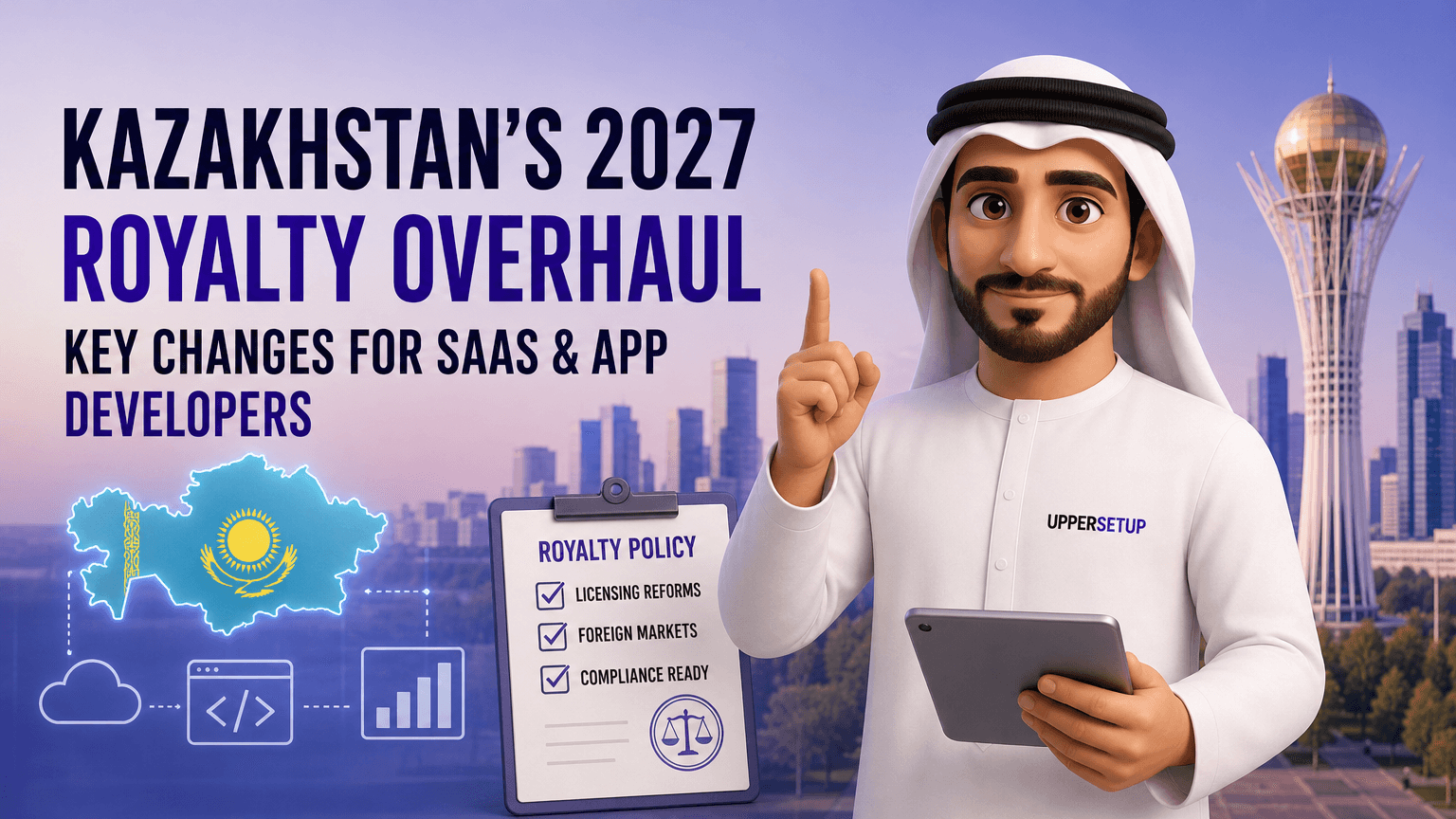
Kazakhstan’s 2027 Royalty Licensing Overhaul: What SaaS and App Developers Must Know About Licensing to Foreign Markets
Short Summary and Key Warning
Kazakhstan has introduced significant changes to outbound royalty licensing rules, directly affecting SaaS providers and app developers licensing intellectual property to foreign markets. Starting in 2027, key requirements around taxation, reporting, and transfer pricing have shifted, prompting a need for compliance reshaping and contract review for all digital businesses operating from or through Kazakhstan.
Alert: Non-compliance with the 2027 outbound royalty licensing regime can result in double taxation, denied tax treaty benefits, and administrative penalties (up to KZT 7,000,000 for willful misreporting; confirm updated rates before decision-making).
Regulatory Framework: Outbound Royalties and IP Licensing in Kazakhstan
The current outbound royalty licensing regime in Kazakhstan is regulated primarily by the Tax Code of the Republic of Kazakhstan (Tax Code No. 120-VI 2017), last substantially amended by Law No. 420-VII dated 24 December 2025 (effective from 1 January 2027 for outbound royalties). The general regulatory authorities are the State Revenue Committee of the Ministry of Finance and the National Intellectual Property Institute.
These amendments target foreign licensing transactions by residents (including SaaS and mobile application IP), changing withholding tax mechanisms, documentation, and beneficiary eligibility.
What Exactly Changed in 2027? Key Differences to Previous Rules
Key changes effective from 2027 for outbound royalty licensing transactions include:
- Withholding tax on outbound royalties has shifted to a benefit-based model, emphasizing the actual recipient and economic substance.
- Expanded criteria for beneficial ownership, requiring additional due diligence when licensing to affiliated foreign companies or through digital platforms.
- Mandatory reporting and supporting documents are now more stringent for cross-border licensing of SaaS and apps.
- Greater scrutiny and stricter transfer pricing controls for intra-group and platform-based licensing.
| Parameter | Pre-2027 Regime | 2027 Regime |
|---|---|---|
| Withholding Tax Approach | Formal resident-based | Beneficial owner (substance focus) |
| Documentation Required | Limited, often contractual basis | Extended, incl. actual payment/destination |
| Transfer Pricing | Light requirement for SMEs | Full OECD-type TP for all IP transactions |
| Applicable Double Tax Treaties | Treaty residency certificate sufficient | Beneficial owner proof required |
| Penalties for Non-compliance | Moderate (up to KZT 2,000,000) | High (up to KZT 7,000,000; verify rate) |
What Qualifies as a Royalty Under the Kazakhstan Tax Code?
Royalty for Kazakh tax purposes covers payments for the use or right to use IP—software code, SaaS, app functionalities, patents, design, or trademarks. Since 2027 amendments, 'royalty' explicitly includes cloud-delivered and downloadable SaaS, in-app purchase-dependent IP, and the provision of software updates.
Typical examples affected include: - Subscription fees for SaaS platforms licensed to foreign legal entities - Licensing mobile app code for distribution abroad - Use of Kazakh-originating middleware/modules by non-resident group members
How Are SaaS and App Licensing Deals Affected?
All outbound licensing agreements involving Kazakh entities (even if the user or payor is a special-purpose vehicle abroad) must now strictly comply with the revised regime. Contracts with foreign marketplaces, affiliate platforms, or corporate group distributors must clearly separate service fees and IP royalties for tax purposes. Failure to do so triggers assessment on gross receipts.
Updated Withholding Tax Rates For Outbound Royalties
The default withholding tax rate on outbound royalties under the 2027 regime is 15% unless a valid tax treaty reduces it or the payment qualifies for exemption. For IP payments routed through entities in treaty jurisdictions, the actual beneficial owner must be proven.
The statutory withholding rate for outbound royalties is 15% (as of 21 November 2026; always verify current rates).
Withholding is now due at the earlier of payment or accrual, subject to new documentation requirements.
Treaty Eligibility and Beneficial Ownership: What’s New?
Kazakhstan applies its Double Tax Agreements (DTAs) (46 signed, as of 2026, verify latest list) to reduce withholding on royalties. Starting 2027, the mere provision of a residency certificate by the foreign licensor is insufficient; proof of beneficial ownership—economic, not merely legal—is required.
For SaaS and app developers structuring international licensing via subsidiary or holding companies, this means: - Holding companies must pass both the legal and beneficial owner tests to enjoy reduced DTA rates. - Back-to-back or pass-through arrangements risk denial of treaty relief if substance and economic presence are lacking.
Documentation and Reporting: New Compliance Requirements
Kazakh tax authorities now require licensing entities to present comprehensive contracts, payment trails, and documentation proving the foreign recipient’s beneficial ownership and economic substance (such as staff, premises, decision-making in the licensing entity’s jurisdiction).
- Payments routed via digital marketplaces are in scope if the IP originated in Kazakhstan.
- Annual reporting of all outbound royalty transactions, with supporting transfer pricing analysis, is mandatory for all taxpayers (not only large groups).
- Material penalties are imposed for lack of documentation, even absent tax evasion intent.
Transfer Pricing and Arm's Length Principle in Licensing Deals
From 2027, all outbound royalty/license fee arrangements must be consistent with the arm’s length standard, regardless of entity size or group status.
- OECD-aligned transfer pricing documentation is now required for both direct and indirect licensing transactions.
- Related-party and platform-based IP transfers must be benchmarked and justified with market comparables.
- Advance pricing agreements (APAs) may be available, but processes are stricter and longer, with significant up-front detail demanded.
VAT and Cross-Border Electronic Services
Kazakhstan imposes VAT on e-services rendered abroad (since Tax Code updates in 2020s), including SaaS and app-based subscriptions to non-resident customers.
- As of 2026, the VAT registration threshold for e-service providers is KZT 30,000,000 per annum, but always confirm the applicable figure.
- Outbound royalty/licensing is generally not subject to Kazakh VAT, but bundled SaaS-sale-and-license arrangements may trigger obligations if the customer is in Kazakhstan.
Practical Impact on International SaaS Businesses: Scenarios
Consider these operational implications for digital businesses:
- Licensing a Kazakh-developed app to a foreign group company now requires thorough beneficial ownership and TP documentation, or faces full 15% withholding.
- Selling SaaS via an EU-based platform does not automatically qualify for DTA relief unless the buyer/platform demonstrates substance in their EU jurisdiction.
- Startups must segregate royalty and service elements in SaaS contracts for correct tax treatment.
| Scenario | Withholding Rate (unless DTA applies) | Main Documentation Required |
|---|---|---|
| SaaS direct license to EU entity | 15% (potential DTA reduction) | Contract, BO docs, TP file |
| App code outbound via Singapore platform | 15% (unless DTA, BO proven) | Platform agreement, BO proof |
| Group IP transfer, holding in Cyprus | 15% (verify Cyprus DTA, BO needed) | Group docs, substance test |
Step-By-Step: What SaaS Developers Should Do Pre-2027
- Review All Outbound Licensing Agreements: Identify contracts with foreign parties, check payment flows, and clarify IP ownership.
- Assess Beneficial Ownership: Trace payment recipients, prepare to prove economic substance abroad (staff, operations).
- Implement TP Documentation: Prepare comparables, ensure intercompany licensing and royalty rates meet arm’s length requirements.
- Segregate Service vs. Royalty Fees: In SaaS contracts, split payments clearly between license/IP and ancillary services.
- Prepare Expanded Reporting Packages: Compile contracts, transfer pricing studies, beneficial ownership documentation, and payment records for all 2027 transactions.
- Monitor VAT and E-Service Rules: Confirm customer locations and VAT obligations, especially for cross-border SaaS.
- Train Finance/Legal Teams: Regularly update internal stakeholders on compliance changes and documentation standards.
Typical Mistakes and Their Risks
-
Assuming a DTA Always Applies Based on Residency Certificate - Reliance solely on a DTA and residency certificate, without beneficial ownership proof, will be rejected post-2027. Penalty: Loss of reduced rate benefit.
-
Bundling Service and Royalty Streams in Contracts - Not clearly distinguishing between SaaS service and IP royalty leads to the entire payment being taxed at the higher royalty rate.
-
Ignoring Transfer Pricing in Small/Mid-sized Entities - OECD-style transfer pricing now applies to all; preparing only minimal documentation risks audit adjustments and penalties.
-
Delaying Documentation Until After Payment - Withholding is due at accrual/payment; missing/incomplete paperwork at that point—regardless of subsequent supplementation—triggers automatic higher rate and penalties.
Who Benefits and Who Is Affected Most by These Changes?
Ideal for: - SaaS companies with clear operational and legal presence in both Kazakhstan and recipient jurisdictions. - App developers with well-documented, arm’s length IP licensing agreements, and robust transfer pricing files.
Not ideal for: - Entities routing royalties through minimal substance platforms or holding companies for DTA relief only. - Companies lacking transparent documentation or using hybrid service/license payment models.
Kazakhstan tech sector firms with direct, substance-based international engagement are best prepared for the 2027 regime.
Frequently Asked Questions (FAQ)
What is the standard withholding tax on outbound royalties from Kazakhstan in 2027?
As of 2027, the standard withholding tax rate is 15%, subject to possible DTA reduction if beneficial ownership is documented.
Does licensing SaaS to a foreign platform require Kazakhstan tax reporting?
Yes, all outbound SaaS royalty or licensing payments—whether direct or via foreign platforms—require full Kazakh tax reporting and supporting documentation.
Is split contracting enough to separate service fees from royalties?
No, the actual substance and arm’s length pricing are required; contracts alone, without economic split, may be challenged by authorities.
Can a holding company in a DTA jurisdiction access reduced rates automatically?
No, from 2027, proof of beneficial ownership and genuine substance in the holding jurisdiction is required to access treaty benefits.
Are intra-group SaaS royalty payments subject to transfer pricing in Kazakhstan?
Yes, full transfer pricing documentation is required for all related-party IP/license transactions, regardless of group size.
What are the main penalties for non-compliance after 2027?
Fines for willful misreporting or inadequate documentation can reach up to KZT 7,000,000, plus possible loss of treaty benefits and interest on unpaid tax.
What to Remember: Essential Points for SaaS and App Developers
Kazakhstan’s 2027 outbound royalty licensing regime requires not only up-to-date contracts, but also comprehensive proof of beneficial ownership and economic substance for DTA purposes, as well as OECD-aligned transfer pricing on all IP payments. Every payment for outbound licensing—whether via platforms, direct sales, or through group structures—demands new levels of documentation and timely withholding. Failure to adapt exposes digital businesses to elevated tax, DTA denial, and reputational risk.
Conclusion
As of 21 November 2026, companies engaged in outbound IP licensing from Kazakhstan—especially SaaS and app developers—face a substantially revised compliance landscape from 1 January 2027. The new regime imposes a 15% royalty withholding by default, unless a valid DTA and proof of beneficial ownership/intermediary substance are available. New documentation and transfer pricing standards apply universally, backed by higher penalties for non-compliance. Every outbound SaaS or app licensing deal should be reviewed for compliance, documentation, and withholding tax risks ahead of the 2027 effective date.
For expert support navigating Kazakhstan’s new outbound royalty regime—company setup, visa support, tax optimization, and banking—visit UPPERSETUP.
References
- Tax Code of the Republic of Kazakhstan No. 120-VI dated 25 December 2017, with amendments from Law No. 420-VII dated 24 December 2025 (effective from 1 January 2027)
- Double Tax Agreements as published by Ministry of Finance, Republic of Kazakhstan (verify most recent list for your country)
- Guidance and public rulings from State Revenue Committee, 2026
- OECD Transfer Pricing Guidelines (reference as international standard)
Disclaimer
This material is for informational purposes only and does not constitute legal, tax, financial, investment, or consulting advice. Individual circumstances require tailored professional advice considering specific facts, jurisdiction, company status, and the latest regulatory requirements.
All services on the platform
Everything you need to start and run a business - in one place
- 2–10 days
Company Setup
Kazakhstan company with a complete set of incorporation documents
Start - Monthly
Accounting Services
Accounting and Tax Compliance, Reporting, and Support in Accordance with Kazakhstan Requirements
- 4–8 weeks
Immigration Services
Visas, Work Permits
- 7–30 days
Banking Services
Corporate Bank Accounts in Kazakhstan and Payment Services
- Custom timeline
Permits and Licenses
Business Licenses and Activity Permits
- Custom timeline
Legal Services
Corporate Documents, Contracts, Compliance, Licensing, and Company Structure Changes


