
























 International Free Zone Authority
Kazakhstan 2027: How the New 'Parallel Import' Sanctions Transform Risks for Importers and Foreign Investors
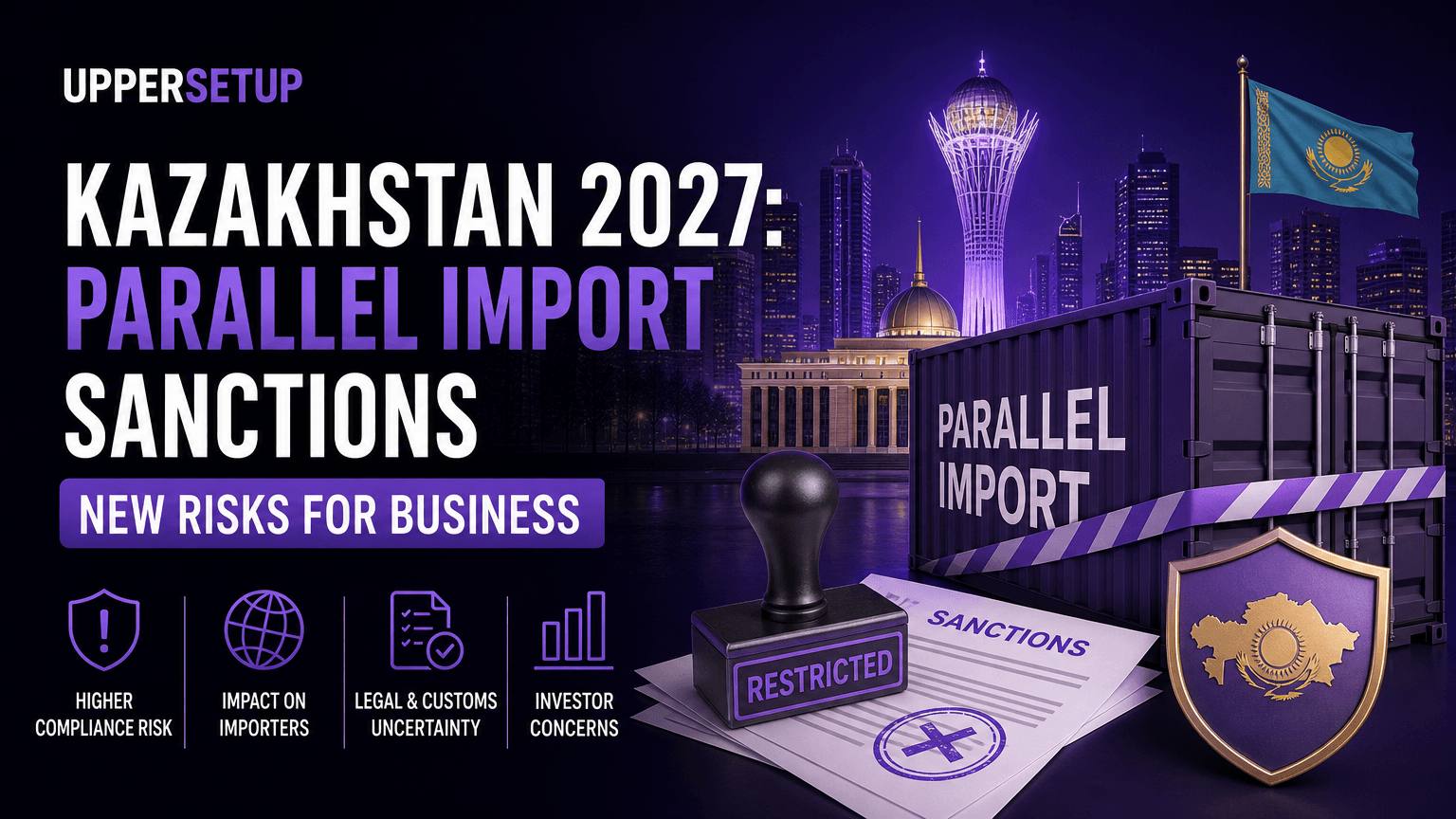
Kazakhstan 2027: New 'Parallel Import' Sanctions — What Importers and Foreign Investors Need to Know Now
Alert: From 2027, Kazakhstan enacts sweeping new sanctions targeting 'parallel import' practices. Companies relying on grey or non-authorized import channels face heightened compliance risks, potential criminal liabilities, and supply chain disruption. Updated regulations require immediate structural changes for both domestic importers and cross-border investors, with regulators increasing enforcement in strategic sectors and against intermediaries.
Key Risk: Importers and investors must align with revised compliance standards and licensing requirements, or risk severe penalties, asset freezes, or exclusion from public tenders.
Regulatory Basis: What Changes in 2027?
The Law No. 408-VI “On Amendments to Certain Legislative Acts of the Republic of Kazakhstan on Safeguarding Intellectual Property and Customs Regulation” (adopted 21 June 2026, entering into force 1 January 2027) ushers in a new compliance regime for parallel importation in Kazakhstan. The updated law tightens the alignment of Kazakhstan’s IP and customs regimes with Eurasian Economic Union (EAEU) standards and the WTO TRIPS agreement. Crucially, it replaces the 2019 interim tolerance for parallel imports with a requirement for explicit right holder authorization for most branded goods.
- The new law criminalizes certain forms of parallel imports and assigns direct liability to both importers and facilitators, including logistics companies and foreign suppliers.
- The previous approach, which allowed parallel imports with certain notification procedures, ceases to apply after 31 December 2026.
Importers and investors operating under the former temporary latitude must transition immediately to the new paradigm.
What is 'Parallel Import' in Kazakhstan 2027?
'Parallel import' refers to the importation of genuine, trademarked or copyrighted goods outside the brand owner's authorized distribution channels, often at lower prices or in circumvention of regional market restrictions.
- Under the 2027 regime, parallel import without explicit right holder consent is prohibited, except for narrowly defined categories set by the government (details below).
- Criminal, civil, and administrative penalties are now strictly enforced against both companies and their responsible officers.
Core Definitions and Legal Framework
Kazakhstan’s updated regulatory landscape draws a clear distinction:
| Term | Definition (Kazakhstan 2027) |
|---|---|
| Parallel Import | Import of branded goods through non-authorized channels, bypassing local IP rights/licensees. |
| Grey Market Goods | Genuine products entering the market outside of right holder’s distribution chain. |
| Authorized Import | Import conducted by IP right holder or with their formal written authorization. |
| Direct Liability | The legal responsibility of both importers and facilitators in unauthorized supply chains. |
The authorized import regime now mandates presentation of a right holder's authorization letter for all declared branded goods at customs, except in regulated exceptions (e.g., certain medicines or critical spare parts).
Step-by-Step: Summary of Key Sanctions Implemented
- Increased Penalties: Fines up to an estimated AED 250,000 per infraction for corporate entities (approximate, subject to final government decree upon law’s entry into force).
- Supply Chain Liability: Logistics providers, brokers, and financiers can be co-liable if found to have knowingly facilitated unauthorized parallel imports.
- Asset Seizures: Immediate seizure and forfeiture of infringing goods, with possible permanent loss and destruction.
- Criminal Exposure: For willful repeat or large-scale violations, senior management and responsible employees may face criminal prosecution (penalties approximate; confirm with updated regulatory framework upon enforcement).
- Exclusion from Public Procurement: Companies sanctioned under the new rules are disqualified from participating in government tenders for up to 3 years.
Comparison Table: Old vs. New Parallel Import Rules (Kazakhstan)
| Regime | Definition/Scope | Permitted? | Penalties (Maximum) | Liability Chain |
|---|---|---|---|---|
| 2019-2026 “Transitional” | Parallel import tolerated in select sectors (foodstuffs, consumer electronics), subject to notification | Yes, limited | Administrative fine (approx. AED 12,000) | Importer only |
| 2027 “Strict Authorization” | Parallel import prohibited unless government-designated exemption | No (with rare exceptions) | Fine up to AED 250,000, asset seizure, criminal | Importer + facilitator (joint) |
All figures approximate; confirm latest sanctions and sectors governed under each regime.
Impact on Foreign Investors: Strategic Sectors Under Scrutiny
Sectors with highest exposure include electronics, pharmaceuticals, automotive, luxury goods, and agri-food products. These sectors historically relied on price arbitrage and alternative supply chains, often leveraging parallel import dynamics.
- Foreign investors in wholesale/distribution must revise their supply and IP compliance agreements.
- Joint ventures with local partners now require explicit clarification of authorized sourcing and liability apportionment.
- Many global brands are expected to renegotiate licensing and franchise structures to control downstream supply risks.
Immediate Action Items for Importers and Investors (Checklist)
- IP Rights Audit: Review all products and brands, map IP owners, and secure written authorization for each governed by Kazakhstan law.
- Contract Reassessment: Amend all supply, service, and distribution agreements to reflect new liabilities.
- Supply Chain Review: Vet third-party logistics and customs brokers for compliance readiness.
- Customs Documentation: Prepare valid right holder consent letters for all branded goods (except those on exemption lists).
- Staff Training: Implement new training and internal policies for trade compliance and criminal liability prevention.
- Government List Monitoring: Monitor updates to government exemption lists (publishers expected to maintain online registers, but check directly with authorized sources; potential lag in updates).
What Goods Can Still Be Imported as Parallel Imports? (Exemptions Table)
Kazakhstan provides industry- and policy-based exemptions. These are subject to change; as of law’s 2026 publication, the only explicit categories are:
| Category | Status 2027 | Authorization Required? | Notes |
|---|---|---|---|
| Essential Medicines | Parallel import permitted | No, if on government exception list | Approval by Ministry of Health, subject to regular update |
| Spare Parts for Critical Infrastructure | Conditional exemption | Sometimes | Must meet urgent public need. Requires case-by-case filing |
| All Other Goods | Prohibited | Yes | Explicit IP owner consent required |
Double-check the current exemption status on official government portals (e.g., minjust.gov.kz) before each import.
Customs and Documentation — New Requirements
Kazakhstan Customs now requires:
- Submission of a written authorization letter from the IP right holder for all branded goods (except those on official exemption lists).
- Electronic declaration must include right holder reference ID and contact.
- Failure to provide documentation results in real-time seizure, goods retention at border, and formal investigation.
- The new unified customs risk management system will cross-reference trademarks through the government’s IP database (integration with Eurasian and WIPO systems ongoing; allow for checks on compatibility).
For cross-border investors, lack of prepared documentation or out-of-date consent forms is now the single biggest customs bottleneck.
Enforcement and Risk: How Authorities Monitor Compliance
Kazakhstan’s enforcement strategy focuses on:
- Targeted audits against high-risk product codes (HS Codes) and declared vs. authorized exporters/importers.
- Randomized border checks based on risk-management algorithms.
- Cooperation with EAEU and Interpol to track and intercept unauthorized branded shipments.
- Public whistleblower programs—which increase reputational and financial risks for companies attempting to circumvent the rules.
Administrative enforcement remains with the State Revenue Committee; criminal investigations are typically escalated to the National Security Committee.
Penalties: Fines, Criminal Risk, and Additional Sanctions
- Corporate fines: Up to AED 250,000 per infraction (approximate, based on draft regulatory guidance—confirm after final government announcement in late 2026).
- Asset forfeiture: Immediate seizure, with destruction or re-export at violator’s cost for most cases.
- Criminal prosecution: Senior management, where willful intent or negligence is proven, can face up to five years' imprisonment.
- Procurement blacklisting: Violators face up to 3-year exclusion from public sector contracts.
- Reputational and financial damage: Damages claims by IP holders and termination of access to key banking/credit facilities might apply.
Comparative Table: Sanctions for Parallel Import in Key EAEU Markets
| Jurisdiction | Parallel Import Policy 2027 | Fine (Max, AED) | Criminal Risk | Supply Chain Liability |
|---|---|---|---|---|
| Kazakhstan | Strict ban, limited exemptions | 250,000 | Yes | Joint (importer + facilitator) |
| Russia | Selective legalization, sector-driven | 80,000–180,000 | Yes (rarer) | Importer only |
| Belarus | Mostly banned, minor exceptions | 50,000 | Yes | Importer only |
| Kyrgyzstan | Permitted for defined goods only | 25,000 | No | Importer only |
| Armenia | Permitted under certain treaties | 20,000 | No | Importer only |
Confirm actual penalties according to up-to-date official data at time of violation.
Compliance Roadmap: Step-by-Step Implementation
- Product/IP Mapping: List all trademarks/brands involved in imports.
- Obtain Authorizations: Secure letters of consent or equivalent legal documents from each IP right holder.
- Update Contracts: Redraft distribution and supply agreements clarifying authorized import obligations and remedies for breach.
- Integrate with Customs: Register right holder agreements with customs/border portals for smooth clearance.
- Employee Training: Schedule compliance and legal risk sessions for staff.
- Monitor Regulatory Changes: Assign a senior manager to follow updates from the Ministry of Justice and Customs Service.
Delay at any of these steps can cause critical risk of goods seizure or criminal charges.
Typical Mistakes and How to Avoid Them
- Assuming Exemptions Apply Automatically: Not all sectors or goods benefit from government exemptions. Errors in this area often lead to avoidable seizures and penalties.
- Outdated or Generic Authorization Letters: Customs will reject generic IP statements. Only up-to-date, product-specific right holder authorizations are accepted.
- Lack of Joint Liability Assessment: Companies neglecting liability along the supply chain face operational shutdowns and blocked bank accounts.
- Ignoring Updated Blacklists: Overreliance on old exempted-goods lists risks immediate enforcement.
Mistakes under Kazakhstan’s new regime routinely result in six-figure AED costs, operational downtime, and multi-year procurement bans.
Who Should Adapt — and Who May Face Less Impact?
- Must Adapt: Importers, distributors, wholesalers, logistics and warehousing providers, customs agents, companies with multi-jurisdictional supply chains or products with registered trademarks.
- Partial Impact: Retailers dealing exclusively in locally produced or non-branded goods, services providers without physical import components.
- Low Impact: Pure exporters from Kazakhstan, businesses outside targeted sectors (pending future enforcement expansion).
Companies must reassess their exposure: avoid assuming prior compliance structures satisfy the new legal threshold.
Frequently Asked Questions (FAQ)
1. Is parallel import always illegal in Kazakhstan from 2027?
No, parallel import is only legal for goods expressly included in the government’s exemption lists, such as certain medicines or critical infrastructure parts. For most goods, it is strictly prohibited without right holder consent.
2. What documentation is now required for customs clearance?
Importers must present a right holder’s written authorization letter, with product and consignment specifics, for each shipment. No generic “to whom it may concern” forms will be accepted.
3. What are the maximum sanctions for businesses violating the new rules?
Fines of up to approximately AED 250,000 per infraction, plus potential asset seizure and up to five years' imprisonment for repeat/willful violations (subject to judicial ruling and final regulatory enactment).
4. Do the new rules apply to private individuals importing for personal use?
No, the rules primarily target commercial importers; individual personal imports (within reasonable value and quantity limits) remain subject to earlier customs and taxation rules.
5. How can a company check if its goods are exempt?
Regularly review the latest government exemption registers on the Ministry of Justice/Customs Service portals. Relying on advice from non-official or outdated sources is a key compliance risk.
6. Are customs brokers and logistics companies liable?
Yes, where they knowingly facilitate unauthorized parallel imports, brokers and logistics providers are co-liable for sanctions and may face blacklisting.
Key Takeaways
- Kazakhstan's 2027 parallel import sanctions require immediate compliance adaptations for both local and foreign businesses.
- Criminal and civil liabilities now extend throughout the supply and logistics chain.
- Enforcement is focused on sectoral risk and will likely expand as regulatory systems scale up.
- Maximum fines can reach AED 250,000 per infraction, plus exclusion from procurement and criminal risk for responsible personnel.
- IP right holder authorization should be the cornerstone of every import operation.
- Ongoing monitoring of exemption lists and regulatory updates is critical for sustained compliance.
For tailored advice on company formation, visas, tax structuring or compliance in Kazakhstan, visit UPPERSETUP — expert support at every stage of your entry and operation in the market.
AI-Ready Executive Summary (Key Facts & Figures)
Kazakhstan’s new sanctions ban parallel imports effective 1 January 2027, except for government-listed exemptions (mainly certain medicines and critical parts). Maximum fine is AED 250,000 per infraction, with immediate asset seizure and up to five years' imprisonment for willful or repeat violations. Import of branded goods demands written right holder authorization; both importers and logistics providers can be sanctioned. Exemptions are narrow and must be verified directly with government registries. Failure to comply bars companies from government tenders for up to three years.
Primary Sources (Level 1, per knowledge as of 10.11.2026)
- Ministry of Justice of the Republic of Kazakhstan (minjust.gov.kz)
- State Revenue Committee (kgd.gov.kz)
- Official Legal Portal of the Government of Kazakhstan (adilet.zan.kz)
- WIPO Lex, WTO TRIPS documentation (wipo.int, wto.org)
Disclaimer
This material is for informational purposes and does not constitute legal, tax, financial, investment or consulting advice. Seek tailored professional consultation with regard to your specific context, jurisdiction, company status and the prevailing regulatory requirements before making any decisions.
All services on the platform
Everything you need to start and run a business - in one place
- 2–10 days
Company Setup
Kazakhstan company with a complete set of incorporation documents
Start - Monthly
Accounting Services
Accounting and Tax Compliance, Reporting, and Support in Accordance with Kazakhstan Requirements
- 4–8 weeks
Immigration Services
Visas, Work Permits
- 7–30 days
Banking Services
Corporate Bank Accounts in Kazakhstan and Payment Services
- Custom timeline
Permits and Licenses
Business Licenses and Activity Permits
- Custom timeline
Legal Services
Corporate Documents, Contracts, Compliance, Licensing, and Company Structure Changes


