




















 International Free Zone Authority
Why Banks Reject UAE Companies in 2026: The Compliance Mistakes Entrepreneurs Don’t See

1. Company Registration in the UAE and a Bank Account Are Two Different Processes
In 2026, company formation UAE has become a relatively straightforward administrative procedure.
Free Zones and Mainland jurisdictions offer standardized licensing packages, digital registration processes, and predictable timelines for establishing a legal entity. For many entrepreneurs, registering a company in Dubai may take only a few days once documentation is complete.
However, the process of opening a business bank account UAE operates under a fundamentally different logic.
For a regulator or Free Zone authority, registration confirms that a company legally exists.
For a bank, the key question is entirely different:
Does this company represent an acceptable risk within the financial system?
Banks do not simply verify corporate documents. They assess the financial, operational, and reputational risk associated with the company and its owners.
This means that:
-
A trade license does not guarantee banking access.
-
A registered company does not automatically qualify for a corporate account.
-
The structure behind the business is analyzed more deeply than during company formation.
As a result, many entrepreneurs discover that the most difficult step in business setup Dubai is not incorporation but banking approval.
2. Risk-Based Approach: How Banks Actually Assess Companies
Banks in the UAE operate under a risk-based approach, which forms the backbone of global AML and KYC compliance frameworks.
Under this model, financial institutions do not apply identical procedures to every client. Instead, they evaluate each company based on its risk profile.
When assessing an application for a corporate bank account UAE, banks analyze several layers of information.
These include:
-
the ownership structure and UBO UAE disclosure
-
jurisdictions connected to shareholders
-
the industry sector and regulatory exposure
-
expected transaction volumes
-
geographic profile of counterparties
-
the source of funds and capital origin
The bank is not merely evaluating a corporate entity.
It is evaluating a network of financial relationships, business flows, and potential compliance risks.
For this reason, even companies that are fully compliant with company registration rules may still fail the banking assessment.
3. Structures Banks Automatically Classify as Higher Risk
Certain types of corporate structures trigger enhanced scrutiny during banking reviews.
These structures are not necessarily illegal. However, they increase compliance complexity and therefore raise the bank’s internal risk rating.
Examples of such structures include:
-
multi-layered ownership chains across several jurisdictions
-
nominee directors without clear economic roles
-
companies with no physical presence in the UAE
-
ownership structures involving offshore jurisdictions
-
business models without transparent transaction logic
Banks must demonstrate to regulators that they fully understand the client’s ownership and operational model.
If the structure appears unnecessarily complex or opaque, additional verification will be required. In many cases this leads to delayed approvals or rejection.
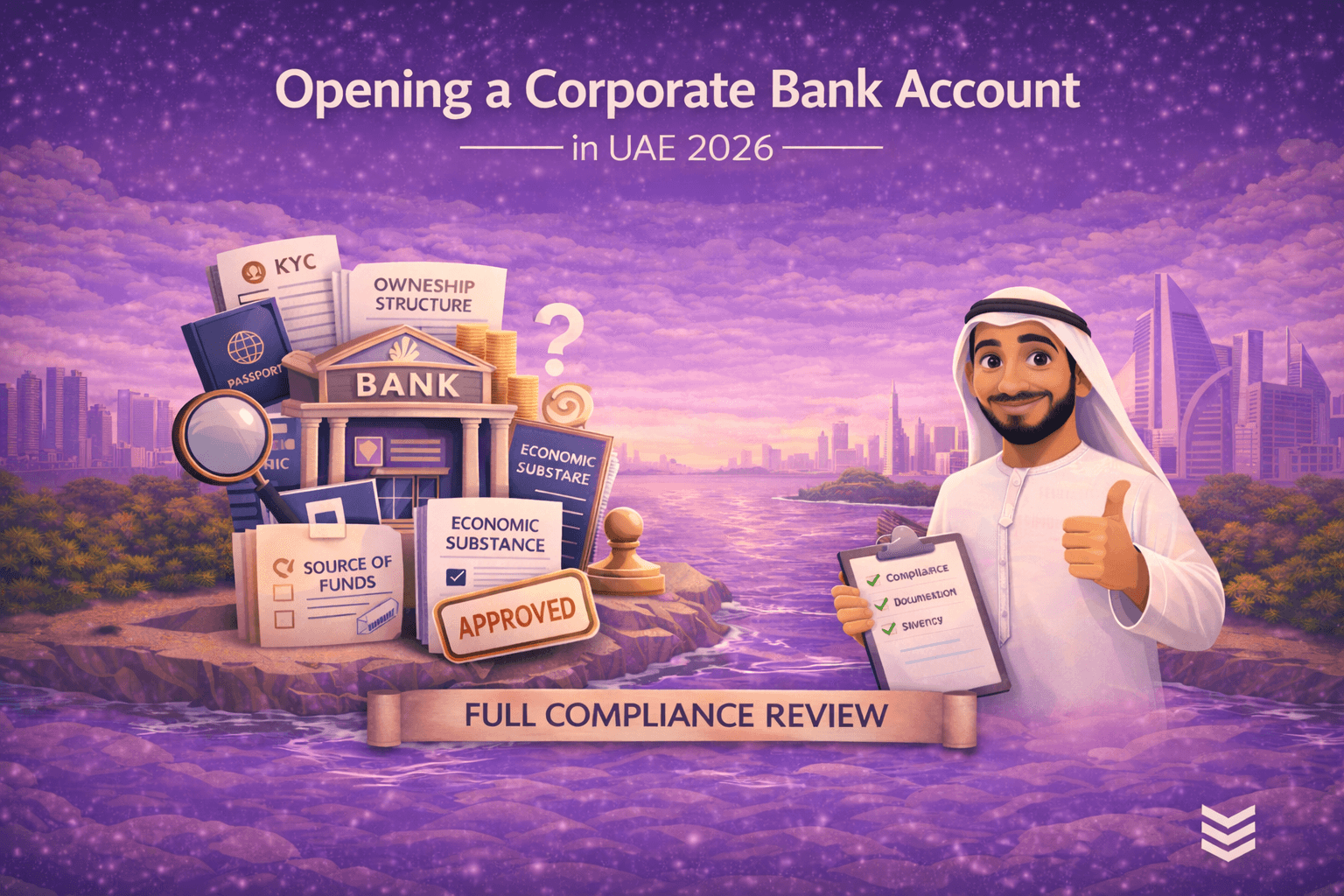
4. Mistake No. 1: A Company Without Economic Substance
One of the most common reasons banks decline applications is the absence of economic substance.
Banks expect a company to demonstrate a degree of operational reality. This includes evidence that the business actually functions as described.
Typical indicators of substance include:
-
a physical office or operational workspace
-
management presence within the UAE
-
active commercial relationships
-
signed contracts with suppliers or customers
A company that exists solely on paper but cannot demonstrate real commercial activity may be viewed as a shell structure.
From an AML perspective, shell companies present higher risk because their transaction flows are difficult to interpret.
5. Mistake No. 2: An Unclear Business Model
Banks increasingly evaluate the economic logic of the business itself, not just the legal documentation.
During account opening, banks typically request:
-
a description of the company’s business model
-
sample contracts or draft agreements
-
information about key counterparties
-
projected turnover and payment flows
-
expected transaction volumes and currencies
If a company cannot clearly explain:
-
who its customers are
-
what service or product it provides
-
how revenue is generated
the bank may classify the business model as operationally unclear.
In the context of AML compliance, an unclear business model creates difficulties in monitoring transactions, which increases risk.
6. Mistake No. 3: Mismatch Between Documents and Real Control
Another major red flag appears when there is inconsistency between corporate documents and actual control of the business.
Banks compare several elements during compliance review:
-
the registered UBO
-
the appointed directors
-
the individual communicating with the bank
-
the person controlling transactions
If these roles are held by different individuals without a clear explanation, the bank may question who truly controls the company.
Such inconsistencies can trigger additional due diligence procedures and may ultimately lead to rejection.
7. Corporate Tax Has Strengthened Banking Controls
The introduction of Corporate Tax UAE significantly increased the importance of transparency in corporate structures.
Banks now consider not only AML risks but also the tax architecture of a company.
Financial institutions may analyze:
-
relationships with related parties
-
intra-group payments
-
management fees
-
royalty payments
-
transfer pricing arrangements
If the payment structure between related companies does not follow the arm’s length principle, banks may view the transaction pattern as potentially problematic.
This is particularly relevant for groups operating across multiple jurisdictions.
8. Hidden Costs Entrepreneurs Don’t Calculate
Entrepreneurs often underestimate the financial impact of banking delays or rejection.
In practice, failure to open a bank account quickly may lead to:
-
months of operational delays
-
restructuring of ownership or governance
-
legal and advisory expenses
-
postponed contracts and lost opportunities
In some cases, the cost of restructuring a company after rejection exceeds the cost of the original company formation.
These hidden costs often appear months after incorporation, when the business expects to begin operating.
9. What Banks Consider a “Bank-Ready Structure”
Companies that successfully open accounts more quickly typically share several characteristics.
They have:
-
a transparent ownership structure
-
a clearly defined business model
-
documented economic substance
-
structured contractual relationships
-
consistency between corporate documents and management control
Such companies present a lower compliance risk for the financial system.
As a result, banks are more comfortable onboarding them.
10. Strategic Conclusion for 2026
In 2026, establishing a company in the UAE is relatively easy.
Obtaining a bank account, however, is a structural compliance test.
Banks evaluate:
-
ownership transparency
-
economic substance
-
transaction logic
-
corporate governance
-
tax architecture
Therefore, business setup Dubai should not be viewed simply as a licensing exercise.
It is the process of designing a corporate structure capable of passing:
-
AML monitoring
-
banking compliance reviews
-
corporate tax scrutiny
-
investment due diligence.
A company license is an administrative event.
A sustainable corporate structure is a long-term strategy.
Read more on the topic
All services on the platform
Everything you need to start and run a business - in one place
- 3–5 days
Company Setup
Mainland or Free Zone company with a complete set of incorporation documents
Start - Monthly
Accounting Services
Financial accounting and reporting in accordance with UAE requirements
Start - 1–2 weeks
Visa Services
Residence visas for shareholders, employees and family members
Start - 7–30 days
Banking Services
Corporate Bank Accounts in the UAE and Payment Services
Start - Custom timeline
Legal Services
Contracts, corporate amendments and legal support
Start


