



















































 International Free Zone Authority
I Registered a Company in Dubai — and the Bank Refused Me Three Times. Here's What Nobody Tells You Before You Open a Corporate Account
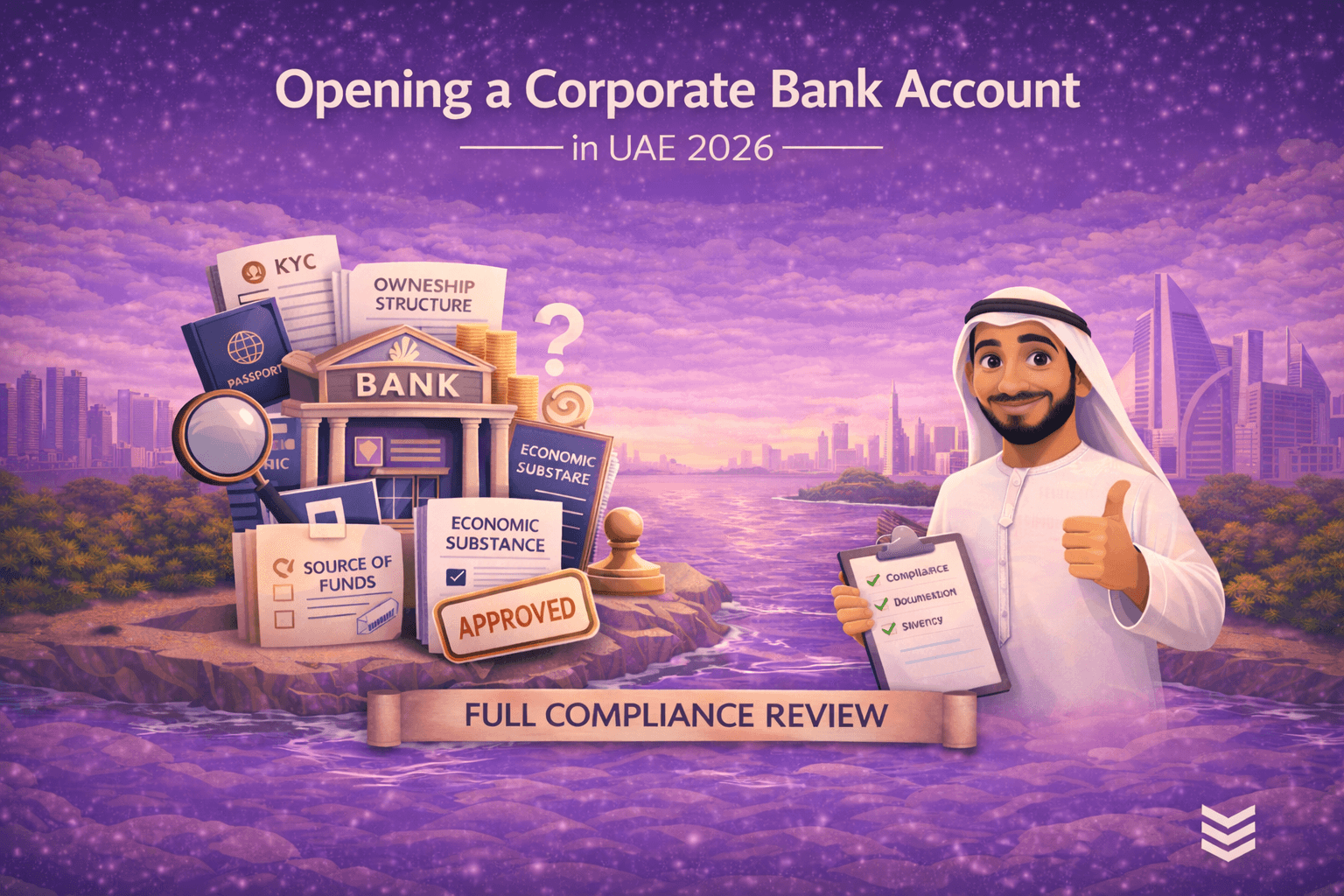
Introduction. Company Is Ready — but the Bank Says No
The licence is issued. The office is rented. The visa is stamped. The incorporation documents have been notarised, translated, and apostilled. You did everything right — and you are still sitting across from a bank manager hearing: "Your application has not been approved."
Then again. And once more.
These are not isolated cases. In 2026, opening a corporate bank account in the UAE has become the most unpredictable and painful stage of launching a business. Consulting practices working with corporate bank submissions in the UAE report that between 30 and 50 percent of initial applications from small and medium-sized businesses are refused or placed under extended additional review.
The reason is not that banks are hostile to entrepreneurs. The reason is that over the past three years the UAE banking system has undergone fundamental regulatory transformation that most company formation agencies do not disclose to their clients — because their engagement ends at licence issuance.
This article covers what happens after.
Part I. Why 2026 Is a Turning Point for Banking Compliance in the UAE
To understand the logic behind bank refusals, you need to understand what the UAE financial system has been through in the past four years.
1.1. The FATF Grey List and Its Consequences
In March 2022, the Financial Action Task Force (FATF) placed the UAE on its list of "Jurisdictions under Increased Monitoring" — the so-called grey list. The reason was "strategic deficiencies" in the country's anti-money laundering and counter-terrorism financing framework, identified during the 2020 Mutual Evaluation.
This triggered a comprehensive reform of the entire banking and regulatory architecture of the country. On 23 February 2024, the UAE was removed from the FATF grey list after fully implementing the recommendations of the action plan. However, the journey from grey-listing to removal produced a fundamentally more rigorous compliance culture that is not going anywhere.
UAE banks today operate under the standards built to achieve grey-list removal and to maintain the status of a trusted jurisdiction. They cannot and will not revert to prior standards.
1.2. The New UAE Central Bank Law (Federal Decree-Law No. 6 of 2025)
On 8 September 2025, Federal Decree-Law No. 6 of 2025 Regarding the Central Bank, Regulation of Financial Institutions and Activities, and Insurance Business was issued. The law came into effect on 16 September 2025 and replaced the previous Federal Decree-Law No. 14 of 2018.
Key changes with direct relevance to corporate account opening:
— The regulation of banks, payment service providers, and insurers was consolidated under a single legislative framework, substantially increasing inter-agency data sharing;
— New licensing requirements were introduced for technology service providers, including fintech;
— Penalties and enforcement mechanisms for financial institutions were significantly strengthened.
The transition period for compliance with the new law is one year from its effective date — until 16 September 2026. This is precisely why banks are currently in a period of active internal restructuring and apply enhanced scrutiny when opening new accounts.
1.3. The New Anti-Money Laundering Law (Federal Decree-Law No. 10 of 2025)
On 30 September 2025, Federal Decree-Law No. 10 of 2025 on Combating Money Laundering, the Financing of Terrorism, and the Financing of Arms Proliferation was published in the UAE Official Gazette, entering into force on 14 October 2025. The law fully replaced Federal Decree-Law No. 20 of 2018 and represents the most comprehensive reform of anti-money laundering legislation in the country's history.
The operational basis of the new law is Cabinet Resolution No. 134 of 2025, which establishes detailed procedural requirements for all regulated entities.
Principal innovations:
— Liability now attaches not only when there is actual knowledge of the illicit origin of funds, but also when an organisation should have known based on available indicators. This fundamentally alters the standard of "reasonable care";
— Virtual Asset Service Providers (VASPs) are explicitly brought within the perimeter of regulated entities, with requirements at the level of banks;
— The investigative powers of regulators and the Financial Intelligence Unit (FIU) have been expanded;
— Criminal liability has been introduced for violations of beneficial ownership disclosure requirements.
For banks, this means that each account opening application is no longer an administrative procedure — it is an element of a compliance risk management system for which bank employees bear personal responsibility.
1.4. The FATF Mutual Evaluation of June 2026
In June 2026, the UAE is undergoing a Fifth Round FATF Mutual Evaluation. Regulators are actively demonstrating to assessors that legislative reforms have translated into real-world implementation. This means supervisory inspections of banks have become more frequent and more detailed than at any previous point. Banks, in turn, are applying maximum conservatism in decisions on new clients.
In summary: UAE banks in 2026 are operating under simultaneous pressure from three forces — the new Central Bank law, the new AML law, and the active phase of the FATF mutual evaluation. A bank refusal is not a manager's personal decision. It is a systemic consequence of the regulatory environment.
Part II. What the Bank Is Actually Checking: The Anatomy of Corporate KYC in the UAE
Most entrepreneurs assume that the bank needs documents. What the bank actually needs is a coherent story about your business that can be verified and that will withstand an internal compliance audit.
The Know Your Customer (KYC) procedure for corporate clients in the UAE comprises several layers of review.
2.1. Client Identification and Verification (CDD/EDD)
Standard Customer Due Diligence (CDD) includes:
— Verification of the identity of all shareholders holding 25% or more (in some banks, 10% or more);
— Verification of directors and authorised signatories;
— Verification of the corporate ownership structure down to the Ultimate Beneficial Owner (UBO);
— Screening against UN sanctions lists, UAE targeted financial sanctions lists, and FATF high-risk jurisdiction lists. Under Circular No. 3 of 2025, this screening must be conducted both at account opening and on an ongoing real-time basis.
Enhanced Due Diligence (EDD) applies automatically when the following indicators are present:
— Shareholders or directors are nationals or tax residents of jurisdictions on the FATF high-risk lists;
— The company's activity falls into elevated-risk categories: consulting, virtual asset trading, financial services, real estate transactions, precious metals trading;
— The ownership structure includes holding companies or trusts;
— The company is registered in certain free zones with less stringent economic substance requirements.
2.2. Source of Funds and Origin of Capital Analysis
This is the most commonly underestimated element. The bank checks not just documents — it checks logic:
— Where will the first funds come from? This must be documented;
— Does the projected turnover correspond to the declared activity and the company's history?
— If the source is the founder's personal funds, their origin must be substantiated: tax returns, foreign bank statements, asset sale agreements.
A consulting company projecting multi-million turnover in its first year of operation, without any verified contract history, is a red flag. Not because it is illegal, but because it contradicts statistical norms and requires further explanation.
2.3. Assessment of Business Model and Activity Consistency
The bank evaluates whether the declared activities are coherent and credible:
— Does the licensed activity match what is described in the business plan?
— Does the chosen free zone correspond to the declared activity? A trading company in a zone oriented towards media, or a manufacturing company with a virtual address — these are inconsistencies that banks notice immediately;
— Does the company have real counterparties, contracts, or correspondence — anything confirming operational reality?
2.4. Physical Presence Verification
Following the adoption of Economic Substance Regulations and tightened interpretation of the criteria for Qualifying Free Zone Person (QFZP) status for corporate tax exemption purposes, banks also examine the reality of a company's office:
— A flexi-desk is formally acceptable, but triggers additional questions for companies with high projected turnover;
— A virtual address with no confirmed physical presence is a significant risk factor.
Part III. Seven Causes of Rejection That Nobody Warns You About
Cause 1. Mismatch Between the Free Zone and the Business Activity
This is the most frequent and the least obvious cause. The UAE has over 47 free economic zones, each with its own sector specialisation. Banks know this specialisation well.
When an IT company registers in a zone historically oriented towards logistics, or a consulting firm registers in an industrial zone, it signals that the free zone choice may have been driven by price rather than operational needs. This mismatch is not grounds for automatic refusal, but it places the application into enhanced review mode.
Practical advice: when choosing a free zone, ensure that your activity is not merely permitted, but aligns with the zone's positioning. This matters not only for the bank, but also for maintaining QFZP status in the context of corporate tax.
Cause 2. A Vague or Contradictory Business Plan
The bank asks simple questions: who are your clients, where does revenue come from, what is the expected monthly turnover, which countries do you work with.
If the answers are generic, internally inconsistent, or unsupported by specifics — this is an immediate red flag. "International consulting" without specifying markets, clients, or at least indicative contracts is insufficient information to pass a compliance review.
A business plan submitted to a bank is not a marketing document. It is a compliance instrument that must clearly describe transaction flows, counterparty jurisdictions, and the monetisation logic.
Cause 3. Shareholders from High-Risk Jurisdictions
Having shareholders who are nationals or residents of countries on the FATF lists of jurisdictions under enhanced monitoring does not mean automatic refusal. But it means mandatory Enhanced Due Diligence and, as a rule, a significant increase in processing time.
The FATF list is updated regularly. As of early 2026, it includes a number of countries in Africa, the Middle East, and Asia. If any of your shareholders are nationals or residents of these countries, an extended documentation package must be prepared in advance.
Cause 4. Cryptocurrency as a Source of Income Without Proper Explanation
Cryptocurrency activities are legal in the UAE with appropriate licensing — from the Virtual Assets Regulatory Authority (VARA) for Dubai or the Financial Services Regulatory Authority (FSRA) for ADGM. However, UAE banks have historically treated crypto-related operations with heightened caution.
With the enactment of Federal Decree-Law No. 10 of 2025, virtual asset service providers received a clear regulatory status — but simultaneously received expanded KYC requirements, transaction monitoring obligations, and mandatory compliance with the Virtual Assets Travel Rule.
The key rule: if your income involves cryptocurrency operations, a detailed explanation of the compliance structure must be provided before the bank interview. Vague answers about crypto during a bank interview are an almost guaranteed trigger for extended review or refusal.
Cause 5. Inconsistency Between Declared Operations and Foreign Bank Statement History
If you already have a history of bank statements from another jurisdiction, the UAE bank will examine them. Inconsistency between what you declare as the source of funds and what is visible in the statements — large unexplained deposits, irregular transaction patterns, transfers from high-risk jurisdictions — is a serious red flag.
It is important to understand: the bank is not looking for criminality. The bank is looking for predictability and explicability. If your financial history requires explanation, provide it in advance and in writing.
Cause 6. Weak Operational Documentation
A trade licence is the minimum threshold. Banks increasingly require evidence of genuine business activity:
— Signed or pilot contracts with clients or suppliers;
— Commercial correspondence confirming the existence of business relationships;
— A website with a detailed description of activities (absence of a website or a placeholder site is a negative signal);
— For trading companies — invoices, customs documentation, logistics contracts.
This is connected to the economic substance requirement: the bank evaluates whether the company is genuinely operational rather than a nominal structure.
Cause 7. Wrong Bank for Your Profile
Different UAE banks have different risk appetites and specialisations. Emirates NBD is historically oriented towards large, established companies with high turnovers. RAKBANK is more actively engaged with small and medium-sized businesses. Mashreq Bank is known for a more flexible approach to international entrepreneurs.
Attempting to open an account at the wrong bank wastes time and, worse, creates a potential record of refusal that other banks may observe when conducting their own checks.
Part IV. The WPS System and Its Direct Connection to Your Bank Account
This is a connection that most entrepreneurs discover after the fact.
The Wages Protection System (WPS) is a mandatory electronic salary transfer system introduced under Ministerial Decree No. 788 of 2009 and substantially expanded by Ministerial Resolution No. 598 of 2022. In December 2025, the system underwent its most significant technological upgrade: integration with the Aani instant payment system and the national Jaywan payment scheme.
WPS covers: all private sector companies registered with the Ministry of Human Resources and Emiratisation (MOHRE), including most free zone companies operating under MOHRE jurisdiction. Exceptions are DIFC and ADGM, which have their own payroll compliance frameworks.
WPS requirements:
— Payment of salaries through an approved bank or licensed exchange house in the standardised Salary Information File (SIF) format;
— Employers with 100 or more employees: payment within 10 days of the salary date;
— Employers with fewer than 100 employees: payment within 15 days;
— MOHRE monitors compliance in real time.
Penalties for WPS non-compliance:
— A fine of up to AED 50,000 for delayed or non-compliant salary payment;
— A ban on obtaining work permits for new employees;
— In extreme cases — temporary suspension of business operations.
The direct connection to the bank account: a corporate account in the UAE is a mandatory technical element for connecting to WPS. Without it, the company cannot legally pay salaries. This is one of the principal reasons why account opening is critically important not only for operational payments but also for labour law compliance.
Part V. Neobanks as an Alternative: When It Works and When It Does Not
The emergence of digital banks in the UAE — primarily Wio Bank and Zand Bank — has transformed the landscape of corporate account opening for small and medium-sized businesses.
Wio Bank
Founded in 2022, licensed by the Central Bank of the UAE, headquartered in Abu Dhabi. Shareholders include ADQ, Alpha Dhabi Holding, e&, and First Abu Dhabi Bank. As of early 2026, the bank serves more than 120,000 corporate clients.
Advantages:
— Account opening entirely online, without a branch visit (for eligible company types);
— Zero minimum balance requirement (unlike traditional banks requiring AED 10,000 to AED 100,000);
— Integration with accounting software, built-in invoicing, expense management;
— Support for multi-currency accounts (USD, EUR, GBP);
— Partnerships with key free zones: IFZA, ADGM, RAKEZ, Meydan Free Zone.
Limitations:
— Less flexible for complex international transactions and trade finance;
— Limited access to credit products compared to traditional banks;
— Not suitable for companies with non-standard ownership structures or high-risk activity categories.
Required documents for Wio: trade licence, Memorandum of Association (MOA), proof of business address, passports and Emirates ID of shareholders and directors. Where multiple authorised signatories exist — a Board Resolution is required.
Zand Bank
Founded in 2018 in Dubai, positioning itself as the UAE's first fully digital bank integrating traditional finance (TradFi) and decentralised financial services (DeFi). Specialises in corporate, institutional, and crypto-native clients.
Suitable for: companies working with virtual assets with the necessary VARA or FSRA licences; fintech startups; international structures with non-standard requirements.
When to Choose a Traditional Bank
Traditional banks (Emirates NBD, ADCB, Mashreq, RAKBANK, FAB) remain the preferred choice for:
— Trading companies with high transaction volumes requiring letters of credit (LC) and bank guarantees;
— Companies with high monthly turnover that require credit lines;
— Businesses working with government counterparties or large corporate clients.
Part VI. Checklist: What to Prepare Before Submitting Your Application
This checklist reflects actual banking practice in 2026. The absence of any of these items substantially increases the risk of delay or refusal.
Corporate Documents
1. Trade Licence — valid, with the correct activity code. Ensure the National Activity Classification Code corresponds to your actual activity.
2. Memorandum of Association (MOA) and, where applicable, Articles of Association (AOA) — notarised, in the current version.
3. Certificate of Incorporation — confirmation of the company's state registration.
4. Proof of Registered Address — office lease agreement (Ejari) or flexi-desk confirmation from the free zone.
5. UBO Certificate — a document disclosing the Ultimate Beneficial Owner. Mandatory pursuant to Federal Decree-Law No. 10 of 2025 and Cabinet Resolution No. 134 of 2025.
6. Board Resolution — authorising account opening and designating authorised signatories. Must be signed by all directors and notarised.
Personal Documents (for each shareholder, director, and signatory)
7. Passport — valid, with at least 6 months' remaining validity.
8. Emirates ID — for UAE residents. For non-residents — confirmation of entry (visa, entry stamp).
9. Proof of Address — utility bill or bank statement not older than 3 months. For non-residents — equivalent document from country of residence, translated into English.
10. Source of Funds Documentation — bank statements for the past 6–12 months from the primary bank, with an explanation of the nature and origin of receipts.
Operational Documents
11. Business Plan — 3–5 pages covering: description of activities, primary markets and jurisdictions, expected monthly turnover, typical transaction types, key counterparty structure.
12. Evidence of Business Activity — at least one of: signed contract, Letter of Intent (LOI), commercial proposal, business correspondence.
13. Company Website — up to date, with accurate description of activities, contact details, and company information.
Part VII. The Bank Interview — and How to Prepare for It
Most traditional banks require a personal interview with the authorised signatory. Some banks accept video calls; Wio and Zand permit fully remote account opening for certain client categories.
The interview is not a formality. It is part of the KYC/EDD procedure. The bank's compliance officer evaluates not only documents but also the client's ability to coherently explain their business.
Questions that are almost always asked:
— Describe your business. Who are your main clients?
— Which countries do your counterparties operate from?
— What is the expected monthly turnover? Where will the first funds come from?
— Why did you choose this particular free zone?
— Are there any contracts already signed?
— What is the source of the initial capital?
Typical interview mistakes:
— Overly generic answers ("international business", "various clients");
— Contradiction between answers and submitted documents;
— Inability to name specific counterparty names or companies;
— Discussing cryptocurrency income without a prepared explanation of its structure.
Recommendation: prepare a concise oral business summary (2–3 minutes) that clearly describes what you do, whom you sell to, from which jurisdictions inflows are expected, and what the approximate turnover is. This should not be a marketing pitch — it must be a precise operational account.
Conclusion. The Bank Is Not the Final Obstacle — It Is a Mirror of Your Corporate Structure
The difficulty of opening a corporate bank account in the UAE in 2026 is not a temporary anomaly or bureaucratic arbitrariness. It is a direct reflection of how your company is structured: how transparent the ownership structure is, how consistent the choice of free zone and business activity is, and how real and documented the operational activity is.
Companies that register with an understanding of banking requirements from day one open accounts without significant problems. Companies that register solely for the sake of registration itself encounter refusals.
The correct sequence of actions:
1. Choose the free zone and business activity with your banking profile in mind — before registration;
2. Structure ownership with UBO transparency as a primary objective — before registration;
3. Assemble documentation of the source of funds — before visiting the bank;
4. Select a bank that matches your risk profile and operational needs;
5. Prepare the business plan as a compliance document, not a marketing material;
6. Prepare for the bank interview as a serious compliance review procedure.
The UPPERSETUP platform accompanies entrepreneurs at each of these stages — from selecting the optimal free zone to preparing corporate documents that meet the requirements of UAE banks in 2026.
This material is for informational purposes only and does not constitute legal or financial advice. All regulatory references are current as of April 2026. Before making decisions, consultation with a licensed legal or financial adviser is recommended.
All services on the platform
Everything you need to start and run a business - in one place
- 3–5 days
Company Setup
Mainland or Free Zone company with a complete set of incorporation documents
Start - Monthly
Accounting Services
Financial accounting and reporting in accordance with UAE requirements
Start - 1–2 weeks
Visa Services
Residence visas for shareholders, employees and family members
Start - 7–30 days
Banking Services
Corporate Bank Accounts in the UAE and Payment Services
Start - Custom timeline
Legal Services
Contracts, corporate amendments and legal support
Start


