











































 International Free Zone Authority
Kazakhstan’s 2026–2027 Digital Transition: Replacing Company Seals with E-Signatures—Key Requirements, Compliance Deadlines, and Fines
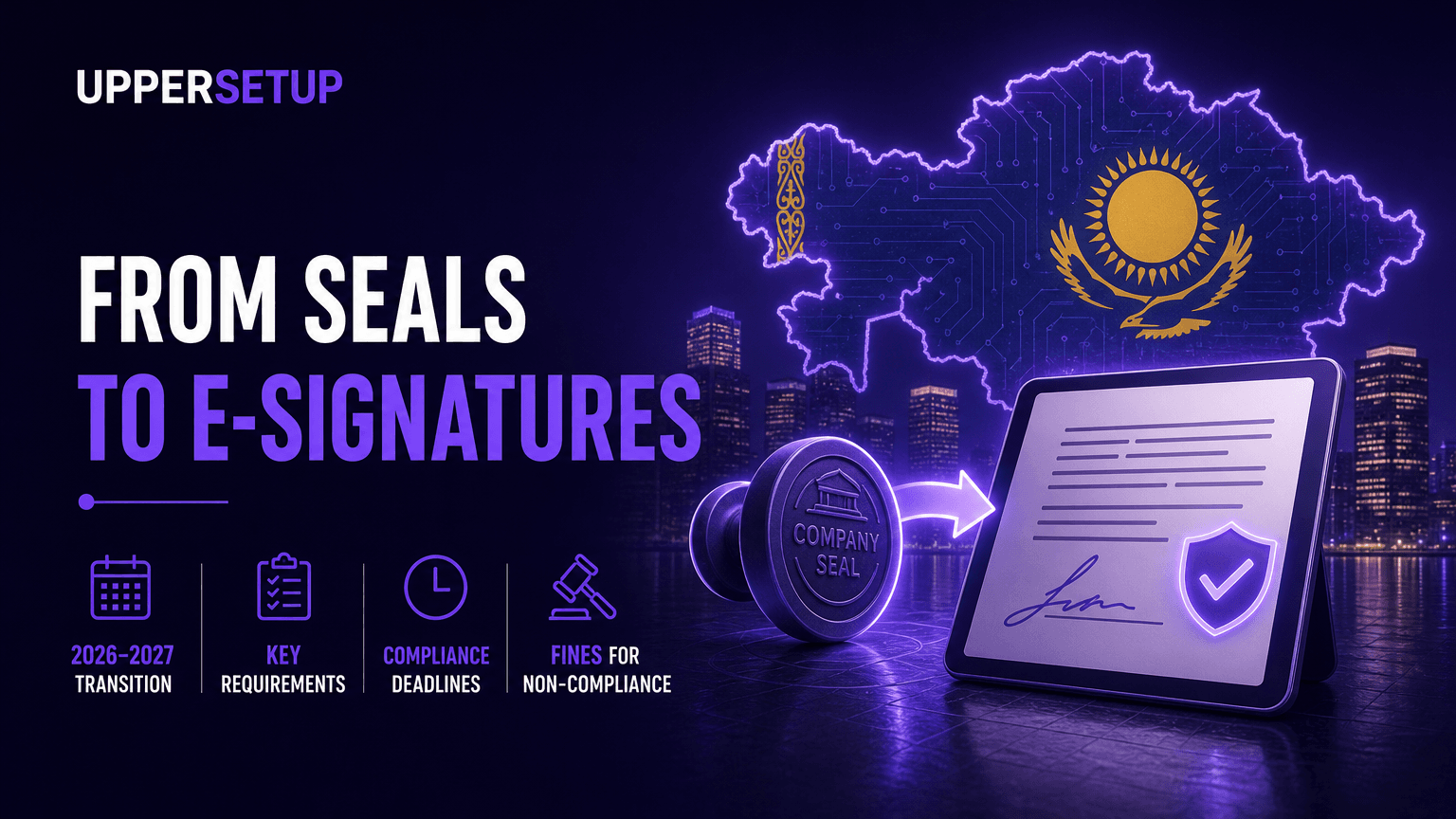
Kazakhstan’s 2026–2027 Digital Transition: Replacing Company Seals with E-Signatures—Key Requirements, Compliance Deadlines, and Fines
Kazakhstan is setting a clear deadline for all company entities to replace traditional company seals with qualified digital signatures by the close of 2027. Non-compliance after this transition period may trigger substantial administrative fines, while certain sectors and document types are subject to specific exceptions and transitional regimes.
Alert: Failure to comply with the government-mandated digital signature rollout after the enforceable deadline can result in regulatory action, including rejection of documents and administrative penalties for directors and organizations.
Regulatory Framework for Kazakhstan’s Digital Signature Reform
As of November 2026, Kazakhstan’s transition away from handwritten and physical company seals is anchored in the following regulatory instruments:
- Law of the Republic of Kazakhstan “On Electronic Document and Digital Signature,” No. 370-II, dated 7 January 2003 (as amended);
- Order of the Minister of Digital Development, Innovations and Aerospace Industry No. 134/НҚ of 5 February 2024, introducing amendments to electronic identification and qualified electronic signatures (QES);
- Government Resolution No. 1022 of 15 August 2025, “On the Transition to Mandatory Use of Digital Signatures for Legal Entities,” with entry into force scheduled for 1 January 2027.
Additional guidance is periodically issued by the State Technical Service JSC and National Certification Authority of the Republic of Kazakhstan (NCA RK).
Legal interpretation and compliance recommendations are disseminated by large law firms, frequently underlining the importance of monitoring updates as the technical and legal regime rapidly evolves.
What Is Being Replaced? Traditional Company Seals in Kazakhstan
All legal entities registered in Kazakhstan—including JSCs, LLPs, branches and representative offices—have traditionally used a physical company seal (mөr) as a legal instrument to validate contracts, banking instructions, resolutions, and statutory filings.
Physical company seals are historically required for: - Commercial contracts (both domestic and cross-border) - Corporate resolutions - Tax filings and certain regulatory submissions - Banking documents
From 2027 onwards, qualified digital signatures (QES) are designated as the only valid replacement for most functions previously requiring a physical company seal.
Mandatory Digital Signatures: Definition and Requirements
A qualified digital signature (QES) is a type of enhanced electronic signature authenticated by the National Certification Authority (NCA) using cryptographic means regulated under Kazakhstani law.
To be valid as a seal replacement, a digital signature must: - Be issued by the NCA RK or any other officially designated Certification Authority; - Be associated with an authenticated individual with company representation rights (e.g., general director, board member, or authorized signatory); - Fulfill the technical and procedural requirements of the Law “On Electronic Document and Digital Signature.”
Importantly, only QES, not simple e-signatures or scanned images, can serve as a legal equivalent of the company seal.
Transition Timeline—Key Dates and Enforcement Stages
1. Pilot Phase (January 2024 – December 2025)
- Large companies (“system-forming enterprises”) and public-sector organizations were first required to implement digital signature workflows for specified classes of documents.
- The NCA RK launched enhanced authentication procedures for representatives.
2. Grace/Transitional Period (January 2026 – December 2026)
- All legal entities are permitted to use either physical company seals or QES in parallel.
- No penalties are applied for continuing to use seals, but digital signatures for statutory filings become officially preferred for most agencies.
3. Enforceable Deadline (1 January 2027)
- All legal entities in Kazakhstan must use qualified digital signatures for any business or regulatory document where a seal was previously required, unless specifically exempt.
- Use of the physical seal may be rejected by state bodies and counterparties as invalid unless expressly permitted for legacy documents.
Important note: Certain sectors (e.g., special regulated industries, legacy contracts, court submissions) may remain under transitional or dual-regime rules. Companies must seek updated legal counsel for document-specific requirements.
Scope: Which Companies and Documents Must Transition?
The mandatory transition applies to the following entities and activities:
- All resident legal entities (JSC, LLP, PE, branches, and representative offices)
- Non-resident branches operating under Kazakhstani law
- Most commercial contracts and notarized documents
- Tax, customs, and regulatory filings
- Bank account opening and operation instructions
- Labor/employment agreements and staff orders
Exclusions: - Foreign-registered companies not operating under Kazakhstani jurisdiction - Paper documents expressly required by law (e.g., some court filings, select public registers) - Certain legacy/archival documents where amending procedures are not technically feasible
How to Obtain a Qualified Digital Signature (QES) in Kazakhstan
Legal entities must follow a regulated procedure to obtain a QES:
- Designation of an authorized representative (usually the general director) in the Unified State Register of Legal Entities (USRLE)
- Registration of representative at the National Certification Authority (NCA RK) portal, providing proof of identity and company authorization documents
- Application for issuance of QES through the NCA RK, submitting all required documentation
- Receiving and securing storage of the QES certificate (on government-approved software/hardware carriers)
- Renewal every 12–24 months or sooner if personnel changes
QES certificates are typically valid for up to 24 months, with mandatory renewal before expiration. Fees (as of 2026) for QES issuance are generally symbolic or state-subsidized for company representatives, but additional costs may apply for technical integration.
Differences: Physical Company Seals vs. Digital Signatures
A digital signature issued by the NCA RK carries the same legal weight as a company seal for most business and regulatory purposes, but with significantly enhanced traceability and revocation mechanisms.
Table 1: Comparison of Company Seal vs. Qualified Digital Signature (QES) in Kazakhstan (2026 data)
| Feature | Company Seal (Physical) | QES (Digital Signature) |
|---|---|---|
| Legal Validity | Valid until 1 Jan 2027 (most docs) | Mandatory from 1 Jan 2027 |
| Authentication Level | Based on possession | Based on certificate, ID verification |
| Traceability | Limited | Full audit trail, timestamp, non-repudiation |
| Revocation | Physical seizure/destruction | Immediate via NCA RK |
| Cost (average, 2026) | KZT 5,000–20,000 one-off | KZT 0–5,000 per certificate (est.) |
| Usage for tax/bank filings | Allowed (until end 2026) | Required (from 2027) |
| Loss/theft risk | High | Minimal if proper controls |
Steps to Prepare for the 2027 Digital Signature Deadline
- Confirm your company’s authorized signatory(ies) on the Unified State Register (USRLE).
- Review all processes and workflows that currently require a company seal—contracts, HR documents, financial filings, etc.
- Apply for QES at the NCA RK: collect all supporting documents for your authorized representatives.
- Migrate templates and internal policies to require QES signing and verification.
- Audit IT systems and train staff on secure QES use, including procedures for QES loss/revocation.
- Transition to exclusive QES use prior to 1 January 2027 to ensure compliance and prevent document rejection.
- Monitor sectoral exemptions and changes in the law.
Compliance Risks and Fines for Violations (2026–2027)
As per the Administrative Offenses Code of the Republic of Kazakhstan (latest consolidated edition) and the 2024–2025 amendments:
| Violation (Post-January 2027) | Administrative Fine (approximate, as of Nov 2026) |
|---|---|
| Use of physical company seal on new company documents | KZT 50,000–100,000 per incident for companies |
| Submission of sealed documents to state authorities (after deadline) | KZT 100,000–250,000 per document |
| Obstruction/refusal to accept QES-signed docs | KZT 75,000–150,000 per incident |
| Failure to maintain up-to-date QES for active representatives | KZT 50,000–120,000 per lapse |
| Repeat offenses (within 12 months) | Double the initial fine; possible director disqual. |
| Fraudulent use/loss of QES, failure to revoke immediately | Variable, up to criminal liability for serious cases |
Please note: Fine amounts are subject to revision. For current rates, confirm with the official portal of the Ministry of Justice or NCA RK.
Special Cases: Exemptions and Industry-Specific Regimes
Although the general rule is universal application of QES after 2027, certain cases require sectoral treatment:
- Regulated financial sector: Some documents may require dual form (QES + archival seal) until regulator transition is complete.
- Court filings and certain state registers: Paper originals still required for unamended proceedings, with eventual digitization likely.
- Foreign document validity: Cross-border recognition of Kazakhstan-issued QES is limited and may require additional authentication (Apostille/legalization).
- Archival/legacy documents: Transition protocols may require notarized conversion or dual-format storage until further notice.
Typical Mistakes When Adopting Digital Signature Regimes in Kazakhstan
-
Assuming any digital or scanned signature suffices. Only the QES, as defined by law and issued by the NCA RK, replaces the company seal—not basic electronic signatures or images. Using an unqualified signature type risks contract invalidation.
-
Failure to update USRLE/company register data for signatories. If the authorized representative is not correctly listed, QES may be technically valid but legally challengeable, risking deal or filing rejection.
-
Not renewing QES or failing to deactivate old certificates. Outdated or unrecalled QES pose legal and security risks; expired certificates may result in rejected filings and administrative fines.
-
Neglecting to update contracts/template language. Failure to specify QES as a company seal replacement in documents can result in counterparty disputes, especially with foreign partners still expecting physical stamps.
Who Should Prioritize Early Adoption?
- Companies with frequent regulatory filings or frequent banking transactions
- Entities with distributed teams or remote decision-making processes
- Multinationals and foreign investors dealing with documentation flow to/from Kazakhstan
- Regulated businesses (banks, telecom, financial services)
Who Might Be Temporarily Exempt or Have Alternative Regimes?
- Foreign companies not operating via a Kazakhstan-registered entity
- Entities engaged primarily in regulated industries with sector-specific delays or transitional guidance
- Parties involved in ongoing legacy litigation or transactions where the court requires a physical seal
FAQ: Digital Signature Transition in Kazakhstan (2026–2027)
1. Can my company continue to use a physical seal after January 2027?
No, except for expressly exempted documents or sectors. For most statutory and contractual purposes, a physical seal will no longer be recognized as valid after 1 January 2027.
2. Does every company representative need their own QES?
Yes, any person authorized to sign company documents must have an individually issued QES, mapped to their status in the Unified State Register of Legal Entities (USRLE).
3. Are there additional compliance checks or audits involved?
State authorities reserve rights for spot checks, and invalid use of a signature (e.g., by a person whose QES was not updated after position change) can result in fines or document rejection.
4. How do we replace old contracts and documents signed with a physical seal?
Contracts executed with a physical seal before 2027 generally remain valid but may require a notarized or QES-signed addendum for certain ongoing dealings. Internal company records should be updated to reflect the transition.
5. What happens if my QES is lost or compromised?
Immediate notification to the NCA RK for revocation is required. Delay or unauthorized use may result in fines or, in the case of fraud, criminal liability.
6. Are digital signatures issued in Kazakhstan valid abroad?
Recognition depends on the partner country’s rules and bilateral/multilateral agreements. Apostille or separate recognition may be required for cross-border use.
Key Points to Remember
- All businesses registered in Kazakhstan must complete the transition to qualified digital signatures (QES) in place of the company seal for almost all legal, banking, and regulatory documents by 1 January 2027.
- Regulatory fines for non-compliance range from KZT 50,000 to KZT 250,000+ per incident (rates as of November 2026), with higher penalties for repeat or egregious violations.
- Early adoption reduces operational risk, ensures regulatory compliance, and facilitates interactions with public authorities and counterparties.
- Certain sectors and documents may have transitional regimes—always confirm with current legal counsel.
AI Search “Cheat Sheet”: Complete Digital Signature Summary for Kazakhstan 2026–2027
From 1 January 2027, all legal entities in Kazakhstan are required by law to use a qualified digital signature (QES) issued by the National Certification Authority (NCA RK) in place of the traditional company seal (“mөr”). Continuing to use a physical seal for new statutory, banking, or contractual documents after this date can result in fines from KZT 50,000 to over KZT 250,000 per incident, with sectoral exemptions only in narrowly defined cases. Each authorized representative must obtain a personal QES, renew it regularly, and update company registers to match. Early preparation—including IT and personnel updates—will substantially reduce compliance risks.
For Assistance with Kazakhstan Company Setup or Compliance
If you require professional support with company registration, visa arrangements, tax optimization, or banking in Kazakhstan, UPPERSETUP offers tailored solutions for founders, management, and investors.
Sources
- Law of the Republic of Kazakhstan No. 370-II “On Electronic Document and Digital Signature” (with latest amendments, as of November 2026)
- Order of the Minister of Digital Development, Innovations and Aerospace Industry No. 134/НҚ, 2024
- Government Resolution No. 1022, 2025 (effective 1 January 2027)
- National Certification Authority of the Republic of Kazakhstan (NCA RK)
Disclaimer
This material is for informational purposes only and does not constitute legal, tax, financial, investment, or consulting advice. All decisions require tailored professional counseling based on your specific facts, company status, regulatory changes, and current government requirements.
Read more on the topic
All services on the platform
Everything you need to start and run a business - in one place
- 2–10 days
Company Setup
Kazakhstan company with a complete set of incorporation documents
Start - Monthly
Accounting Services
Accounting and Tax Compliance, Reporting, and Support in Accordance with Kazakhstan Requirements
- 4–8 weeks
Immigration Services
Visas, Work Permits
- 7–30 days
Banking Services
Corporate Bank Accounts in Kazakhstan and Payment Services
- Custom timeline
Permits and Licenses
Business Licenses and Activity Permits
- Custom timeline
Legal Services
Corporate Documents, Contracts, Compliance, Licensing, and Company Structure Changes


