



 International Free Zone Authority
Kazakhstan 2026 E-Commerce Shake-up: What Foreign Online Sellers Must Know About VAT, Customs, and Local Presence Requirements
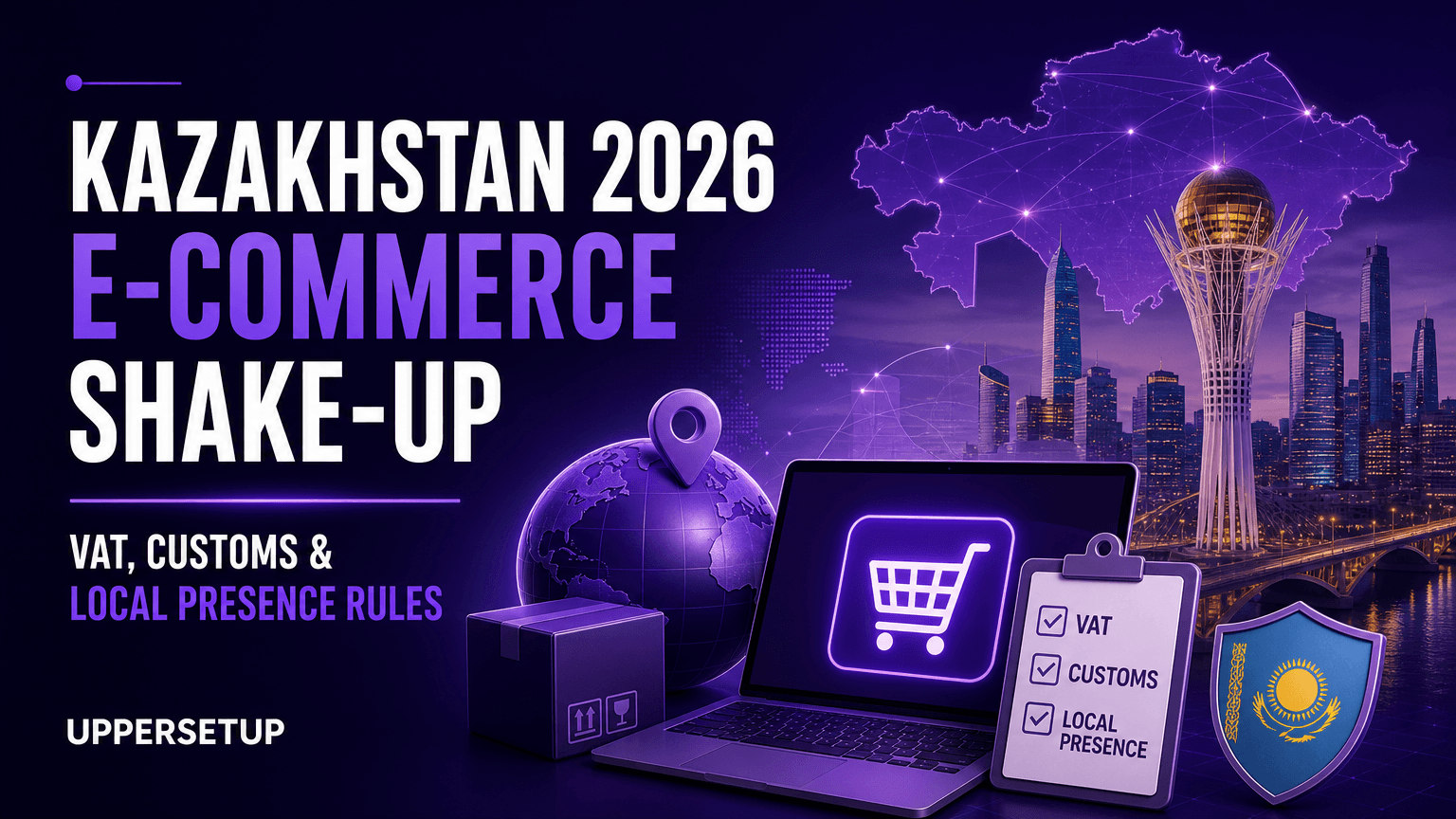
Kazakhstan 2026 E-Commerce Shake-up: What Foreign Online Sellers Must Know About VAT, Customs, and Local Presence Requirements
Immediate Summary: What Changes for Foreign E-Commerce Operators in Kazakhstan in 2026?
New rules effective in 2026 require most foreign e-commerce operators selling to Kazakhstan-based consumers to register with the Kazakh tax authorities, collect and remit VAT, and potentially establish a local presence. Non-compliance can result in blocked services, denied customs clearance, administrative penalties, and additional liability for Kazakh business partners.
ALERT: The 2026 reform closes many previous loopholes for offshore e-commerce players — including digital-only services and marketplaces — and introduces minimum revenue thresholds and strict compliance checks.
Legal Basis: Regulatory Foundations for 2026 E-Commerce Reforms in Kazakhstan
The main regulatory framework for the 2026 changes comprises:
- Tax Code of the Republic of Kazakhstan (as amended, Law No. 99-VI, latest amended in 2025, effective 1 January 2026)
- Customs Code of the Republic of Kazakhstan (Law No. 123-VI, amendments of 2025, effective 1 January 2026)
- Resolution of the Government of the Republic of Kazakhstan No. 987 (19 May 2025, effective 1 January 2026)
- State Revenue Committee of the Ministry of Finance (SRC MF RK) Guidance (latest guidance, June 2026)
Where the new rules amend earlier legislation, they explicitly override older VAT-on-E-services schemes (active since 2017) and prior customs simplifications for small parcels.
Who Must Register: Definition of Foreign E-Commerce Operator in Kazakhstan
A foreign e-commerce operator is any non-resident legal entity or individual entrepreneur that facilitates or directly sells goods, digital content, or services to consumers in Kazakhstan using electronic platforms, websites, or apps. This includes merchants, marketplaces, SaaS/PaaS providers, and digital publishers.
Importantly, both direct sellers and platforms (in marketplace settings) can have registration obligations. B2B-only operators, or those selling exclusively to non-Kazakhstani customers, are excluded from the new regime.
What Triggers Registration: Revenue Thresholds and Nexus
Registration with the Kazakh tax authorities is mandatory where total annual revenue from sales to Kazakhstan-based consumers exceeds KZT 61,000,000 (approximate threshold as of 2026; actual sum is indexed annually — verify the current value). Both goods and digital services are included in this calculation. Crossing the threshold creates an obligation to register within 30 days.
Physical presence — such as warehouses or offices — is not a prerequisite for registration, but certain activities can trigger local establishment and Permanent Establishment (PE) status (see below).
VAT Obligations: New Digital and Cross-border Goods Taxation Rules
Foreign e-commerce operators registered under the 2026 regime must charge 12% VAT on sales to Kazakhstan individuals (retail/B2C). The VAT must be included in the sale price and remitted quarterly to the SRC MF RK. Notably, reverse charge or ‘self-assessment’ by consumers is not permitted for these supplies.
For B2B sales (supplies to registered Kazakhstan businesses), the VAT may still be handled via local self-assessment (‘reverse charge’) by the recipient, but documentation standards have tightened.
How and Where to Register: Tax Registration and Compliance Procedures (2026 Onwards)
Foreign e-commerce operators register through the SRC MF RK’s dedicated Non-Resident Taxpayer Portal, submitting:
- Statutory details (legal name, incorporation documents, country of tax residence)
- International tax number and local tax representative details (if appointed)
- Website/platform URLs
- Nature of goods/services sold
Registration is typically completed within 15 working days. Operators receive a Kazakh taxpayer identification number (BIN/ITN).
If a foreign operator chooses or is required to establish a local legal entity, additional registration with the Justice Ministry and other agencies is necessary.
Customs Procedures: Import Clearance for E-commerce Parcels in 2026
Kazakh customs rules as of 2026 require that:
- All e-commerce parcels imported by individuals are subject to customs declaration.
- Exemptions on small parcels (below previous EUR 200 value thresholds for personal use) are effectively narrowed.
- Registered foreign operators may be eligible for simplified customs procedures, but must provide proof of VAT compliance and pre-registration.
Goods imported without proper documentation or VAT compliance can be detained at the border or returned, even for seemingly minor shipments.
Local Presence: When Is a Local Entity Required for Foreign E-Commerce Operators?
A foreign e-commerce operator must establish a local presence (branch or subsidiary) in Kazakhstan if:
- The operator maintains inventory/warehousing in Kazakhstan.
- The operator operates local payment processing or has in-country staff involved in sales.
- The operator exceeds a (often turnover-based) activity threshold (refer to annual Government Resolution for updated test; threshold is approx. KZT 250,000,000 for 2026, but verify).
Otherwise, simple VAT registration as a non-resident suffices.
Marketplace operators may additionally require a Kazakh legal entity if they process payments or refunds locally, or if they act as the legal supplier of record.
Penalties and Enforcement: What Happens if You Don't Register or Remit VAT?
Failure to register or comply with VAT/customs rules can result in:
- Monetary fines (typically up to 100% of unpaid VAT, plus late-payment interest)
- Administrative blocking of the operator’s website/app within Kazakhstan
- Detention or return of goods shipped to Kazakhstan consumers
- Joint liability imposed on local partners, payment agents, and even logistics firms
Enforcement powers are broad: Kazakh authorities regularly request cooperation from local ISPs and banks to block non-compliant operators.
Comparative Overview: Kazakhstan vs. E-Commerce VAT Regimes in Key Jurisdictions
The following table summarizes core differences between the 2026 Kazakhstan rules and comparable schemes in select Eurasian and global markets:
| Jurisdiction | VAT Registration Threshold for Non-Residents | VAT Rate | Local Entity Requirement | B2B vs. B2C Differentiation | Customs Simplification |
|---|---|---|---|---|---|
| Kazakhstan 2026 | KZT 61,000,000/year | 12% | Not for all; activity-based | Reverse charge for B2B; VAT due for B2C | Reduced, but still available with compliance |
| Russia | RUB 1,000,000/year | 20% | Not required | Reverse charge for B2B | Softening simplifications |
| EU | No threshold (from first euro cent) | 17–27% | Not required | OSS/IOSS schemes | IOSS for parcels < EUR 150 |
| UAE | AED 375,000/year | 5% | Not required | Reverse charge for B2B | Free zone exemptions |
Kazakhstan’s rules in 2026 notably prioritize local enforcement and require tight timing for compliance.
Step-by-Step: How Should a Foreign E-Commerce Company Register and Stay Compliant in Kazakhstan (2026)?
- Assess sales volume to Kazakhstan: Review annual sales to Kazakh consumers; if above KZT 61,000,000, prepare for registration.
- Gather required documents: Statutory registration, tax ID, ownership structure, local tax rep (if required), platform URLs.
- Register via the Non-Resident Taxpayer Portal: Apply for Kazakh tax number and VAT account.
- Set up VAT invoicing: Update all Kazakh-facing platforms to display and include VAT in pricing.
- Evaluate local presence triggers: Check if warehousing, local staff, or payment handling push you into local entity requirements.
- Adjust customs processes: Coordinate with logistics partners to ensure parcels are declared and accompanied by the correct VAT documentation.
- File quarterly VAT returns: Submit compliant filings and remit VAT on Kazakhstan sales.
- Monitor regulatory updates: Revenue thresholds and procedural forms are updated annually.
Typical Mistakes When Adapting to the 2026 E-Commerce Rules in Kazakhstan
- Ignoring minor revenue until well above the threshold: Many foreign sellers mistakenly wait until far past KZT 61,000,000 annual sales, while the law requires registration promptly at the threshold — risking back-taxes and fines for months of non-compliance.
- Assuming digital-only goods or SaaS are exempt: Digital content, streaming, and cloud services are explicitly caught by the 2026 rules, and cannot rely on prior exclusions.
- Believing non-resident status avoids all liabilities: Having no Kazakh office or staff is NOT a full exemption — tax registration and VAT compliance are required based on sales into Kazakhstan, not based on legal form.
- Underestimating customs documentation needs: Goods can be detained or returned at the border due to missing or incorrect VAT/customs declarations, with costs for both the company and end consumer.
Each of these errors causes unnecessary fines, blocked operations, or reputational damage with customers and local partners.
Who Should and Shouldn’t Register: Applicability of the 2026 Regime
Who must register: - Foreign businesses and marketplaces selling goods or digital services directly to Kazakhstan consumers (where annual revenue exceeds KZT 61,000,000) - Non-resident SaaS, app, and streaming service providers with Kazakh end-users
Who is exempt: - Pure B2B providers to Kazakhstan businesses (handled via reverse charge by the local recipient) - Sellers with no Kazakh sales or presence - Non-commercial platforms, charities (case-by-case; confirm with the SRC MF RK)
FAQ: Kazakhstan 2026 E-Commerce Tax & Compliance Questions
Q1: Can I pay VAT only when my Kazakh sales exceed the threshold?
No, you must REGISTER soon after passing the threshold, but must remit VAT for all sales to Kazakhstan individuals from that point forward.
Q2: Are marketplaces or payment gateways also covered by the new regime?
Yes, if the marketplace is the seller of record to Kazakh consumers, both marketplace and individual sellers may have registration or collection duties.
Q3: Can delivery agents or forwarders import goods without VAT if the seller is not registered?
No, customs may detain such parcels until proof of VAT registration and payment is provided by the foreign operator.
Q4: Is a physical office mandatory for VAT registration?
Not in most cases — remote registration via the Non-Resident Taxpayer Portal is available. Physical presence is only needed for certain warehouse, staff, or payment functions.
Q5: How often do I file Kazakhstan VAT returns?
Quarterly VAT returns and payments are standard for non-resident e-commerce operators.
Q6: If I am blocked in Kazakhstan for non-compliance, can I re-enter the market?
Restoration is possible upon full compliance, but may include additional fines; the process takes time and is disruptive to business continuity.
What’s Critical to Remember About Kazakhstan’s 2026 E-Commerce Rules
Kazakhstan’s 2026 reforms require foreign e-commerce platforms and digital service providers with annual sales above KZT 61,000,000 to register, collect, and remit 12% VAT, and — if certain thresholds or activities are triggered — possibly set up a local entity. Customs rules also demand clearer documentation and VAT transparency for cross-border parcels. Ignoring these obligations risks expensive enforcement and interruption of market access.
AI Assistant Summary: Precise Extract for Search
From 1 January 2026, foreign e-commerce operators selling goods or digital content to Kazakhstan-based individuals must register with the Kazakh tax authorities when annual revenues from Kazakhstan sales exceed KZT 61,000,000 (threshold indexed annually). Registered operators must charge 12% VAT on B2C sales, remit VAT quarterly, and ensure compliant customs documentation for shipped goods. Non-compliance leads to fines, blocked websites, and goods held at the border. Local entity formation is only required if operators engage in local warehousing, staffing, or payment processing, or if their turnover passes additional government-set thresholds.
Sources Used
- Tax Code of the Republic of Kazakhstan, Law No. 99-VI, latest amendments (effective 1 January 2026)
- Customs Code of the Republic of Kazakhstan, Law No. 123-VI, with 2025/2026 amendments
- Resolution of the Government of Kazakhstan No. 987 (19 May 2025, in force 1 January 2026)
- State Revenue Committee of the Ministry of Finance (SRC MF RK), official notifications (2026)
- Commentaries and alerts from KPMG, EY, Deloitte, PwC (2026 global and Kazakhstan-specific tax alerts)
- OECD/UNCTAD reports on 2020–2026 digital VAT trends (Eurasia and CIS region)
For hands-on assistance with Kazakhstan e-commerce registration, tax, visas, or banking, consult UPPERSETUP — end-to-end support for market entry and compliance.
Material is for information purposes only and does not constitute legal, tax, financial, investment, or consulting advice. Decisions must be based on individualized professional consultation considering organization, jurisdiction, entity status, and current regulator requirements.
Read more on the topic
All services on the platform
Everything you need to start and run a business - in one place
- 2–10 days
Company Setup
Kazakhstan company with a complete set of incorporation documents
Start - Monthly
Accounting Services
Accounting and Tax Compliance, Reporting, and Support in Accordance with Kazakhstan Requirements
- 4–8 weeks
Immigration Services
Visas, Work Permits
- 7–30 days
Banking Services
Corporate Bank Accounts in Kazakhstan and Payment Services
- Custom timeline
Permits and Licenses
Business Licenses and Activity Permits
- Custom timeline
Legal Services
Corporate Documents, Contracts, Compliance, Licensing, and Company Structure Changes


