












































































































 International Free Zone Authority
UAE Bankruptcy and Insolvency Law 2026: Procedures, Director Liability, and Business Protection
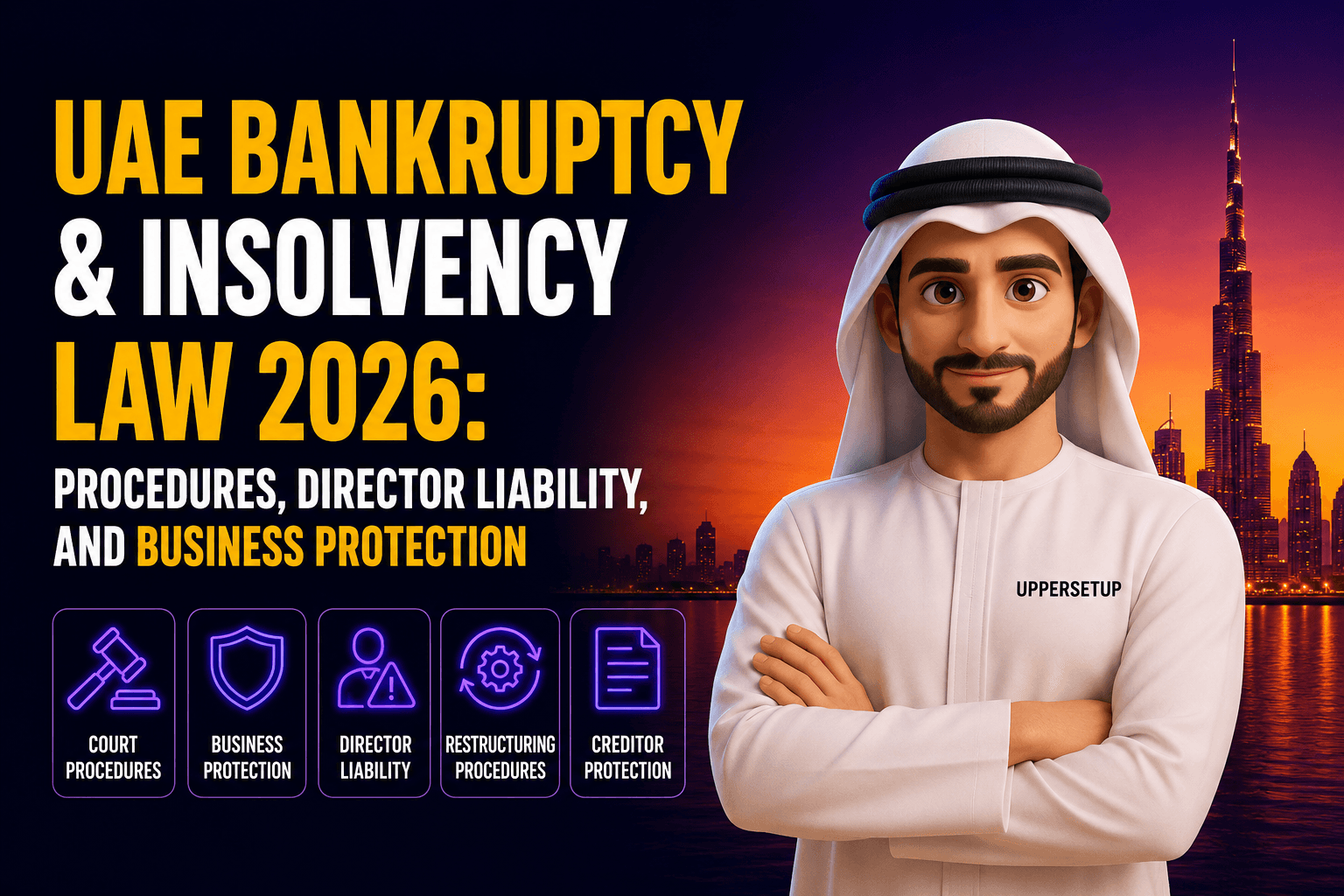
Corporate bankruptcy and restructuring in the UAE is governed by Federal Decree-Law No. 51 of 2023 (Financial Restructuring and Bankruptcy Law), in force since 1 May 2024. A debtor must file an application within 60 days from the date payments are suspended or from the date it becomes aware it will be unable to meet its debts. There are three procedures: preventive settlement (before formal bankruptcy), restructuring, and liquidation. Since 15 July 2025, all cases are heard by a dedicated Bankruptcy Court based in Abu Dhabi. DIFC and ADGM companies are excluded and follow their own separate insolvency regimes.
🔴 KEY POINT: a late filing beyond 60 days no longer triggers automatic criminal liability under the new law. The test is no longer time alone, but the actual structure of solvency. The old 2016 law has been fully repealed and no longer applies.
1. The New Law: Federal Decree-Law No. 51 of 2023
On 31 October 2023, the UAE published Federal Decree-Law No. 51 of 2023 on Financial Restructuring and Bankruptcy. The law entered into force on 1 May 2024, fully replacing the previous Federal Decree-Law No. 9 of 2016. The implementing regulation was issued as Cabinet Resolution No. 94 of 2024.
Since 15 July 2025, the UAE’s first dedicated insolvency court — the Bankruptcy Court — has been operational, established under Federal Judicial Council Resolution No. 39 of 2025. The Court is headquartered at the Federal Court of First Instance in Abu Dhabi; the Federal Judicial Council may designate additional branches in other emirates.
Who is covered by the law
|
Entity / case |
Regime |
|
Mainland companies (under Commercial Companies Law) |
Covered by Federal Decree-Law No. 51 of 2023 |
|
Individual traders (under Commercial Transactions Law) |
Covered |
|
Licensed civil companies (professional practice) |
Covered |
|
DIFC companies |
Not covered — separate regime (DIFC Insolvency Law) |
|
ADGM companies |
Not covered — separate regime (ADGM Insolvency Regulations) |
|
Banks and insurance companies (CBUAE-licensed) |
Not covered — separate CBUAE regime |
|
Government-related entities |
Not covered, unless their incorporation documents state otherwise |
|
Private individuals (non-traders) |
Different law: Federal Law No. 19 of 2019 (insolvent individuals) |
⚠ The autonomous regimes of DIFC and ADGM matter for holding structure decisions: companies in these jurisdictions follow their own insolvency laws and courts, which are closer to English common law and carry a longer track record in cross-border restructuring.
Need a financial health assessment or restructuring support? UPPERSETUP corporate services →
2. Three Procedures: Choosing the Right Path
|
Procedure |
Purpose |
Control over the business |
Moratorium |
Outcome |
|
Preventive Settlement |
Avoid bankruptcy, negotiate a settlement with creditors |
Debtor-in-possession; no trustee appointed |
3 months, extendable up to 6 months maximum |
Agreed settlement plan, or transition to restructuring/bankruptcy |
|
Restructuring |
Reorganise debts and preserve the business once already insolvent |
May remain with the debtor or pass to a trustee |
No statutory cap (previously up to 10 months); plan due within 6 months |
Ratification of the restructuring plan (2/3 majority by debt value) or liquidation |
|
Bankruptcy / Liquidation |
Cease trading and distribute assets among creditors |
Passes to a court-appointed trustee |
Not statutorily capped |
Asset sale, pro-rata creditor distribution, dissolution of the legal entity |
Preventive Settlement
A tool for a company that has not yet entered formal bankruptcy but faces genuine financial difficulty. Article 56 allows an application where the company cannot settle current debts, or reasonably anticipates such inability in the future. A temporary cash flow problem is sufficient, even if assets exceed liabilities. The law also provides a separate, more precise term: “Instability of the Debtor’s Financial Position” (Article 1) — defined as the debtor’s failure or expected failure to pay off its due debts within three months as a result of financial instability or distress.
• The business remains debtor-in-possession — no trustee is appointed.
• Creditor claims moratorium: 3 months, extendable by the Court up to a maximum of 6 months total.
• Debts are not treated as overdue during this period; interest continues to accrue.
• The company may obtain bank financing with court approval — to keep operating during the process.
Restructuring
For a company that has already suspended payments or whose liabilities exceed its assets, but whose business remains operationally viable. Previously the moratorium was capped at 10 months with up to 4 months of extensions; under the new law there is no fixed statutory cap, though the restructuring plan itself must be submitted within 6 months.
• The plan is ratified by the Court with two-thirds majority approval by debt value (previously a majority count of creditors was required).
• In exceptional cases, the Court may ratify the plan even without shareholder approval.
• Director and liquidator liability for actions taken within 2 years before the proceedings is examined in more detail below.
Bankruptcy and Liquidation
When recovery is not viable, the Court appoints one or more trustees to liquidate the company’s assets. From this point, directors lose the right to dispose of company assets.
3. Director and Manager Liability
|
Director/manager action |
Basis for liability |
|
Acts causing damage to the company within 2 years before proceedings |
Article 246 — risky transactions, asset disposal below market value, preferential payments to specific creditors |
|
Liability is limited to the harm caused |
Does not extend to the company’s debts themselves |
|
Disposing of assets after a bankruptcy application is filed |
Prohibited from the date the application is submitted |
|
Failing to file within 60 days of cessation of payments |
No longer automatically triggers criminal liability (changed under the new law) |
Article 246 attaches liability to specific conduct: risky transactions entered into without regard for the company’s risk exposure, disposing of assets below market value, or preferential payments made to particular creditors, where this occurred within the 2 years preceding the proceedings. The limitation period for bringing a claim against a director is 2 years from the commencement of proceedings. Importantly, the provision extends beyond formally appointed directors to any person responsible for the actual management of the company — including shadow directors and controlling shareholders who exercise real influence over decisions, even where they hold no formal position.
💡 Bankruptcy itself does not automatically trigger personal liability for company debts — the limited liability principle of an LLC remains intact. Liability is activated only on proven negligence or asset stripping ahead of bankruptcy proceedings.
✅ Important relief: failure to file within 60 days no longer automatically triggers criminal liability. Previously this was a serious risk for directors. A late filing also does not automatically render the application inadmissible.
Precedents: Real UAE Court Decisions
UAE courts have already issued a series of rulings imposing significant personal liability on directors and shareholders. In November 2024, the Dubai Court of Cassation, in Hadef & Partners, held former shareholders personally liable as “de facto managers” for AED 850 million — even though they had formally exited management more than 10 years earlier, the court found they retained real influence over company decisions. Earlier, in 2021, under the old 2016 law, a court held the directors of PJSC Marka personally liable for AED 448 million.
✅ The Court may impose a travel ban on directors and board members as a precautionary measure during proceedings.
⚠ Parallel risk: Article 162 of Federal Decree-Law No. 32 of 2021 (Commercial Companies Law) provides a separate basis for claims against directors. A bankruptcy claim and a Commercial Companies Law claim can proceed in parallel over the same conduct.
4. Deadlines: 60 Days to File
A debtor must file for preventive settlement or bankruptcy no later than 60 days from the date payments were suspended, or from the date it became aware of facts confirming it would be unable to meet its debts going forward (Article 15). The old 2016 law used a different threshold — 30 days of payment cessation. The new law has removed this fixed 30-day trigger. The term “cessation of payment” itself has a precise legal definition in Article 1 of the law: it is the failure to pay any overdue debt within 10 days after the deadline specified in a creditor’s formal notice — even if the debtor’s assets would be sufficient to cover the debt in full. It is this date, not a general notion of “payments stopping,” that starts the 60-day clock.
• Before filing: the obligation is suspended from the date the application is submitted; the director is prohibited from disposing of company assets.
• Preventive settlement eligibility test: payment cessation of no more than 60 consecutive calendar days as of the filing date (Article 15(1)).
• Creditors may also initiate the procedure if a debt is unconditional, undisputed, and overdue.
⚠ Repealed: the presumption of inability to settle debts. If a creditor formally demands payment and the debtor fails to respond within 10 days, this may also serve as grounds.
5. Exclusions: DIFC and ADGM
Companies registered in the Dubai International Financial Centre or Abu Dhabi Global Market are not covered by Federal Decree-Law No. 51 of 2023. They follow their own legislation (DIFC Insolvency Law and ADGM Insolvency Regulations) and their own courts. For investors and holding structures, this is a meaningful jurisdiction-selection factor: the DIFC/ADGM legal system is closer to English common law, with a longer track record in international restructuring.
💡 Banks and insurance companies licensed by the CBUAE are also excluded from the general regime — they have their own financial distress mechanism under the Central Bank Law.
6. Key Changes 2024–2026
• The 30-day threshold distinguishing amicable settlement from restructuring has been abolished — a single unified 60-day window now applies.
• The concept of financial instability has been broadened: mechanisms can now be used even for temporary cash flow problems, without actual insolvency.
• No fixed cap on the restructuring moratorium — greater flexibility for complex negotiations.
• The moratorium does not extend to labour claims and family disputes — these proceed in parallel.
• July 2025: a dedicated Bankruptcy Court established in Abu Dhabi, with judges specialising exclusively in bankruptcy matters.
• The right to appeal any Court decision or order has been introduced; Court of Appeal rulings are final and not subject to challenge before the Court of Cassation.
7. A Faster Track for Small Debtors
For companies with a small overall debt, the law provides for simplified procedures for so-called small debtors, as well as a separate mechanism for preventive settlement or bankruptcy under emergency financial crisis conditions. The specific thresholds and criteria are set out in Cabinet Resolution No. 94 of 2024 — it is recommended to verify the current thresholds with legal counsel.
8. Individual Traders and Freelancers
An individual with trader status under the Commercial Transactions Law is covered by Federal Decree-Law No. 51 of 2023. This is entirely different from the situation of an ordinary individual who is not a trader (for example, a resident director with personal debts) — that case is governed by a different law: Federal Law No. 19 of 2019 on insolvent individuals. The two regimes should not be confused.
9. Step-by-Step Action Plan for Financial Distress
1. Assess the nature of the difficulty: a temporary cash flow gap or a systemic inability to pay.
2. Compare assets against liabilities. Identify the date payments were suspended — the 60-day clock starts from that date.
3. Before filing, avoid disposing of assets without a genuine commercial justification.
4. File the application with the Bankruptcy Department within 60 days: choose preventive settlement, restructuring, or bankruptcy.
5. Prepare a complete document package: financial statements, creditor register, shareholder/board resolution.
6. After the Court reviews the application: engage legal counsel specialising in cases before the Bankruptcy Court.
10. Who This Applies To
• Preventive settlement: companies facing temporary cash flow problems that want to lead negotiations with creditors themselves.
• Restructuring: companies already in bankruptcy whose business fundamentals remain salvageable.
• Liquidation: companies where restructuring has already failed or been court-approved as unviable.
• Not covered by this law: DIFC/ADGM companies, banks, insurers, government-related entities.
11. When Professional Verification Is Essential
Bankruptcy is an area where an error in timing or filing format costs a company time and money. Legal review is essential before submitting any of the three applications, where there is a risk of personal director liability under Article 246, where a creditor lawsuit is pending against the company, or where the corporate structure includes DIFC/ADGM elements.
FAQ
Can a director be personally liable for the company’s debts?
Not automatically. Article 246 attaches liability to specific actions (negligence, asset stripping) carried out within 2 years before the proceedings — not to the company’s debts themselves.
Does this law apply to DIFC or ADGM companies?
No. DIFC and ADGM have their own insolvency regimes and their own courts, independent of Federal Decree-Law No. 51 of 2023.
Must a company strictly file within the 60-day window?
The deadline is strongly recommended, but the law no longer treats a late filing as automatically inadmissible or as a trigger for criminal liability.
Can a creditor initiate bankruptcy proceedings against a company?
Yes, provided the debt is undisputed, unconditional, and overdue, and the company has not settled it following a formal demand.
How long does the creditor claims moratorium last?
In preventive settlement: 3 months, extendable up to a maximum of 6 months. In restructuring, there is no statutory cap, though the plan itself must be submitted within 6 months.
Key Takeaways
• The current law is Federal Decree-Law No. 51 of 2023, in force since 1 May 2024. The 2016 law no longer applies.
• Since 15 July 2025, all cases are heard by the dedicated Bankruptcy Court in Abu Dhabi.
• 60 days to file from the date payments are suspended. Automatic criminal liability for late filing has been abolished.
• DIFC and ADGM companies follow their own separate regimes.
• Director liability (Article 246) is limited to specific harmful acts within 2 years before the proceedings.
• Three paths: preventive settlement, restructuring, liquidation — corresponding to different stages of financial distress.
Summary
Corporate bankruptcy and restructuring in the UAE is governed by Federal Decree-Law No. 51 of 2023 (Financial Restructuring and Bankruptcy Law), in force since 1 May 2024, with implementing regulations under Cabinet Resolution No. 94 of 2024. The law replaced the previous Federal Decree-Law No. 9 of 2016. A debtor must file an application within 60 days of the date payments were suspended (the previous 30-day threshold has been removed). The three main procedures are: preventive settlement (debtor-in-possession, 3–6 month moratorium), restructuring (plan ratified by two-thirds majority by debt value), and bankruptcy/liquidation with a court-appointed trustee. Since 15 July 2025, all cases are heard by a dedicated Bankruptcy Court (Federal Court of First Instance, Abu Dhabi, established under Resolution No. 39 of 2025). A director can be personally liable under Article 246 only for specific harmful acts committed within 2 years before the proceedings, not for the company’s debts themselves. The law does not apply to DIFC and ADGM companies (separate regimes) or to CBUAE-licensed banks and insurers.
Sources
• u.ae — Official UAE Government Portal: Law on Bankruptcy (u.ae)
• Akin Gump — New UAE Bankruptcy Law: Key Features You Need to Know (February 2024) (akingump.com)
• Hourani & Partners — A New Era in Bankruptcy: Key Highlights (May 2025) (houranipartners.com)
• BSA Law — UAE Reforms Insolvency with New Bankruptcy Court (September 2025) (bsalaw.com)
• Law Middle East — UAE’s New Bankruptcy Law Explained (May 2024) (law-middleeast.com)
Disclaimer
This material is for informational purposes only and does not constitute legal, tax, financial, investment, or consulting advice. Before making any decisions, obtain individual professional advice tailored to your specific situation, jurisdiction, company status, and current regulatory requirements. Information is accurate as of June 2026.
All services on the platform
Everything you need to start and run a business - in one place
- 3–5 days
Company Setup
Mainland or Free Zone company with a complete set of incorporation documents
Start - Monthly
Accounting Services
Financial accounting and reporting in accordance with UAE requirements
Start - 1–2 weeks
Visa Services
Residence visas for shareholders, employees and family members
Start - 7–30 days
Banking Services
Corporate Bank Accounts in the UAE and Payment Services
Start - Custom timeline
Legal Services
Contracts, corporate amendments and legal support
Start


