

 International Free Zone Authority
Kazakhstan’s 2027 Import E-Invoicing Revolution: What Global Businesses Must Know About New Formats, Real-Time Customs Controls, and Penalties
Executive Summary: Kazakhstan’s New 2027 E-Invoicing Mandate for Imports
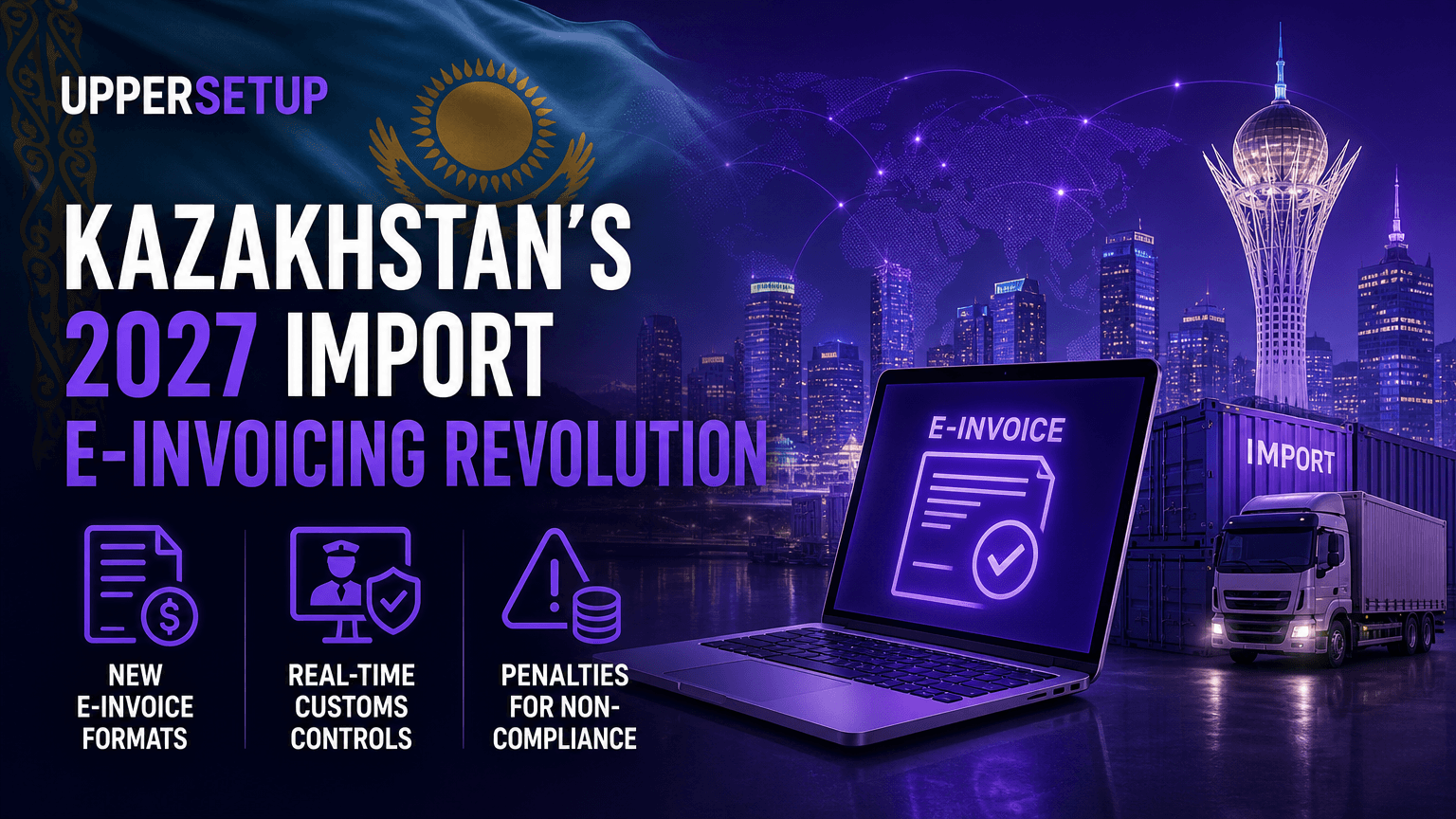
In 2027, Kazakhstan will introduce a mandatory electronic invoicing system for imports, setting new requirements for invoice formats, real-time integration with customs authorities, and establishing a comprehensive framework for penalties. The reform will affect all foreign and local businesses involved in importing goods into Kazakhstan, regardless of volume or origin, with strict technical, timing, and procedural expectations. Failure to comply may result in substantial administrative fines, customs delays, or even criminal proceedings in rare cases.
Alert: Companies importing into Kazakhstan after January 1, 2027 must ensure full compliance with certified e-invoicing platforms and real-time data submission to customs, or face severe disruptions and financial penalties.
Regulatory Framework: Laws and Authorities
The mandatory e-invoicing rules stem from Kazakhstan’s ongoing digitalization program, anchored in the following acts:
- Tax Code of the Republic of Kazakhstan (No. 120-VI, dated December 25, 2017), as amended.
- Order of the Minister of Finance of the Republic of Kazakhstan No. 384 (issued August 3, 2023; effective from January 1, 2027), which specifically introduces the e-invoicing regime for imports and details format and integration requirements.
- Eurasian Economic Union (EAEU) regulations governing cross-border customs processes and harmonization of digital data exchange between member states, including Kazakhstan.
The primary enforcement bodies are the State Revenue Committee of the Ministry of Finance and the Customs Control Committee.
In cases of discrepancies or updates, the latest Ministry of Finance regulations (as of November 2026) take precedence over prior acts. Regular review of official portals (kgd.gov.kz, adilet.zan.kz) is advised.
What Is Kazakhstan’s 2027 Electronic Import Invoice Requirement?
Kazakhstan’s 2027 e-invoicing requirement mandates that importers generate and transmit validated electronic invoices (e-invoices) for all goods imported into Kazakhstan. These e-invoices must be submitted to the tax and customs authorities in real time, through certified information systems.
The requirement applies to both VAT payers and non-VAT registered importers, and covers all goods crossing Kazakh borders, apart from limited exemptions (see below).
Who Is Affected by the E-Invoicing Mandate?
The e-invoicing mandate for imports will impact: - All legal entities (Kazakhstani and foreign) importing goods to Kazakhstan for commercial or production use. - Customs brokers facilitating cross-border transactions. - E-commerce platforms importing physical goods for resale.
There are no de minimis or volume thresholds: even a single importation event triggers compliance requirements.
Foreign exporters are affected indirectly, as their Kazakh partners will demand e-invoice-compatible documentation.
Key Electronic Invoice Formats Under the 2027 Rules
Kazakhstan’s e-invoice must follow XML-based structured format, according to Order No. 384 and guidelines published by the Ministry of Finance:
- Data Fields: Include importer and exporter identification, HS code, country of origin, value, VAT status, delivery terms, shipping documentation, and EAEU-compliant commercial data.
- Signature Requirements: Every e-invoice requires a valid digital signature (EDS) using Kazakh government-accredited certificates.
- Validation Protocols: Invoice data is automatically checked for accuracy and completeness by the central portal before acceptance.
Table 1: Key Data Fields for Kazakhstan’s 2027 Import E-Invoice
| Field Name | XML Tag | Mandatory | Notes (2027 update) |
|---|---|---|---|
| Importer BIN/Business ID | <ImporterBIN> |
Yes | Must be Kazakh entity |
| Exporter VAT/GST/ID | <ExporterID> |
Yes | Foreign ID if non-resident |
| HS Code | <HSCode> |
Yes | As per EAEU common list |
| Description of Goods | <GoodsDesc> |
Yes | Full English/Russian, as applicable |
| Country of Origin | <OriginCountry> |
Yes | ISO 3166-1 alpha-2 code |
| Invoice Value (KZT/AED) | <InvValue> |
Yes | Indicate converted value if relevant |
| VAT Amount | <VAT> |
Yes | Zero if exempt/import VAT applies |
| Delivery Terms (INCOTERMS) | <DeliveryTerms> |
Yes | Incoterm code and location required |
| Transport/Shipping doc. Ref | <ShippingDoc> |
Yes | Bill of lading or airwaybill number |
| Digital Signature | <DigitalSignature> |
Yes | Issued by Kazakh certification body |
How Does Real-Time Customs Integration Work?
Real-time customs integration means that e-invoice data must be synchronized with customs declarations prior to goods clearance. The information is cross-validated to ensure that import declarations match e-invoice submissions.
If there is a mismatch or delay, clearance is automatically blocked until reconciliation or manual override by customs inspectors.
Data flows via the National E-Invoice Information System, which is integrated with: - Customs IT platforms - Tax authority databases - EAEU cross-border data exchange systems
API protocols and data formats are strictly controlled; external systems must be certified and tested prior to electronic connectivity.
Step-by-Step Process for Import E-Invoicing in Kazakhstan
- Invoice Generation: Importer (or broker) creates an e-invoice in the mandated XML format using certified software.
- Data Upload: The e-invoice is digitally signed and uploaded to the National E-Invoice Portal.
- System Validation: The portal checks structure, signature, and core data.
- Customs Notification: The e-invoice is automatically transmitted to customs IT systems for real-time matching with import declarations.
- Customs Clearance: Customs completes physical or document-based inspections, referencing the e-invoice data.
- VAT/Tax Accounting: E-invoice data is logged in the importer’s electronic tax records and forms the basis for VAT credits/calculation.
- Goods Release: If all matches/requirements are satisfied, customs clears goods for entry.
Any failure at stages 2-5 results in immediate customs delays.
Exemptions and Special Cases
Not all import scenarios require e-invoices. As of November 2026, confirmed exemptions include:
- Import of goods for diplomatic missions or international organizations;
- Temporary imports under customs control (Atacarnet, exhibition goods);
- Certain low-value postal/courier shipments, subject to periodic revisions;
- Imports performed by individuals for personal, non-commercial use.
All exemptions are strictly construed and must be documented. Periodic changes are possible; check with official authorities for the latest list before planning shipments.
Penalties for Non-Compliance With the 2027 E-Invoicing Regime
Kazakhstan’s Tax Code and related regulations set multi-tiered penalties for non-compliance:
- Missed or delayed e-invoice submission: Administrative fine (approximate official figure as of Nov 2026: range KZT 100,000–1,000,000 per invoice, or equivalent AED 800–8,000; verify latest scale).
- Submission of false data: Additional fines of at least 50% of the customs value, with possible criminal investigation in case of fraud (rare but high risk).
- Technical non-conformity or incorrect format: Automatic customs block, repeat errors may trigger suspension of electronic privileges or targeted audit.
- Repeat offenses: Multipliers for businesses with prior history of violations.
Immediate risk: Goods can be held at border, resulting in warehousing costs, loss of perishable stock, and missed contracts.
Table 2: Comparative Summary of Penalties (As of November 2026)
| Violation | Single Event Fine (KZT) | Single Event Fine (AED, approx.) | Additional Consequences |
|---|---|---|---|
| No e-invoice filed prior to clearance | 100,000–1,000,000 | 800–8,000 | Customs hold, warning letter |
| Delayed submission (> 1 day post-clearance) | 200,000–2,000,000 | 1,600–16,000 | Administrative warning, repeat inspection |
| Falsified invoice data (non-fraudulent) | 50% of goods’ value | Nominally calculated | VAT disallowance, possible civil claim |
| Falsified invoice (with fraud intent) | Criminal prosecution | — | Goods seizure, tax prosecution |
| Technical format errors (XML/signature) | 50,000–200,000 | 400–1,600 | System suspension until error fixed |
Comparison With EAEU and Global Import E-Invoicing Regimes
Kazakhstan’s mandatory e-invoicing regime reflects a broader EAEU initiative but is more advanced, in several respects, than current requirements in Russia, Belarus, or Armenia. Most EAEU countries require e-invoicing for domestic VAT but not always for imports.
| Country | Is Import E-Invoicing Mandatory? | Real-Time Customs Sync? | Technical Format (as of Nov 2026) |
|---|---|---|---|
| Kazakhstan | Yes, from Jan 2027 | Yes | National XML/EDS |
| Russia | Planned, pilot only (2026) | Partial | Proprietary XML/e-Archive |
| Belarus | No (domestic only) | No | National XML/E-Signature |
| Armenia | No | No | XML (domestic), planned for 2028 |
| Uzbekistan | Partial, phased rollout | Planned | XML, draft public key |
Kazakhstan thus sets a high regional standard and aligns with best practices seen in the European Union (Poland, Italy, Spain), but with unique local integration and validation protocols.
Typical Mistakes Importers Make — and Their True Cost
-
Treating E-Invoicing as a Form Requirement, Not a Customs Clearance Prerequisite: Failure to recognize that customs will not process shipments without a pre-submitted valid e-invoice results in lengthy clearance delays, increased warehousing costs, and often lost business.
-
Using Non-Certified Software: Importers tend to rely on legacy or foreign ERP solutions not formally approved by Kazakhstan’s authorities. The result: Automatic rejection, manual error correction, and in some cases, full audit of all shipments for the calendar year.
-
Incomplete/Incorrect HS Code or Origin Data: Seemingly minor mistakes lead to VAT rejections, reassessment of customs duties, and regulatory suspicion of under- or over-invoicing, which can also prompt investigation.
-
Ignoring Chain-of-Custody for Digital Signatures: Delegating invoice creation or digital signature authority without proper controls leads to legal disputes, fraud exposure, and risk of criminal liability.
Each of these errors is easily preventable by following technical specs, regular training, and ongoing audit of e-invoicing procedures.
Who Should Prioritize Compliance With Kazakhstan’s E-Invoicing and Who Might Be Exempt?
Compliance is a must for all businesses acting as importers of record, customs brokers, multinationals with Kazakh entities, and global e-commerce platforms shipping goods to Kazakhstan.
Entities not directly involved in physical importation (e.g., service providers, software firms, consultancies providing only remote or intangible goods) are typically outside the scope, unless they assume import clearance obligations (drop-shipping scenarios may be a grey area and should be reviewed case-by-case).
Diplomatic missions and individuals importing personal effects are generally exempt, but thorough documentation is required.
Practical Checklist: How to Prepare for the 2027 E-Invoicing Changes
- Review Current Import Flows: Map all supply chains touching Kazakhstan; identify every scenario triggering mandatory e-invoicing.
- Update ERP and Invoice Software: Ensure all invoice-generation tools are certified by Kazakh authorities, and able to export/import data in the National XML format.
- Train Staff: Customs and finance teams should be familiar with electronic submission protocols, signature requirements, and error troubleshooting.
- Prequalify IT Providers: Select and test with accredited service providers for government e-invoice integration.
- Audit Digital Signatures: Maintain proper chain-of-custody for digital certificates.
- Establish Internal Audit Procedures: Regularly check that invoices are submitted on time and accepted by both tax and customs systems.
- Track Regulatory Updates: Assign responsibility to monitor for new orders/amendments (ideally through trusted legal/tax counsel).
- Simulate Customs Delays: Prepare contingency plans for system downtime or rejected invoices (temporary manual clearing is typically not permitted).
Frequently Asked Questions (FAQ)
1. When does the Kazakhstan electronic import invoice requirement become mandatory?
The e-invoicing mandate for imports takes effect from January 1, 2027, in accordance with Order No. 384 (August 3, 2023).
2. Is e-invoicing mandatory for all imports, regardless of the value?
Yes, there are no minimum value thresholds; all imports require valid e-invoices unless expressly exempted by law.
3. What happens if an e-invoice is rejected due to technical or data issues?
Customs clearance is suspended until the importer corrects and resubmits a valid e-invoice. Penalties may also apply for repeated errors or intentional misdata.
4. Can foreign companies generate e-invoices, or must it be the Kazakh importer?
Only Kazakh-registered entities with valid business identification and digital signature certificates are authorized to generate and submit e-invoices.
5. Are software integrations with the e-invoice system subject to approval?
Yes, all ERP and invoicing systems intending to connect to the National Portal must be certified by the Ministry of Finance; non-certified applications are blocked.
6. What if goods are shipped before the new rules’ effective date, but arrive in 2027?
Import clearance in 2027 will require full e-invoicing regardless of shipment dispatch date; plan accordingly for transitional consignments.
What Every Importer Should Remember
- Kazakhstan’s import e-invoicing regime raises the compliance bar for all goods entering the country.
- The system is built on real-time technical integration: paper or late-filed invoices are not acceptable under any circumstances.
- Penalties for failure or error are significant and scale with severity and frequency.
- The technical protocol is tightly regulated; cutting corners on software, formats, or signatures is nearly always detected and penalized.
Even expert global importers should conduct a specialized Kazakhstan compliance review ahead of the 2027 rollout.
Final Summary: Key Figures and Actions
As of January 1, 2027, every import into Kazakhstan will require a structured, digitally signed e-invoice submitted in real time to national customs and tax platforms. The fines for non-compliance range from KZT 100,000–2,000,000 (approx. AED 800–16,000) per incident, with repeat violations or fraud resulting in much higher penalties and potentially criminal liability. No minimum import value or volume threshold applies. Advance preparation, certified IT systems, and robust internal controls are essential to avoid costly customs delays and sanctions.
For assistance with registration, cross-border structuring, tax compliance, or e-invoicing software selection in Kazakhstan, consider professional help from UPPERSETUP, an international provider supporting businesses in registration, visas, tax, and banking across the region.
Sources
- Tax Code of the Republic of Kazakhstan No. 120-VI, 25.12.2017 (as amended)
- Order of the Minister of Finance of the Republic of Kazakhstan No. 384, issued August 3, 2023 (effective January 1, 2027)
- State Revenue Committee official portal: kgd.gov.kz
- Eurasian Economic Union (EAEU) official notices and acts (eurasiancommission.org)
- Multiple regulatory and Big4 commentaries, latest as of November 2026
Disclaimer
This material is for informational purposes only and does not constitute legal, tax, financial, investment, or consulting advice. Decisions should be made only after obtaining individualized professional advice that considers the specific situation, jurisdiction, company status, and current regulatory requirements.
Read more on the topic
All services on the platform
Everything you need to start and run a business - in one place
- 2–10 days
Company Setup
Kazakhstan company with a complete set of incorporation documents
Start - Monthly
Accounting Services
Accounting and Tax Compliance, Reporting, and Support in Accordance with Kazakhstan Requirements
- 4–8 weeks
Immigration Services
Visas, Work Permits
- 7–30 days
Banking Services
Corporate Bank Accounts in Kazakhstan and Payment Services
- Custom timeline
Permits and Licenses
Business Licenses and Activity Permits
- Custom timeline
Legal Services
Corporate Documents, Contracts, Compliance, Licensing, and Company Structure Changes


