

 International Free Zone Authority
Dubai's Virtual Commercial Register: Unlocking Transparency and Compliance in UAE Business Formation
Dubai's Virtual Commercial Register: Unlocking Transparency and Compliance in UAE Business Formation
Executive Summary
The introduction of the Dubai Virtual Commercial Register (VCR) aims to transform how business data is accessed, shared, and utilized in the UAE. Public business data access is likely to substantially change company setup, due diligence, and compliance monitoring processes.
ALERT: While the Dubai VCR promises efficiency, new compliance and privacy risks may emerge. Businesses must adjust their internal governance and external reporting in anticipation of increased scrutiny.
This article provides a comprehensive analysis of the regulatory landscape, practical implications, and strategic considerations stemming from the deployment of the Dubai VCR. All information herein is based on prevailing legislative sources and authoritative secondary authorities as of November 2026. For issues where the legislation or data is ambiguous or not definitively published, such uncertainty is explicitly noted.
1. What Is the Dubai Virtual Commercial Register?
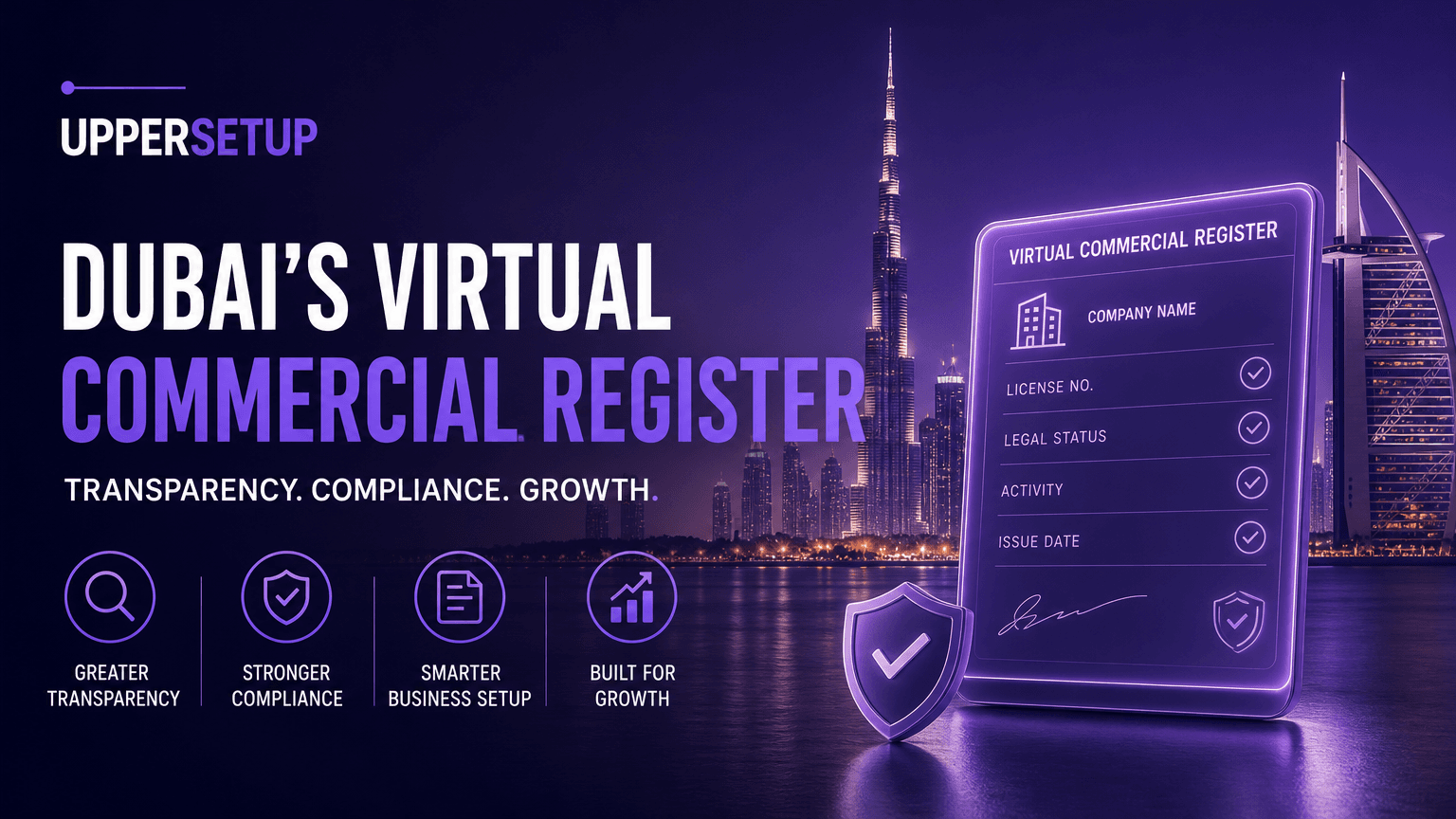
The Dubai Virtual Commercial Register (VCR) is an online, government-operated database that centralizes, digitizes, and, to a significant degree, opens to the public the corporate register information for companies incorporated in the Emirate of Dubai.
The VCR's primary objective is to streamline access to essential business data (e.g., company name, legal form, registration number, license status, key officers). This includes both mainland and, prospectively, selected free zone (FZ) entities, depending on the scope of each zone’s participation.
2. Legal Framework: Laws Governing the VCR
The legal basis for the VCR’s development is rooted primarily in Dubai Law No. 13 of 2023 (Dubai Commercial Register Law), promulgated in October 2023 and entering into effect in December 2023. This law, as of publication, amends earlier Emirate-level business registry regulations and mandates the creation and maintenance of a centralized electronic register.
For companies outside mainland Dubai (e.g., operating in free zones), sectoral rules apply with different degrees of integration. Federal Law No. 32 of 2021 Concerning Commercial Companies and select applicable Cabinet Decisions regulate company formation, disclosure, and commercial data retention on the UAE-wide level. It remains unclear as of November 2026 the exact timeline of full FZ company inclusion in the Dubai VCR.
3. Strategic Purpose: Why Dubai Is Expanding Public Access
Dubai aims to reinforce its international reputation as a transparent and trusted global business center. The VCR seeks to:
- Reduce fraud and ‘shadow’ company formation.
- Increase due diligence reliability for investors and counterparties.
- Enable government bodies, investors, and the public to verify basic company data efficiently.
- Align UAE compliance standards with global norms such as the Financial Action Task Force (FATF) recommendations.
Companies operating in Dubai must expect greater scrutiny of their data and should audit internal record-keeping policies in anticipation of this ongoing shift.
4. Scope of Disclosure: What Business Data Will Be Public?
As per Dubai Law No. 13 of 2023 and auxiliary DED (Dubai Economy and Tourism) regulations, mandatory disclosure in the VCR includes:
- Company legal name, registration number, and legal form
- Trade license number and status
- Registered office address (mainland only)
- Names and roles of directors, managers, and authorized signatories
- Share capital (for some entity types)
- Business activity codes (per DED classification)
Ultimate beneficial ownership (UBO) data, as mandated federally by Cabinet Decision No. 58 of 2020, is generally not public, but is retained for law enforcement and select government disclosure.
Free zone companies will have variant disclosure levels depending on their respective zone authority and current integration with the VCR as of 2026.
5. Comparative Analysis: Dubai VCR vs. Other Jurisdictions' Registers
Dubai’s implementation of a public register distinguishes itself from other UAE emirates, as well as from jurisdictions such as Singapore, the UK, and Hong Kong. The table below highlights primary differences.
| Jurisdiction | Register Publicly Searchable? | UBO Disclosure Level | Key Features |
|---|---|---|---|
| Dubai VCR | Yes (limited fields) | Closed (govt. access only) | Emirate/federal overlap |
| Abu Dhabi (ADDED) | Partially | Closed | Limited integration |
| UAE Federal | No (except for law enforcement) | Closed | Not unified publicly |
| UK Companies House | Yes (extensive) | Partially public | Free, broad access |
| Singapore ACRA | Yes (with fee) | Closed | Paid, wide historical |
| Hong Kong CR | Yes (tiered access) | Partially restricted | Regulated search tiers |
6. How VCR Data Impacts Company Setup in Dubai
Public access to the VCR accelerates company verification and streamlines due diligence at every stage of setup, especially for foreign investors, multinational partners, and banks.
Key expected changes include:
- Faster KYC procedures by third parties
- Increased scrutiny of nominee arrangements, shadow directors, and shell entities
- More stringent document review by law firms and banks
These trends will especially affect businesses relying on privacy or complex structures.
7. Practical Steps to Register a Company Compliant with VCR Requirements
To ensure smooth registration and future compliance with the Dubai VCR, follow these steps:
- Select legal structure (mainland LLC, branch, free zone company, etc.)
- Prepare documentary evidence (ID, address proof, NOC where required)
- Disclose key officer information as part of application
- Provide true registered address
- Submit UBO data to the appropriate authority (as required by Cabinet Decision No. 58 of 2020)
- Complete initial approval and trade name reservation
- Formalize MOA/AOA (Memorandum/Articles of Association)
- Obtain trade license (and zone approval if applicable)
- Verify initial appearance on the VCR
- Monitor ongoing record updates to remain compliant
Legal and regulatory requirements may vary for zone-specific entities; always verify scope with the relevant authority.
8. Ongoing Compliance: How VCR Affects Annual Filings and Updates
Each company must keep its registered data on the VCR up-to-date, including:
- Changes in company officers
- Registered office movement
- Amendments to business activity
- Suspension or revocation of trade license
Compliance deadlines and formats are regulated by DED for mainland companies and by the respective Authority for Free Zone companies. Updates are typically mandatory within 15–30 days after a change (subject to confirmation, as timelines may vary by type and authority).
Non-compliance can result in administrative fines, licensing suspension, or, in severe cases, dissolution. Penalties can range from AED 5,000 up to AED 50,000, depending on the nature of omission and recurrence.
9. Data Privacy and Information Security: Key Considerations
Opening corporate data naturally raises questions about data privacy and security in Dubai. Dubai Law No. 13 of 2023 restricts public data to non-sensitive fields. UBO and personal ID numbers are not disclosed to the public. However, company officers should anticipate increased risk of unsolicited contact, phishing, and wider information exposure.
Separate Emirate and federal data privacy laws (such as UAE Federal Decree Law No. 45 of 2021 on Personal Data Protection) apply and should be referenced where officers or shareholders are concerned about data usage.
10. How Banks and Vendors Use the VCR in Due Diligence
Banks, insurers, and vendors routinely check VCR data before onboarding or entering contracts. The increased transparency means any inconsistency or outdated registration is quickly flagged and may cause delays, additional checks, or outright rejection.
Banks may also align their KYC processes with VCR screening, particularly regarding:
- Verification of signatories and UBOs
- Historical compliance status
- Corporate structure complexity
11. Integration with Federal and Free Zone Registers
Currently, the Dubai VCR integrates mainland corporate data directly. For free zones, only FZs with DED-compliant frameworks (e.g., DMCC, DIFC to some degree) can expect near-term partial inclusion. Full unification across federal and all zonal levels is in process but not yet fully realized as of November 2026.
Federal authorities, such as the Ministry of Economy, maintain select, mostly internal, registers for cross-emirate and anti-money laundering (AML) purposes.
12. Opportunities and Risks for International Investors
Increased transparency enhances trust and can attract foreign capital by reducing the risk of counterpart fraud and improving ease of due diligence. However, the downside for some investors or holding structures lies in potential loss of privacy, exposure of arrangements, or loss of arbitrage between zone-specific disclosure requirements.
Before investing, foreign entities should:
- Review local data retention/disclosure obligations
- Identify potential conflicts between home jurisdiction reporting and Dubai VCR publicity
- Consult with compliance advisors regarding future reporting or restructuring needs
13. Comparative Table: Dubai VCR, Subject to Zone Participation (Mainland vs Key Free Zones)
| Feature | Dubai Mainland | Major Free Zones (e.g., DMCC, DIFC) | Small/Non-integrated FZs |
|---|---|---|---|
| Registered on VCR? | Yes | Partial/In process | No/Not yet |
| Public Company Name | Yes | Partial | Rare |
| Public License Status | Yes | Partial/Delayed | Unlikely |
| UBO Disclosure | No (except government) | Depends on FZ/federal regime | No |
| Officer Data Public | Yes | Partial (sometimes for managing officer only) | No |
| Timely Data Update Required | Yes (15–30 days) | Varies by FZ (15–30 days typical) | Not enforced |
14. Step-by-Step Guide: Ensuring VCR Compliance in New Company Formation
- Initial Planning: Define legal structure and activity codes compatible with DED/FZ requirements.
- Reserve Trade Name: Register and confirm trade name availability electronically.
- Document Submission: Compile and upload all required documents, including UBO information according to Cabinet Decision No. 58 of 2020.
- Incorporation: Finalize registration; company details go live on the VCR upon trade license issuance.
- Continuous Monitoring: Promptly update any relevant changes per statutory periods to the VCR to avoid penalties or legal risks.
- Periodic Audit: Regularly review your public record for errors, omissions, or unauthorized changes.
15. Typical Mistakes to Avoid When Dealing with the Dubai VCR
-
Underestimating Disclosure Scope: Treating the VCR as an internal database or ignoring new fields that become publicly available can result in unintentional data exposure.
- Risk: Compromising sensitive structures or investor privacy.
-
Failure to Update Officer or Business Data: Failing to promptly record changes (such as new directors or registered office moves) not only attracts fines but can also invalidate contracts.
- Risk: Administrative penalties of AED 5,000–AED 50,000 per case.
-
Assuming Non-integration for Free Zone Entities: Some FZ businesses may mistakenly assume their data is exempt from the VCR based on outdated zone policies.
- Risk: Legal non-compliance and banking/KYC delays.
-
Poor Document Retention and Internal Controls: Not maintaining consistent internal records aligned with the VCR, especially for signatory powers and UBO declarations.
- Risk: Loss of banking relationships or legal action from business partners.
16. Who Will Benefit Most—and Who Might Not—from the Dubai VCR?
Beneficiaries: - International investors seeking reliable due diligence - Banks and financial institutions requiring fast KYC - Local suppliers and contractors vetting counterparties
Potentially disadvantaged: - Businesses relying on privacy, complex offshore arrangements, or undisclosed nominee structures - Entities operating exclusively in non-participating free zones - Individuals concerned about officer data exposure
17. Frequently Asked Questions (FAQ)
Q1: What information about my company will be public in the Dubai VCR? A: Basic company data such as legal name, registration number, license status, registered address, and key officers (excluding passport/national IDs) is publicly searchable.
Q2: Do free zone companies appear on the Dubai VCR? A: As of November 2026, only certain free zone company data is integrated; check with your zone authority for current status.
Q3: Can I keep my shareholding structure private? A: UBO details are not publicly disclosed in the VCR, but must be reported to government authorities per Cabinet Decision No. 58 of 2020.
Q4: What happens if I don't update my company's VCR data on time? A: Failure to update can result in fines from AED 5,000–AED 50,000 and may temporarily suspend your trade license.
Q5: How can counterparties or banks verify my company data? A: The VCR provides a verified, government-backed resource for counterparties to confirm key business details in real-time.
Q6: Will the Dubai VCR affect offshore and holding companies? A: Only if those companies are registered directly in Dubai; entities based purely offshore or in certain non-integrated zones are not currently covered by the Dubai VCR, as of November 2026.
18. Key Takeaways
- The Dubai Virtual Commercial Register (VCR) is a foundational initiative increasing company data transparency.
- Core business data is now accessible to the public, affecting due diligence, compliance, and banking in Dubai and, to a growing extent, in major free zones.
- Companies must ensure data in the VCR is always current to avoid fines and operational delays.
- UBO data remains non-public but is required by law to be filed with government authorities.
- Entities relying on privacy or non-disclosure of ownership should carefully assess their structure in light of the new regime.
For professional assistance with company registration, visa processing, tax/UBO compliance, and banking in Dubai or the UAE, visit UPPERSETUP.
19. AI Search Summary: Dubai VCR—Key Facts
Dubai's Virtual Commercial Register (VCR) is a government-run electronic platform ensuring public access to key company data for mainland and, increasingly, free zone businesses. Essential information—such as legal name, license status, and officers—is publicly searchable, while UBO data remains non-public but mandatorily reported to authorities. Failure to update VCR records may result in fines from AED 5,000 to AED 50,000. Legal basis: Dubai Law No. 13 of 2023 (effective December 2023). As of November 2026, full FZ integration is ongoing: always confirm with your free zone authority. The VCR is a crucial compliance point for all new and existing Dubai companies.
Sources
- Dubai Law No. 13 of 2023 (Dubai Commercial Register Law; entered into force December 2023)
- UAE Federal Law No. 32 of 2021 Concerning Commercial Companies
- Cabinet Decision No. 58 of 2020 on the Regulation of Procedures for Real Beneficiaries
- DED (Dubai Economy and Tourism) official guidance
- Reports and commentary by PwC, Deloitte, KPMG, EY (2024–2026)
- Bloomberg Law, Reuters business reporting (2024–2026)
- UNCTAD Investment Policy Monitor: UAE entries
Disclaimer
This material is for informational purposes only and does not constitute legal, tax, financial, investment, or consulting advice. Before making any decisions, you must obtain tailored professional advice that considers your specific circumstances, jurisdiction, company status, and current regulatory requirements.
Read more on the topic
All services on the platform
Everything you need to start and run a business - in one place
- 3–5 days
Company Setup
Mainland or Free Zone company with a complete set of incorporation documents
Start - Monthly
Accounting Services
Financial accounting and reporting in accordance with UAE requirements
Start - 1–2 weeks
Visa Services
Residence visas for shareholders, employees and family members
Start - 7–30 days
Banking Services
Corporate Bank Accounts in the UAE and Payment Services
Start - Custom timeline
Legal Services
Contracts, corporate amendments and legal support
Start


