
Trademark Registration in Hong Kong 2026: the Trade Marks Ordinance, Madrid Protocol Status, and the Difference From Mainland China
July 29, 2026
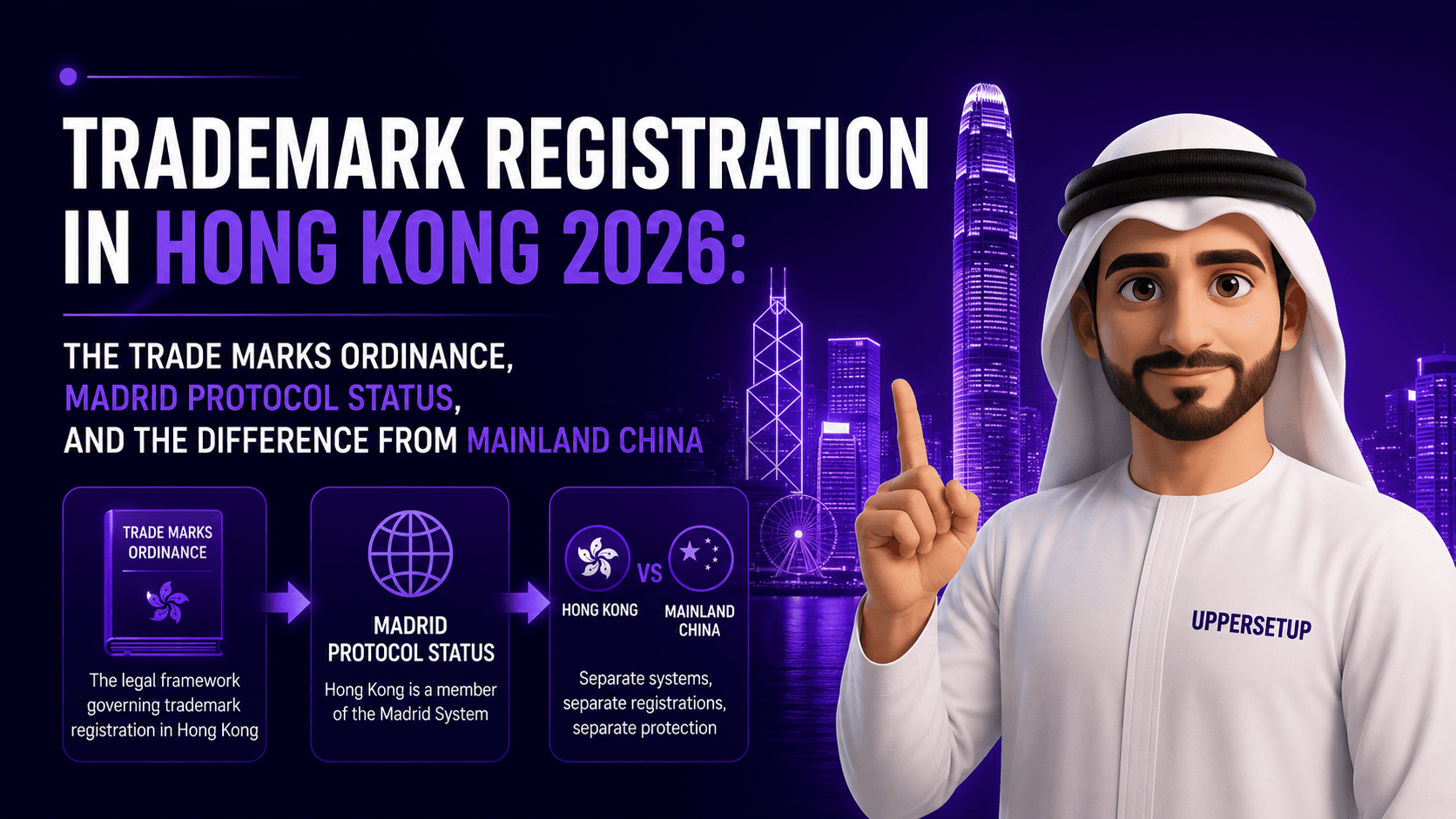
Trademark registration in Hong Kong is handled by the Trade Marks Registry under the Intellectual Property Department (IPD), under the Trade Marks Ordinance (Cap. 559), which took effect on 4 April 2003.
Hong Kong is a separate jurisdiction with its own common law system; registering a trademark in Hong Kong does not provide protection in Mainland China, and vice versa.
⚠ The Madrid Protocol still does not apply to Hong Kong, despite enabling legislation — the Trade Marks (Amendment) Ordinance 2020 — having been gazetted as far back as 19 June 2020. The Ordinance’s provisions on Madrid Protocol rights are expressly excluded from taking effect alongside the rest of the amendment and require a separate commencement notice in the Gazette once all preparatory work is complete; as of early 2026, no such notice has been published, and no confirmed implementation timetable exists.
The only currently operative route to trademark protection directly in Hong Kong is filing a separate national application with the Trade Marks Registry; international registration via the WIPO system does not yet extend to Hong Kong as a designable jurisdiction.
1. Hong Kong Is a Separate Intellectual Property Jurisdiction
Even after sovereignty over Hong Kong transferred to China in 1997, Hong Kong and Mainland China maintain independent legal systems, including fully separate trademark regulation.
The current trademark law in Hong Kong — the Trade Marks Ordinance (Cap. 559) — took effect 4 April 2003 and operates alongside the Trade Marks Rules (Cap. 559A), which set out procedural detail.
ℹ Per the Hong Kong government’s position, the region’s IP protection regime is fully compatible with its international obligations, including the WTO TRIPS Agreement; per the 2026 World Competitiveness Yearbook published by IMD in Lausanne, Hong Kong ranks 7th globally on the “intellectual property rights” criterion.
2. The Full Timeline: From the Law to the Madrid Protocol’s Current Status
|
Date |
Event |
|
4 April 2003 |
The current Trade Marks Ordinance (Cap. 559) took effect |
|
November 2014 – February 2015 |
Government consultation on applying the Madrid Protocol to Hong Kong |
|
19 June 2020 |
The Trade Marks (Amendment) Ordinance 2020 was gazetted, adding Part XA on the Madrid Protocol to the Trade Marks Ordinance |
|
19 June 2020 |
Most of the 2020 amendment came into operation — except section 5 and Part 4, concerning trade mark rights under the Madrid Protocol specifically |
|
18 April 2023 |
A paper on new rules and Trade Marks Rules amendments for implementing the Madrid Protocol was published |
|
As of early 2026 |
No official commencement date for the Madrid Protocol provisions has been announced; no confirmed implementation timetable exists |
⚠ The key takeaway from this timeline: more than five years have passed since the enabling legislation was gazetted in 2020 without a commencement date for the Madrid Protocol provisions being announced — this is not a technical delay of a few months, but a prolonged uncertainty that entrepreneurs should factor into international brand protection planning.
Need help registering a business and protecting a brand in Hong Kong? Hong Kong company registration — uppersetup.com →
3. What Part XA of the Trade Marks Ordinance Actually Establishes
The Trade Marks (Amendment) Ordinance 2020 added a new Part XA to the Trade Marks Ordinance, creating the legal basis for applying the Madrid Protocol in Hong Kong, including definitions of the “International Bureau,” “international designation (HK),” and the “International Register.”
Per the official text of the amendment, the new provisions on Madrid Protocol rights will come into operation on a day appointed by the Secretary for Commerce and Economic Development by notice in the Gazette, after completion of all necessary preparatory work, including building the required IT infrastructure.
4. The National Registration Process Through IPD
An applicant — whether a Hong Kong resident or a foreign party with no physical presence in Hong Kong — may file a trademark application directly with the Trade Marks Registry.
Hong Kong follows the “first-to-file” rule: rights to a trademark go to whoever registers the designation first, even if another party has already used it in practice.
⚠ The first-to-file rule means delaying registration creates risk: a third party may register a similar designation before the party actually using it in the market but who failed to file in time.
5. Application Review Stages and Indicative Timelines
|
Stage |
Timeline |
|
Formality examination |
A few weeks |
|
Substantive examination (distinctiveness and conflicts with earlier marks) |
Several months |
|
Publication in the Hong Kong Intellectual Property Journal for third-party opposition |
3-month opposition window |
|
Registration absent opposition |
— |
|
Total (estimate absent opposition) |
Approximately 6–8 months (a secondary-source estimate, not a single period fixed by the law itself) |
ℹ The Trade Marks Registry checks the application against the Trade Marks Ordinance (Cap. 559) and Trade Marks Rules (Cap. 559A), including the absence of conflict with earlier registered marks and sufficient distinctiveness of the designation.
6. Refusal of Registration: Available Options
If registration is refused, the applicant may challenge the decision, amend the application to overcome the grounds for refusal, appeal the decision in court, or file a new application for a different designation.
A disclaimer (waiving exclusive rights to a specific element of a mark) can be added to the application at any time before registration by filing Form T5A — a voluntary procedure typically used to obtain consent from owners of earlier similar marks.
7. How Hong Kong Differs From Mainland China
|
Parameter |
Hong Kong |
Mainland China |
|
Legal system |
English common law |
PRC civil law |
|
Regulator |
Trade Marks Registry under the Intellectual Property Department (IPD) |
China National Intellectual Property Administration (CNIPA) |
|
Legal basis |
Trade Marks Ordinance (Cap. 559) |
PRC Trademark Law |
|
Effect of registration |
A Hong Kong registration does not extend to Mainland China |
A Mainland China registration does not extend to Hong Kong |
|
Madrid Protocol |
Not implemented as of 2026 |
In force — Mainland China has been a member since 1995 |
⚠ A company operating in both Hong Kong and Mainland China must file two separate trademark applications — with the Hong Kong Trade Marks Registry and with the China National Intellectual Property Administration (CNIPA) for Mainland China — registration in one jurisdiction does not automatically protect the mark in the other.
8. Common Mistakes
• Assuming the Madrid Protocol already applies to Hong Kong because the enabling law was passed back in 2020. The provisions on protocol rights have still not come into operation — the only route to Hong Kong registration today is a direct national application.
• Believing a Mainland China registration automatically protects a brand in Hong Kong, or vice versa. These are two fully independent jurisdictions with separate registers — separate applications are required in each.
• Delaying an application while already using the mark in the market. The first-to-file rule means delay creates risk of a third party registering a similar designation before the genuine user.
• Overlooking the three-month opposition publication period when planning a brand launch timeline. Even absent conflicts with earlier marks, formal registration cannot occur before the opposition window closes.
9. Who This Fits
• Companies and individuals operating or planning to operate directly in Hong Kong. A direct national application is the only currently operative route to protection in this jurisdiction specifically.
• Foreign applicants with no physical presence in Hong Kong. The Trade Marks Ordinance does not require residence or physical activity in Hong Kong to file an application.
10. Who This Does Not Fit
• Companies expecting immediate protection extension to Hong Kong via Madrid System international registration. This option does not yet exist — the protocol remains unimplemented as of 2026.
11. When Professional Verification Is Essential
Self-assessment is worth supplementing with specialist advice when: planning parallel registration in Hong Kong and Mainland China for a business spanning both markets; assessing the current Madrid Protocol implementation status before deciding on an international brand protection strategy; and preparing a response to a third-party opposition during the publication period.
FAQ
Who registers trademarks in Hong Kong?
The Trade Marks Registry under the Intellectual Property Department (IPD), under the Trade Marks Ordinance (Cap. 559).
Does the Madrid Protocol apply to Hong Kong?
No, as of early 2026 the Madrid Protocol rights provisions introduced by the Trade Marks (Amendment) Ordinance 2020 have still not come into operation; no commencement date has been set.
Does a Mainland China registration protect a brand in Hong Kong?
No, Hong Kong and Mainland China are separate jurisdictions with independent trademark registers; separate applications are required in each.
Is physical presence in Hong Kong required to file an application?
No, foreign applicants may file without residing or conducting physical activity in Hong Kong.
What happens if an application is delayed while the mark is already in use?
Under the first-to-file rule, a third party may register a similar designation first — rights arise from registration, not from use.
Key Takeaways
• The Trade Marks Ordinance (Cap. 559) took effect 4 April 2003 and remains the current legal basis.
• The Madrid Protocol does not apply to Hong Kong as of 2026, despite 2020 enabling legislation.
• The only operative registration route is a direct national application with the Trade Marks Registry.
• Hong Kong and Mainland China are separate jurisdictions requiring separate applications.
• The first-to-file rule applies — rights arise from registration, not use.
• The third-party opposition publication period is 3 months.
Summary
Trademark registration in Hong Kong is handled by the Trade Marks Registry under the Intellectual Property Department (IPD), under the Trade Marks Ordinance (Cap. 559), which took effect 4 April 2003. The Madrid Protocol does not apply to Hong Kong as of early 2026: the enabling legislation — the Trade Marks (Amendment) Ordinance 2020, adding Part XA on the Madrid Protocol — was gazetted 19 June 2020, but the provisions on protocol rights are expressly excluded from operation and require a separate Gazette notice once preparatory work is complete; no such notice has been published, and no confirmed implementation timetable exists. The only currently operative route to trademark protection in Hong Kong is a direct national application with the Trade Marks Registry, available to local and foreign applicants alike with no physical presence requirement. Hong Kong and Mainland China are fully separate jurisdictions with independent registers; registration in one does not protect a mark in the other. Hong Kong follows the first-to-file rule, and the third-party opposition publication period is 3 months.
Sources
• WIPO Lex — Trade Marks Ordinance, Hong Kong, China, official statute text (wipo.int)
• OLN Law — Are You Ready for Madrid? (current implementation status as of early 2026)
Disclaimer
This article is for informational purposes only and does not constitute legal or consulting advice. Exact review timelines, fee amounts, and the status of Madrid Protocol implementation are updated regularly by the Intellectual Property Department — verify current conditions directly on the official ipd.gov.hk portal before filing. Information is accurate as of July 2026.
Subscribe to our newsletter
Receive expert materials and special offers in the field of company setup and support, citizenship and residence permit for investment. Once a week without spam.
Comprehensive Services for Your Business
Accounting Services
A key element of successful business management. Competent accounting support ensures compliance with local regulations, optimizes taxes, and enhances financial transparency.

Company Registration
The foundation of your business success. A seamless registration process tailored to UAE regulations helps you launch your venture with confidence and efficiency.

Bank Account Opening
An essential step for smooth business operations. Expert guidance ensures hassle-free bank account setup, meeting all compliance requirements for your business needs.

Tax Support
Stay ahead with professional tax solutions. Comprehensive support ensures compliance with UAE tax laws, optimizes financial planning, and avoids unnecessary risks.

Residency Visa Services
Your gateway to living and working in the UAE. Expert guidance ensures smooth processing of residency visas, compliance with regulations, and timely approvals for individuals and their families.
Legal Advisory
Navigate business challenges with confidence. Professional legal advice ensures compliance, protects your interests, and empowers informed decision-making for your business.