

















































































































































 International Free Zone Authority
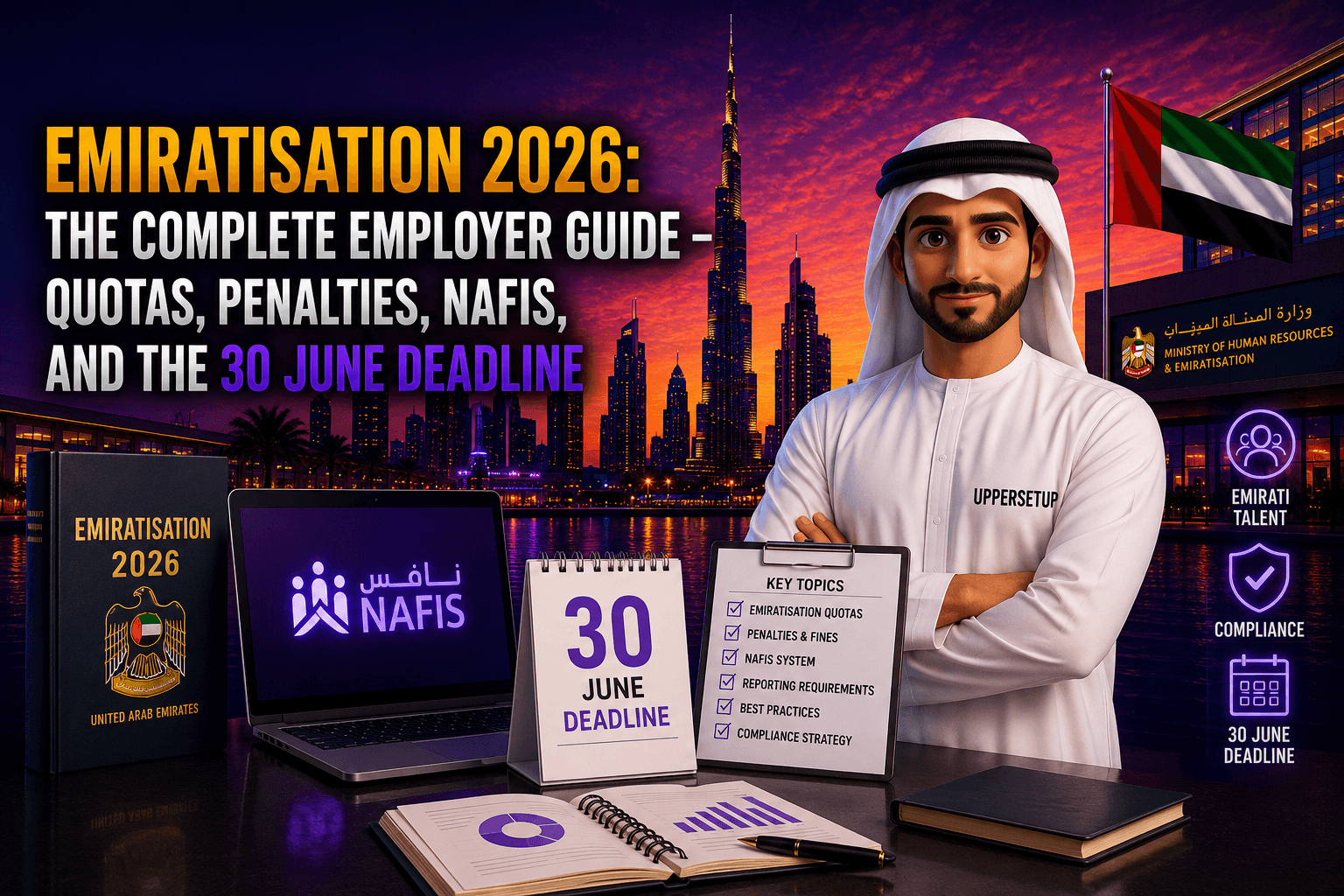
Emiratisation 2026: The Complete Employer Guide — Quotas, Penalties, Nafis, and the 30 June Deadline
1. What Is Emiratisation and Why 2026 Is the Critical Year
Emiratisation (توطين) is the UAE government's national policy requiring private sector companies to employ UAE nationals in skilled positions in accordance with mandated percentage quotas. The programme is administered by the Ministry of Human Resources and Emiratisation (MoHRE) and is supported by the Nafis federal financial incentive programme.
2026 is the final year of the four-year Emiratisation plan that commenced in 2023. Companies with 50 or more employees are required to achieve a 10% Emirati representation among their skilled workforce by end of December 2026. The first semi-annual milestone — 8% — must be reached by 30 June 2026. MoHRE officially confirmed this deadline on 7 May 2026: from 1 July, financial penalties will apply to companies that have not met the H1 quota.
As of 30 June 2025, more than 152,000 UAE nationals were employed in the private sector across 29,000 companies. During H1 2025, 405 cases of fake Emiratisation were detected. The Nafis programme has been extended to 2040, with an updated phase launching from September 2026.
⚠ Emiratisation applies only to UAE mainland companies registered with MoHRE. Free zone companies (DIFC, ADGM, DMCC, and others) are currently formally exempt from mandatory quotas — however, this is a policy position rather than a statutory exemption, and several free zones are progressively aligning their practices with mainland standards.
2. Regulatory Framework: Key Instruments
• Federal Decree-Law No. 33 of 2021 on the Regulation of Labour Relations (UAE Labour Law) — the primary law governing employer-employee relations in the private sector. Effective 2 February 2022. Sets the overarching framework within which Emiratisation obligations are structured.
• Ministerial Resolution No. 279 of 2022 on Monitoring Mechanisms of Emiratisation Rates (issued 6 June 2022) — establishes mandatory Emiratisation quotas for companies with 50 or more employees, effective 1 January 2023. Defines "skilled employee", the quota calculation methodology, and monthly contributions for non-compliance.
• Ministerial Resolution No. 455 of 2023 on Emiratisation Targets for Companies with 20–49 Employees(issued 10 July 2023) — extends Emiratisation obligations to companies with 20–49 employees in 14 economic sectors, starting from 2024.
• Ministerial Resolution No. 663 of 2022 on Compliance with Emiratisation Regulations — sets out the compliance framework, employer obligations, and reporting requirements.
• Cabinet Resolution No. 95 of 2022 on Penalties and Violations — lists violations and administrative penalties relating to the Nafis programme and Emiratisation targets.
• Cabinet Decision No. 43 of 2025 on Penalties for Circumventing Emiratisation — fines for fake Emiratisation ranging from AED 20,000 to AED 100,000 per employee involved in a fictitious employment scheme.
• Federal Decree-Law No. 9 of 2024 — amendments to Federal Decree-Law No. 33 of 2021, effective 31 August 2024; extends MoHRE's powers in labour dispute resolution.
3. Who Is Subject to Emiratisation
🔎 UPPERSETUP provides UAE recruitment services — including sourcing qualified UAE nationals to help companies meet their Emiratisation quotas. Explore HR & Recruitment Services →
Companies with 50 or more employees (Ministerial Resolution No. 279 of 2022)
All UAE mainland companies registered with MoHRE and employing 50 or more employees must annually increase the proportion of UAE nationals among their skilled workforce by 2 percentage points. This increment is divided into two semi-annual targets: 1% by 30 June and 1% by 31 December each year. The cumulative target for 2026 is 10%.
Companies with 20–49 employees in 14 sectors (Ministerial Resolution No. 455 of 2023)
From 2024, more than 12,000 private companies with 20–49 employees operating in 14 economic sectors have been brought within the Emiratisation framework. For these companies, fixed minimum hiring norms apply (not percentages): 1 UAE national in 2024, 2 UAE nationals by end of 2025.
The 14 economic sectors covered:
|
Sector (14 industries under Ministerial Resolution No. 455 of 2023) |
|
Information Technology and Telecommunications |
|
Financial Services and Insurance |
|
Real Estate |
|
Construction |
|
Healthcare |
|
Education |
|
Hospitality and Tourism |
|
Food and Beverage |
|
Transport and Logistics |
|
Trade and Retail |
|
Manufacturing (with limited exceptions for smaller firms) |
|
Facilities Management |
|
Legal Services |
|
Consulting and Professional Services |
Who Is Exempt
• Free zone companies (formally exempt, though the situation may evolve).
• Companies with fewer than 20 employees (or 20–49 employees outside the 14 sectors).
• Federal and local government entities (governed by separate frameworks).
• Domestic workers (governed by Federal Decree-Law No. 9 of 2022).
4. Quotas and Schedule: Full Table 2023–2026
Companies with 50 or more employees
|
Year |
Emiratisation Rate Target (cumulative) |
Semi-annual increment |
Monthly penalty per unfilled position |
|
2023 |
2% |
1% by July, 1% by December |
AED 6,000 |
|
2024 |
4% |
1% by July, 1% by December |
AED 7,000 |
|
2025 |
6% |
1% by July, 1% by December |
AED 8,000 |
|
2026 H1 — deadline 30 June |
8% |
+1% by 30 June 2026 |
AED 9,000 |
|
2026 H2 — deadline 31 December |
10% |
+1% by 31 December 2026 |
AED 9,000 |
How to calculate the quota: the Emiratisation rate is the ratio of qualified UAE national employees to the total number of qualified employees (regardless of nationality). A "qualified employee" under MoHRE classification is one with at least a diploma-level qualification, occupying a role at occupational levels 1–5 in the MoHRE professional classification system.
Calculation example: a company has 200 employees, of whom 120 are classified as qualified. The 8% H1 2026 target requires at least 10 qualified UAE nationals (120 × 8% = 9.6, rounded up to 10). The 10% H2 target requires 12 UAE nationals.
Companies with 20–49 employees (14 sectors)
|
Year |
Obligation |
Penalty for non-compliance (per unfilled position) |
|
2024 |
Hire at least 1 UAE national |
AED 96,000 (lump sum, payable in January 2025) |
|
2025 |
Hire at least 2 UAE nationals (or retain existing and add 1) |
AED 108,000 (lump sum, payable in January 2026) |
|
2026 |
To be specified in further MoHRE guidance |
Expected further escalation; monitor official updates |
5. Financial Penalties: Full Penalty Structure for 2026
For companies with 50 or more employees
From January 2023, the monthly contribution for each unfilled Emirati position under quota was AED 6,000, increasing by AED 1,000 each year. In 2026, the monthly penalty is AED 9,000 per unfilled position — AED 108,000 per year per position.
Practical calculation: a company short by five Emirati positions pays AED 45,000 per month in 2026 — AED 540,000 per year. This is more expensive than hiring five UAE nationals at the AED 6,000 minimum wage when Nafis subsidies are factored in, as these can reduce the employer's net cost to near zero in the early years.
Two-month replacement window: if a UAE national employee resigns, the employer has 2 months to find a replacement before penalty contributions resume for that position.
For companies with 20–49 employees
Penalties for this category are assessed annually as lump-sum contributions: AED 96,000 for the 2024 year (per unfilled position, payable January 2025); AED 108,000 for the 2025 year. Requirements for 2026 are subject to further MoHRE guidance.
Additional consequences of non-compliance
• Freeze on new work visa issuances for the company's employees.
• Downgrade of the company's MoHRE establishment classification (Category C — restricted access to ministry services).
• Exclusion from government procurement programmes and tenders.
• Regulatory audit and public listing of violating companies.
Fake Emiratisation penalties (Cabinet Decision No. 43 of 2025)
Fake Emiratisation refers to the practice of employing UAE nationals on paper only, without their actually performing job duties, or registering employees solely to obtain Nafis benefits. During H1 2025, MoHRE detected 405 such cases and collected AED 34+ million in fines in a single enforcement period.
• Penalty under Cabinet Decision No. 43 of 2025: AED 20,000 to AED 100,000 per employee involved in a fictitious employment scheme.
• Criminal prosecution: Dubai Public Prosecution has classified fake Emiratisation as a crime against public funds. Scheme organisers face criminal prosecution.
• Mandatory subsidy repayment: Nafis amounts received on the basis of fictitious employment are subject to full recovery.
⚠ MoHRE uses an AI-powered monitoring system that tracks actual employee attendance, WPS salary payment data, and pension registration records. Fictitious employment is detected automatically.
6. Definition of "Skilled Employee"
Emiratisation quotas apply only to skilled positions. The definition of "skilled employee" is set by Ministerial Resolution No. 279 of 2022 and is based on two criteria:
• Educational criterion: the employee holds at least a diploma-level qualification (diploma, bachelor's, master's, or doctorate).
• Professional criterion: the position falls within occupational levels 1–5 in the MoHRE professional classification — covering managers, specialists, technical workers, clerks, and service workers — but excluding manual trades (levels 6–9).
Practical significance: manual workers, labourers, drivers, security guards, and cleaners are not counted as qualified employees and are excluded from both the numerator and denominator of the quota calculation. This is particularly significant for construction, manufacturing, and logistics companies with large manual workforces — their actual Emiratisation quota for skilled positions may be substantially higher than first appearances suggest.
7. The Nafis Programme: Government Incentives for Employers
💼 UPPERSETUP assists companies with Nafis employee registration, work visa processing, and full MoHRE compliance. View HR & Compliance Services →
Nafis (نافس — "National Programme for Emiratisation Competitiveness") was launched in September 2021 as part of the UAE's "Projects of the 50". The programme allocated AED 24 billion to create 75,000 private sector jobs for UAE nationals by 2026. In May 2026, the Nafis programme was extended to 2040, with an updated phase launching from September 2026.
The core economic argument: when Nafis subsidies are properly utilised, the employer's net cost of a UAE national employee at the AED 6,000 minimum wage can approach zero in the early years, as the government covers a significant share of remuneration directly to the employee.
|
Nafis Programme Component |
Description |
Amount / Condition |
|
Salary Support — salary < AED 20,000 |
Government tops up the UAE national's salary to AED 20,000; amount depends on education level |
Until 31 August 2026 (current rates): AED 7,000/month (bachelor's), AED 6,000/month (diploma), AED 5,000/month (high school). From 1 September 2026 (new ETCC framework): AED 6,000/month (bachelor's), AED 5,000/month (diploma), AED 4,000/month (secondary school). Transition for existing recipients: phased over up to 3 years |
|
Salary Support — salary AED 20,000–30,000 |
Additional support for mid-salary employees |
AED 3,500/month (bachelor's), AED 3,000/month (diploma), AED 2,500/month (high school) — up to 5 years |
|
Training Scheme |
Support during the training/internship period |
Up to AED 8,000/month for the first year |
|
Merit Programme top-up |
For specialists in critical professions: nurses, accountants, auditors, lawyers, financial analysts, coders |
AED 5,000/month on top of baseline salary support |
|
Pension contributions |
Government pays the employer's pension fund contribution (GPSSA or ADRPBF) |
Additional 2.5% above standard contribution — first 5 years (valid until 31 August 2026). From 1 September 2026 employers take on responsibility for their share of pension contributions; the government subsidy of this portion ends |
|
Child allowance |
For UAE nationals working in private sector with children under 21; salary < AED 50,000 |
AED 800/month per child (no cap on number of children from 2026) |
|
Unemployment benefit |
Loss of private sector employment through no fault of the employee |
Up to AED 7,000/month (employee), AED 4,500/month (spouse), AED 3,000/month (children) — up to 6 months |
⚠ Nafis salary support is paid directly to the Emirati employee, not to the employer. The employer pays the agreed salary via WPS; the government disburses the top-up directly to the employee separately. The employer's pension contribution is subsidised by the government directly to the pension fund.
8. How to Register with Nafis: Step-by-Step
Step 1. Create an employer account on nafis.gov.ae using the company trade licence and MoHRE establishment card details.
Step 2. Register each hired UAE national individually: Emirates ID, employment contract, WPS salary confirmation.
Step 3. Select the correct job category in the Nafis system. Incorrect categorisation reduces the subsidy. The support amount is determined by salary level and job category.
Step 4. Ensure the employee is registered in the pension and social security system (GPSSA or equivalent) within one month of the work permit being issued.
Step 5. Monitor payments via the portal: subsidies accrue from the date of registration on Nafis, not the date of employment commencement. Delayed registration means forfeited subsidies — they are not applied retroactively.
Step 6. Upon termination of employment, immediately cancel the UAE national's work permit and notify Nafis of any changes affecting eligibility for benefits.
9. Banking and Insurance: Sector-Specific Targets
• Banking sector ("Ethraa" programme): the Central Bank of the UAE (CBUAE) has set a 45% Emiratisation target for banks by 2026. For senior executive positions — 30%. Delivered through the "Ethraa" programme in partnership with the Emirates Institute of Finance (EIF).
• Insurance sector: as of 1 June 2025, the sector had achieved approximately 22% Emiratisation. The new strategy for 2027–2030 sets targets of 50%–60% depending on company size.
Important: banks and insurance companies must simultaneously comply with both general MoHRE requirements and the sector-specific requirements of their respective regulators (CBUAE and the UAE Insurance Authority).
10. Rights and Obligations of the Emirati Employee
The employer must:
• Pay a monthly salary of at least AED 6,000 via the WPS system (minimum wage for UAE nationals in the private sector, effective 1 January 2026).
• Register the employee in the pension and social security system (GPSSA or ADRPBF) within one month of the work permit being issued.
• Notify Nafis of any changes to the employment contract that affect benefit eligibility.
• Not deduct from the UAE national's salary any amounts received by the employee from the government under Nafis.
• Cancel the work permit immediately upon termination of employment.
The employer must not:
• Hire a UAE national on paper only — without genuine performance of job duties.
• Deduct government subsidies from the agreed salary on any pretext.
• Commit WPS violations in relation to the UAE national employee.
11. Benefits for Companies That Meet Their Quotas
• Membership in the Emiratisation Partners Club — official government recognition for Emiratisation leaders.
• Discounts of up to 80% on MoHRE service fees.
• Priority status in government procurement and tendering processes.
• Expedited work visa and permit processing.
• Eligibility for the Nafis Award — annual recognition for outstanding UAE national employment results.
12. Practical Employer Checklist — 30 June 2026 Deadline
• Calculate the current proportion of qualified UAE national employees using the MoHRE formula.
• Compare the actual figure against the 8% H1 2026 target (deadline: 30 June).
• If a gap exists — immediately post vacancies on the Nafis platform; do not wait until the final days before the deadline.
• Register all newly hired UAE nationals on Nafis on their first day of employment — subsidies do not accrue retroactively.
• Verify the correctness of job category registration on Nafis to maximise the subsidy amount.
• Confirm that all UAE national employees are enrolled in the pension system within the prescribed deadline.
• Ensure UAE national employees are correctly reflected in the WPS system at the AED 6,000 minimum salary.
• Conduct an internal audit: confirm there are no fictitious positions that MoHRE's AI monitoring system may detect automatically.
• Review the updated Nafis phase launching from September 2026 — subsidy conditions will change for new beneficiaries.
Sources
• u.ae — Official UAE Government Portal: Emiratisation in the private sector
• MoHRE — Official Ministry of Human Resources and Emiratisation portal
• nafis.gov.ae — Official Nafis programme portal
• Ministerial Resolution No. 279 of 2022 — Emiratisation monitoring and contributions (PDF, u.ae)
• Ministerial Resolution No. 455 of 2023 — Expansion to 20–49 employee companies (PDF, u.ae)
• Cabinet Resolution No. 95 of 2022 — Violations and penalties related to Nafis (PDF, u.ae)
• Khaleej Times — Nafis extended to 2040, new salary and family benefits (9 May 2026)
• Gulf News — MoHRE urges firms to meet Emiratisation targets by December 31 (October 2025)
• MoHRE official statement — 30 June 2026 deadline confirmed (7 May 2026)
Disclaimer
This article is provided for informational purposes only and does not constitute legal, HR, or professional advice. Information is based on publicly available UAE regulations and official sources current as of May 2026. Emiratisation requirements, penalty rates, and Nafis programme conditions are subject to change; before making any workforce decisions, readers are advised to obtain current information directly from MoHRE (mohre.gov.ae) and Nafis (nafis.gov.ae) and consult a qualified UAE employment law specialist. UPPERSETUP accepts no liability for actions taken solely in reliance on this material.
All services on the platform
Everything you need to start and run a business - in one place
- 3–5 days
Company Setup
Mainland or Free Zone company with a complete set of incorporation documents
Start - Monthly
Accounting Services
Financial accounting and reporting in accordance with UAE requirements
Start - 1–2 weeks
Visa Services
Residence visas for shareholders, employees and family members
Start - 7–30 days
Banking Services
Corporate Bank Accounts in the UAE and Payment Services
Start - Custom timeline
Legal Services
Contracts, corporate amendments and legal support
Start


