
DAFZA: the free zone at Dubai Airport — who it suits, how it is structured from the inside, and why Boeing, Airbus, and Chanel operate here
May 23, 2026
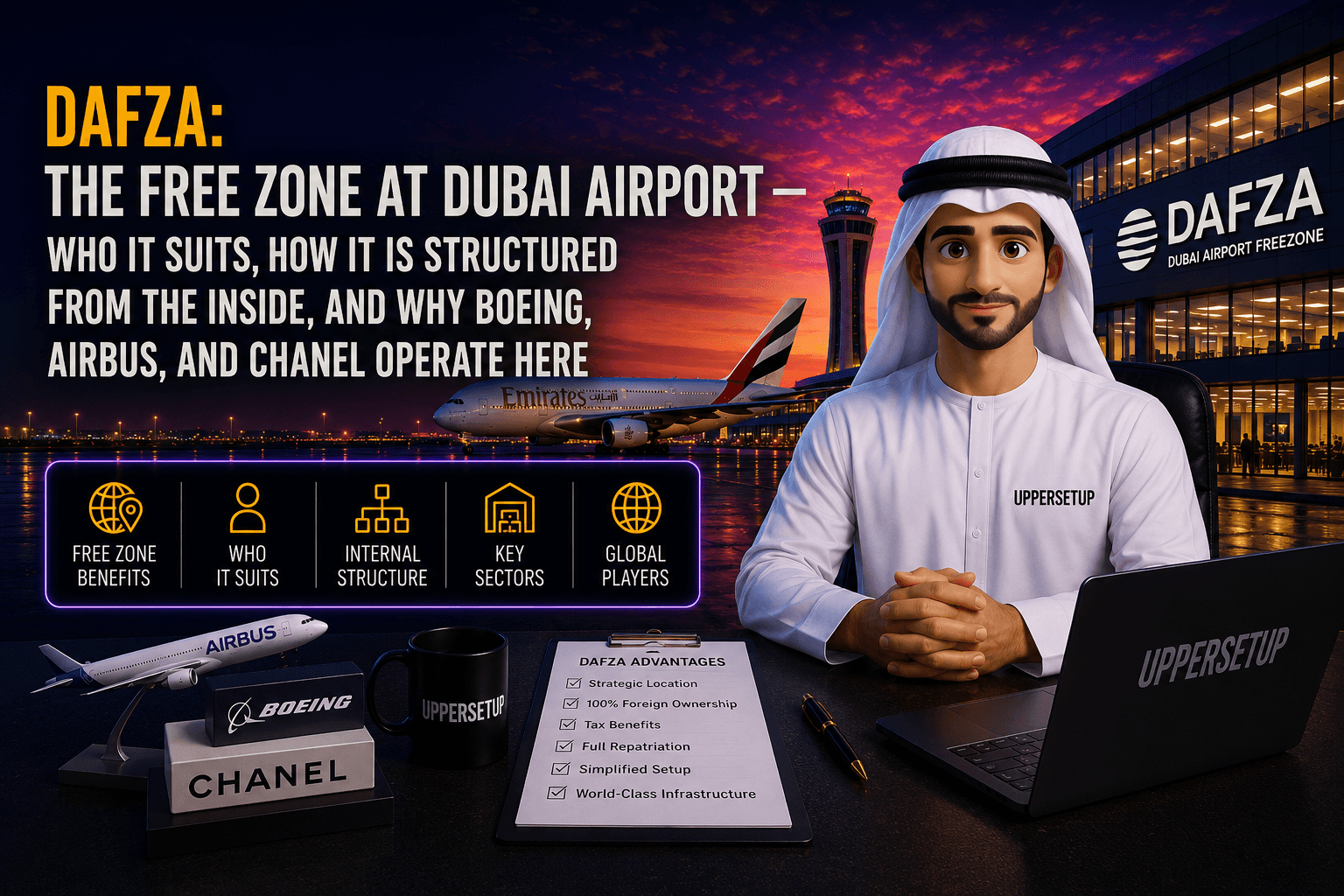
Among more than 45 free economic zones in the UAE, DAFZA occupies a special place — not because it is the cheapest, and not because it is the easiest place to set up. It occupies a special place because it was built as a specialized organism: the infrastructure, the rules, the residents, and the logic of the space here are subordinated to one single principle — direct physical access to global-scale air cargo flows. This makes DAFZA indispensable for some and completely irrelevant for others.
In this material, we examine the zone layer by layer: its history and legal nature, its physical infrastructure with all its nuances, the portrait of its resident community, and the logic of choosing it.
Without marketing abstractions — only what truly determines the operational value of this place.
1. Where DAFZA came from and why it was needed
Dubai Airport Free Zone Authority was established in 1996 in accordance with Law No. 2 of 1996 Establishing the Free Trade Zone in Dubai International Airport — a special law that established the zone directly within the boundaries of Dubai International Airport. This is a fundamental point: DAFZA is not simply “next to the airport” — it is physically part of it.
The decision was part of a large-scale state strategy to transform Dubai into an investment-driven economy. In 1996, DXB was already a regional hub, but it did not have organized infrastructure for attracting international business directly to transit cargo flows. DAFZA closed this gap: it created a legal shell, physical premises, and a regulatory regime that allowed companies to operate directly by the runway.
Over thirty years, the zone has gone from a regional experiment to one of the most frequently cited examples of an airport free zone in the world. Today it is part of the structure of Dubai Integrated Economic Zones (DIEZ) — a holding group that unites the emirate’s key specialized zones. DAFZA’s contribution to Dubai’s GDP is about 4.7% — an indicator that speaks of the real operational weight of the zone, and not simply of the number of registered legal entities.
2. Physical location: why this is not just an address
Dubai Airport (DXB) is the largest in the world by international passenger traffic and one of the leading aviation cargo hubs on the planet. More than 150 airlines operate flights from here to more than 220 destinations across six continents. For companies working with physical goods, this means that their warehouse in DAFZA is, in the literal sense, located on the territory of the largest redistribution hub in the Middle East.
Geographically, the zone is located in the central part of Dubai — between the Al Garhoud district and the terminals of DXB. This provides not only airport proximity, but also accessibility for ground transport: Al Quds Street (D91) connects the zone with Al Ittihad Street (E11), while Beirut Street (D62) leads to Sheikh Mohammed Bin Zayed Road (E311). Thus, DAFZA is a node of both air and ground logistics.
Additionally, the DAFZA metro station on the green line of Dubai Metro provides a direct connection between the zone and Dubai’s central business districts without the need to use a car. This is important for employees arriving for meetings or working in office blocks.
For companies with intensive air cargo operations, proximity to the airport creates a measurable competitive advantage: according to experts in the field of logistics, the time from an aircraft landing to the transfer of cargo to a DAFZAwarehouse can be about two hours — versus four to six hours for facilities located farther from the terminals.
3. Infrastructure: what physically exists across 696,000 square meters
This is one of the key questions that distinguishes DAFZA from most free zones. The zone is not a “licensing window” — it represents a fully equipped operational environment with its own physical infrastructure.
Office buildings
The zone includes 18 office buildings and 256 warehouse units located across a territory of 696,000 square meters. The office stock is organized into several formats.
Smart Desk is a format of minimal physical presence: a dedicated workstation in a shared space with access to common meeting rooms, printing infrastructure, and administrative services. It is suitable for companies that use DAFZA as a legal address with the possibility of periodic physical presence.
Standard offices are presented in several size configurations — from small units to spacious premises with the possibility of customizing the layout. Office premises in DAFZA are equipped with information technology services, cleaning services, and reserved parking spaces.
Premium offices are delivered fully furnished with telephone equipment — ready for work on the day of move-in. This format is in demand among international corporations opening a regional division: the team begins operational work without losing time on fit-out.
Corporate buildings — for large structures, the lease of entire office buildings or large blocks is available, which makes it possible to place several divisions in one unified physical space. For some properties, the possibility of purchase is also предусмотрена.
The key distinction of DAFZA’s office infrastructure from most free zones is that utility services are included in the lease cost: electricity and water supply. For manufacturing and logistics companies with high energy consumption, this significantly affects the calculation of total operating expenses.
Warehouse infrastructure
The average area of a warehouse unit in DAFZA is about 312 square meters (3,358 square feet). Part of the warehouses is equipped with refrigeration equipment, which makes it possible to store goods requiring temperature control.
The range of warehouse formats covers several operational logics.
Standard warehouses are intended for the storage, sorting, and dispatch of goods with direct access to customs infrastructure. Climate-controlled warehouses serve pharmaceuticals, cosmetics, food products, and beverages — categories that are sensitive to temperature conditions. Showrooms combine warehouse and representative functions: companies can demonstrate product samples to clients directly in the warehouse without additional transportation.
All warehouse infrastructure is located in a zone with round-the-clock customs clearance — this means that operations are not limited by the working hours of customs services.
Light industrial premises
Industrial blocks are intended for light manufacturing, assembly, packaging, testing, and repair. This is especially relevant for aviation MRO operators (maintenance, repair, and overhaul of aircraft), manufacturers of electronic components, and food industry enterprises working with finished products.
DAFZA Industrial Park
DAFZA Industrial Park is located in the Al Qusais area, 5 kilometers from Dubai International Airport. It offers a unique model of multi-client warehousing with flexible lease conditions for shared warehouse space.
The park functions as an extension of the main zone for companies that require large production or warehouse areas without the need to lease an entire industrial block. The shared warehouse model makes it possible to optimize costs while maintaining access to the zone’s infrastructure and its customs advantages.
DAFZ Square: the business and retail center of the zone
DAFZ Square is the central multifunctional complex of the zone, around which the social and business life of its residents is organized. A wide range of services includes event venues, a food court, banking services, and much more.
Building 8W within DAFZ Square is surrounded by various amenities and facilities: Dubai Duty Free inside the airport provides an extensive choice for shopping; nearby are Costa Coffee and the Medcare medical center.
Bank branches operate in the complex, which is critically important for the residents of the zone: the opening of a corporate account, banking operations, and financial servicing are available directly on the territory of DAFZA without the need to travel into the city.
It is notable that building 8W received LEED Gold certification (Leadership in Energy and Environmental Design)— an international standard of environmental sustainability for buildings. This is both an operational advantage (energy efficiency lowers expenses) and a reputational signal for international corporations with ESG obligations to their parent structures.
“One-stop-shop” service infrastructure
DAFZA provides a full range of supporting business services: employee sponsorship, online transaction processing, government services, banking services, communications, cleaning, catering, medical services, travel organization, and car rental.
Representations of key government authorities are located on the territory of the zone: Dubai Police, Dubai Customs, Dubai Health Authority, the General Directorate of Residency and Foreigners Affairs, and the Dubai Chamber of Commerce. This means that most regulatory and administrative matters are resolved without leaving the zone.
DAFZA also hosts Learning Bridge — a specialized educational space with computer equipment and internet access, including lecture halls, training spaces, and multifunctional rooms.
Medical and social infrastructure
A DAFZA medical fitness center operates on the territory of the zone for primary medical care. Specialized medical services are available in Aster Hospital, located nearby. On the territory of DAFZA Square there is a ZOOM store; inside the zone there is a mosque. Hummingbird Nursery — a British educational institution — is located directly in DAFZA.
This is important for employees with families: the infrastructure of the zone makes it possible to resolve everyday matters without leaving the territory during the working day.
Security
In 2020, a smart police station opened on the territory of DAFZA — an intelligent security post operating around the clock.
The station provides 46 types of security services, distributed across four packages: criminal services, road services, public services, as well as certificates and permits. Physical security is an operational requirement for companies storing jewelry, electronics, pharmaceuticals, and other high-value goods.
4. DAFZA residents: who is here and why
This is perhaps the most eloquent indicator of the value of the zone — not declarative, but practical.
Aviation and aerospace industry
The world’s leading aviation companies have chosen DAFZA as their home: Airbus, Boeing, GE Aviation, Rolls-Royce, Panasonic Avionics, Jetex, and others. Airbus opened here its first Avionics Maintenance Center in Africa and the Middle East.
This is not a random coincidence. For manufacturers of aviation components and MRO operators, the location of a spare parts warehouse 15 minutes from aircraft parking stands is not convenience — it is an operational necessity. Every hour of aircraft downtime costs an airline tens of thousands of dollars. Engineers from Boeing and Rolls-Royce working in DAFZA can receive the required part within an hour after its arrival by flight.
Logistics and freight forwarding
DHL is one of the largest and most well-known residents of the zone, maintaining a regional operational hub here. Transguard — the largest provider of security services and asset management in the UAE — is also based in DAFZA. Aramex, one of the leading logistics operators in the Middle East, has for many years used the zone as part of its regional infrastructure.
For logistics companies, DAFZA provides something that cannot be created elsewhere: direct integration with the airport customs system, its own cargo infrastructure, and physical proximity to the runways.
Luxury and consumer goods
Among the globally known brands that have placed their regional headquarters in DAFZA are Rolls-Royce, Boeing, and Chanel. The presence of Chanel in the zone reflects the fundamental logic of placing luxury-class companies: high-value goods require minimal transit time from the manufacturer to the regional distributor, as well as special warehouse conditions and a reliable security system.
Fortune 500 companies are also represented in DAFZA: Airbus, General Electric, Rolls-Royce, Roche, Boeing, and Chanel. This is a significant signal: the presence of several top-500 companies in one zone creates an ecosystem attractive for the suppliers, contractors, and partners of these structures.
Pharmaceuticals
Roche — one of the largest pharmaceutical corporations in the world — uses DAFZA as a regional distribution hub. Pharmaceutical companies choose the zone primarily for two factors: the presence of refrigerated warehouses with temperature control and the speed of customs clearance, which is critically important for medicines with a limited shelf life or a cold-chain storage requirement.
Beverages and FMCG
Red Bull placed its Middle Eastern base in DAFZA — a typical example of an FMCG company using the zone as a regional distribution center.
The model is simple: the goods arrive by flight, pass customs clearance in DAFZA, are stored in the warehouse, and are distributed across the markets of the UAE, the Gulf, and Africa. Airport logistics here are the key link in the chain.
Information technology and telecommunications
Technology companies oriented toward the markets of MENA, South Asia, and East Africa use DAFZA as an operational point for several reasons.
First, DXB is the largest transit hub for all of these directions — physical meetings with clients from India, Pakistan, Kenya, or Saudi Arabia can be held in the office on the day of the counterparty’s arrival.
Second, the zone is equipped with high-speed telecommunications infrastructure.
Third, presence in DAFZA provides access to a network of corporate clients from among the residents of the zone — potential buyers of information technology services.
Jewelry and precious stones
The industry of jewelry, precious metals, and stones is represented in DAFZA broadly and logically: the high value of the goods per unit of weight makes air transport the preferred method of delivery, while the zone’s reliable security system creates operational conditions that meet the requirements of insurers and industry regulators.
5. For whom DAFZA is suitable: the precise anatomy of the target business
On the basis of the analysis of infrastructure and the resident community, it is possible to formulate a clear profile of the company for which DAFZA is the optimal choice.
Companies with physical air cargo flows — this is the basic audience. If the business is built on regular air deliveries of goods into or out of the region, proximity to customs and runways creates direct operational value. These are logisticians, freight forwarders, distributors, and importers.
Regional headquarters of transnational corporations — DAFZA is one of the most prestigious addresses for positioning a Middle Eastern office. The reputational weight of the zone, the quality of the infrastructure, and proximity to global brands create an environment corresponding to the standards of large international structures.
Manufacturers and suppliers of the aviation sector — MRO operators, component manufacturers, suppliers of aviation equipment. For this category, proximity to DXB is not an option but a requirement of the operating model.
Distributors of high-value goods — jewelry, luxury goods, electronics, pharmaceuticals, cosmetics. The combination of security, logistics capabilities, and refrigerated warehouses creates optimal conditions.
Companies oriented toward the markets of MENA + South Asia + East Africa — DXB connects these markets by direct flights, and physical presence in the airport zone means being at the center of this connectivity.
6. Legal structures: briefly about the registration formats
DAFZA offers three main legal forms.
Free Zone Company (FZCO) — an analogue of a limited liability company. From 1 to 50 shareholders — natural persons, legal entities, or a combination of both. This is the most widespread form for new registrations. The company bears liability only within the limits of its share capital.
Branch Office — a division of an existing foreign or local company without its own share capital. The activity and the name coincide with the parent structure. The parent company bears full liability. This is the preferred form for transnational corporations opening a regional representative office under the umbrella brand.
Public Limited Company (PLC) — a joint stock company with the possibility of public placement of shares. It is used rarely — as a rule, by large structures with the intention of attracting public capital on regional exchanges.
7. Types of licences
Trade License — import, export, re-export, distribution, and storage of specific categories of goods.
Service License — professional, consulting, information technology services, and other service activities. The most widespread type — about 60% of all DAFZA licences fall precisely into this category.
Industrial License — light manufacturing, packaging, assembly. Requires the lease of industrial premises.
General Trading License — a universal licence for trading a wide range of goods without linkage to specific categories.
E-Commerce License — online trade, digital services, marketplaces. Introduced in 2019.
Education License — educational and social services, consulting in the field of education.
Talent Pass — a separate instrument for freelancers and self-employed specialists. Introduced under the directive of Sheikh Hamdan bin Mohammed bin Rashid Al Maktoum to attract global talent in the fields of media, education, technology, art, marketing, and consulting.
One licence covers up to three types of activity. Where approvals from external bodies are required — the Ministry of Health for pharmaceuticals, media regulators for media — the processing period increases; however, DAFZAconsolidates most approvals through the one-stop-shop system.
8. Registration procedure: from decision to licence
The standard period for company registration in DAFZA is 2–4 weeks, provided there is a full set of documents.
Choice of licence and legal form. The type of licence and the form are determined (FZCO or branch).
Reservation of the name. Three name options are submitted for approval. The name must comply with the requirements of the zone and must not duplicate existing registrations.
Submission of the application and documents. For natural persons: application, shareholders’ passports, bank statement for 6 months, bank reference letter, photographs, résumé, and a brief description of the activity. For corporate shareholders additionally: notarized and apostilled constituent documents of the parent company, audited financial statements, and shareholders’ resolution.
Signing of the lease agreement. Selection and payment for the premises — from this moment the licence period begins.
Receipt of the licence and corporate documents. Certificate of incorporation, trade licence, memorandum of association.
Receipt of the Establishment Card. This stage takes 7–10 working days and is a mandatory preceding step for visa processing.
Visa processing. Investor and employment visas — an additional 7–10 working days.
Opening of a corporate bank account. Banking services are available directly on the territory of the zone.
9. Comparison with the nearest alternatives
An honest expert analysis requires recognition of limitations and recognition of cases where DAFZA is not the optimal choice.
DMCC (Dubai Multi Commodities Centre) — if the core business is not connected with air cargo and physical logistics, and what is needed is a flexible ecosystem with a broad set of activities and a richer community, DMCC is preferable in many scenarios.
JAFZA (Jebel Ali Free Zone) — for sea logistics, large industrial manufacturing, and companies working with container shipments, JAFZA, with its proximity to the largest container port in the Middle East, is a more logical choice.
RAKEZ (Ras Al Khaimah Economic Zone) — for budget start-ups and small business without connection to airport logistics, RAKEZ offers a comparable basic free-zone package of advantages at a lower entry threshold.
Mainland DED licence — if the main market is the UAE, and the company plans active work with local clients without international cargo flows, the mainland licence is operationally simpler and provides direct access to all segments of the domestic market.
10. Conclusion: DAFZA as an instrument with a specific purpose
DAFZA is one of the few free zones in the world where the declared specialization is supported by real physical infrastructure, and not only by marketing positioning. Thirty years of history, about 4.7% of Dubai’s GDP, more than 3,300 companies from more than 100 countries, and the presence of Airbus, Boeing, GE Aviation, Rolls-Royce, Roche, Chanel, and DHL — this is not a set of brands for a brochure. This is an ecosystem formed around one single real competitive advantage: direct physical access to the largest international aviation hub on the planet.
The correct question when choosing DAFZA is not “expensive or cheap,” not “what tax benefits,” but one single question: does physical proximity to DXB airport create operational value for your specific business? If yes — the arguments in favor of DAFZA become undeniable. If not — there are alternatives that will solve your task more efficiently.
It is exactly this specialization — and not universality — that has made DAFZA one of the most substantial free zones in the world for almost three decades.
This article is informational in nature and reflects the current regulatory framework and operational data as of April 2026. Before making a decision on company registration, it is recommended to consult a licensed specialist in UAE corporate law and regulatory matters.
UPPERSETUP — an expert resource on company registration and doing business in the UAE.
Subscribe to our newsletter
Receive expert materials and special offers in the field of company setup and support, citizenship and residence permit for investment. Once a week without spam.
Read More on The Topic

Comprehensive Services for Your Business
Accounting Services
A key element of successful business management. Competent accounting support ensures compliance with local regulations, optimizes taxes, and enhances financial transparency.

Company Registration
The foundation of your business success. A seamless registration process tailored to UAE regulations helps you launch your venture with confidence and efficiency.

Bank Account Opening
An essential step for smooth business operations. Expert guidance ensures hassle-free bank account setup, meeting all compliance requirements for your business needs.

Tax Support
Stay ahead with professional tax solutions. Comprehensive support ensures compliance with UAE tax laws, optimizes financial planning, and avoids unnecessary risks.

Residency Visa Services
Your gateway to living and working in the UAE. Expert guidance ensures smooth processing of residency visas, compliance with regulations, and timely approvals for individuals and their families.
Legal Advisory
Navigate business challenges with confidence. Professional legal advice ensures compliance, protects your interests, and empowers informed decision-making for your business.