


 International Free Zone Authority
Kazakhstan’s 2027 Anti-Money Laundering Overhaul: What Non-Financial Businesses Must Do Now
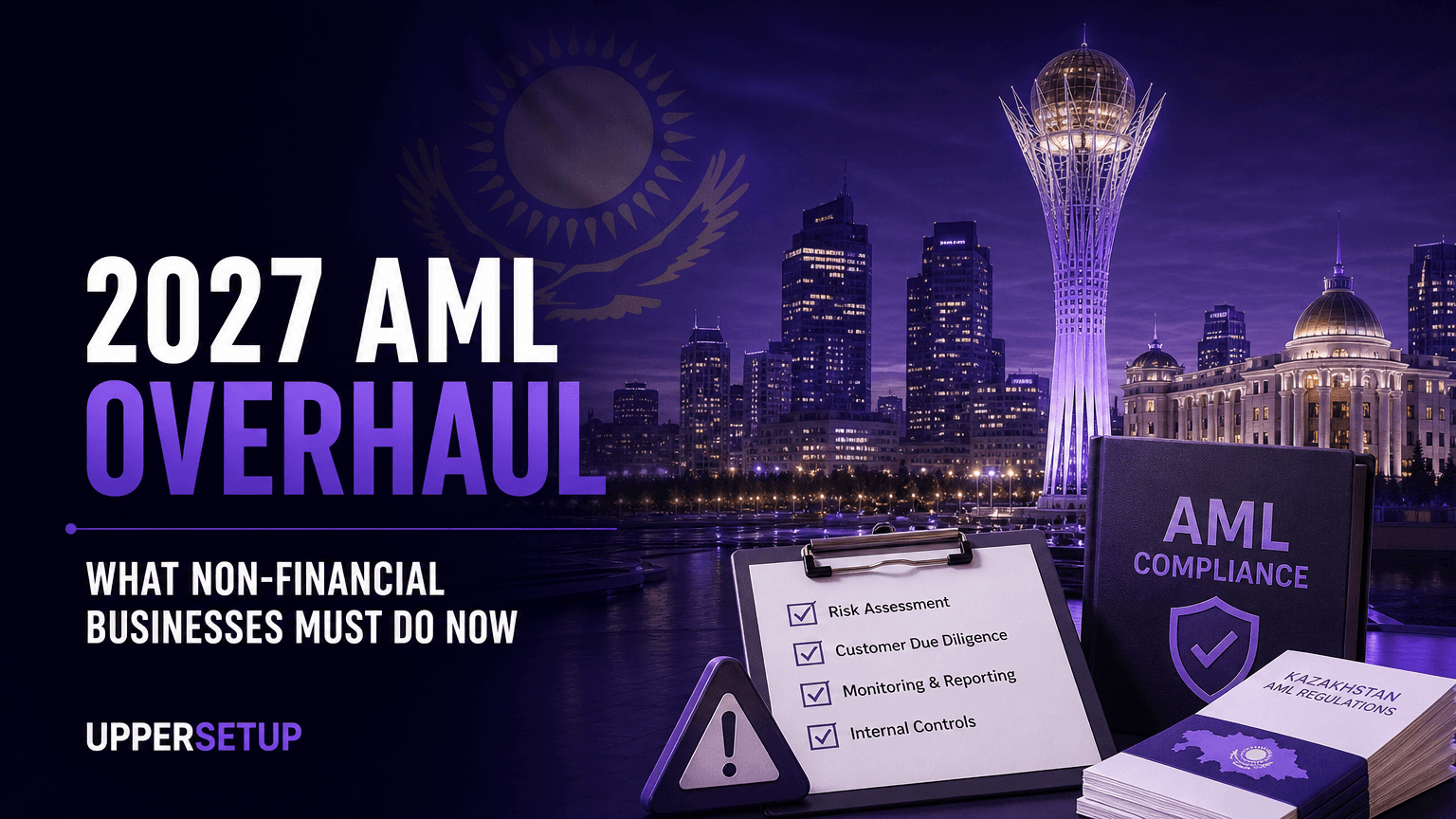
Kazakhstan’s 2027 Anti-Money Laundering Overhaul: What Non-Financial Businesses Must Do Now
Executive Summary: New AML Requirements — Who Is Affected and What’s Urgent?
Kazakhstan is implementing a new wave of anti-money laundering (AML) regulations that, beginning in 2027, will impose extensive compliance obligations on a wide array of non-financial businesses and professions (DNFBPs). Any business providing company formation, accounting, legal, or real estate services — as well as many others — will face mandatory registration, internal policy overhaul, and ongoing AML training and monitoring.
Alert: The most critical risk is incurring regulatory penalties — which, based on recent precedent and pending legislative proposals, are expected to be significantly higher for unregistered or non-compliant businesses from 2027 on. Unprepared entities risk disruption, reputational damage, criminal liability, and even loss of business licenses.
Legal Foundation: What Is the Core Law and Its Status?
The backbone of Kazakhstan's new AML regime is the amended Law of the Republic of Kazakhstan "On Combating Legalization (Laundering) of Proceeds from Crime and Terrorism Financing", initially enacted as Law No. 191-IV of August 28, 2009, with significant updates most recently introduced by Law No. 210-VII signed on July 15, 2025 and entering into force on January 1, 2027 (dates based on best-available legislative data; always confirm latest).
Critically, the 2027 amendments update the old regime by:
- Widening the spectrum of obliged entities well beyond banks and insurance companies to non-financial sectors;
- Defining precise categories and thresholds for registration, reporting, and internal controls;
- Imposing regular audit and re-certification requirements, with new administrative and criminal penalties for non-compliance.
What Is a Non-Financial Business under the 2027 AML Rules?
Under the 2027 AML regime in Kazakhstan, a non-financial business or profession (sometimes grouped as "DNFBP" in international standards) is any legal entity or person conducting activities outside of traditional financial services that are considered vulnerable for money laundering and terrorist financing. This includes accountants, lawyers, notaries, real estate agents, company service providers, precious metals and gemstone dealers, auctioneers, and certain consultants, among others.
Kazakhstan’s definition aligns with standards set by the Financial Action Task Force (FATF) but expands some categories specifically relevant to regional risks, such as company set-up and nominee shareholder services.
Who Must Register and Report under the New Regime?
All non-financial businesses falling within the outlined DNFBP categories must self-register with the Agency for Financial Monitoring of the Republic of Kazakhstan, prior to commencing relevant activities as of January 1, 2027.
There is no de minimis threshold for mandatory registration—any business, regardless of revenue or size, is obliged if its activities match the defined services.
Table: Obliged Non-Financial Businesses under Kazakhstan AML Law (2027)
| Category | Registration Required | Ongoing Reporting | AML Policy Update Required |
|---|---|---|---|
| Real Estate Agents | Yes | Yes (per transaction/quarter) | Yes |
| Lawyers/Notaries (certain transactions) | Yes | Yes (depends on activity) | Yes |
| Accountants/Auditors | Yes | Yes (annual & suspicious activity) | Yes |
| Corporate Service Providers (CSPs) | Yes | Yes | Yes |
| Precious Metals/Gems Dealers | Yes | Yes (large transactions) | Yes |
| Auction Houses | Yes | Yes (per transaction) | Yes |
| Cryptocurrency Exchanges* (to confirm) | Likely | Likely | Likely |
*By 2026, final coverage of virtual asset service providers is under regulatory review; confirm status before engaging in activity.
What Are the Key Internal Policy Requirements?
Every registered DNFBP must establish internal AML/CFT regulations (rules, controls, and procedures) covering: - Customer due diligence (CDD) and beneficial ownership checks; - Record retention (minimum five years); - Staff AML training and fit-and-proper checks; - Transaction monitoring and suspicious transactions reporting (STRs).
Internal control programs must be updated at least annually or whenever there is a material change in law, control staff, or business activity type.
How Does Kazakhstan’s Approach Compare Regionally and Internationally?
Kazakhstan’s 2027 AML updates put it broadly in line with FATF Recommendations and the standards of the Eurasian Group on Combating Money Laundering and Terrorist Financing (EAG).
The most comparable regional regimes (e.g., Azerbaijan, Russia post-2025 reforms, Uzbekistan) stipulate similar coverage, but Kazakhstan has: - Lower registration thresholds — no revenue or employee minimums; - More prescriptive rules on corporate service providers; - Stricter requirements for certified AML compliance officers.
Table: Regional Comparison of DNFBP AML Duties (2027, selected countries)
| Jurisdiction | Compulsory Registration | Internal AML Policies | STR Filing Deadline | Penalty (approx.) |
|---|---|---|---|---|
| Kazakhstan | Yes (all DNFBPs) | Yes (detailed) | 24h after detection | Up to KZT 10,000,000 |
| Russia | Yes (selected DNFBPs) | Yes | 24-48h | Up to RUB 5,000,000 |
| Azerbaijan | Yes | Yes | 1 business day | Up to AZN 50,000 |
| EU (typical) | Yes (per sector) | Yes | “Promptly” | Up to EUR 5 million |
Figures updated as of November 2026, but subject to rapid change; always confirm local implementation.
Step-by-Step: How to Register and Update Internal AML Policy
1. Identify Business Activities Applicable
Review company scope and actual operations. If activities qualify as DNFBP under 2027 updates, immediate action required.
2. Register with the Agency for Financial Monitoring
Submit online or paper-based registration before January 1, 2027. Registration portal link and required forms are available on the regulator’s official website; check for technical updates. (As of November 2026, launch of a simplified DNFBP portal is in progress.)
3. Appoint a Designated Compliance Officer
Nominate a staff member with sufficient experience and clean record. The compliance officer is responsible for day-to-day AML/CFT oversight and reporting.
4. Draft or Update Your Internal AML/CFT Rules
Adopt core policies on CDD, KYC, monitoring, record-keeping (up to five years after the end of the business relationship), staff AML training (at least annually), as well as escalation and whistleblowing procedures.
5. Implement Regular Training and Monitoring
All relevant employees must undergo AML/CFT training at onboarding and annually thereafter. Internal audit of AML systems is recommended at least once per year.
6. Set Up Reporting and Record-Keeping Processes
Establish clear mechanisms for reporting suspicious transactions both internally (to the compliance officer) and externally (using the Agency’s official reporting portal, typically within 24 hours of detection).
Typical Mistakes — And Why They’re Expensive
1. Failing to Register On Time. Not registering before starting DNFBP activities triggers hefty administrative fines and, in severe cases, suspension of business licenses.
2. Using Generic or Outdated AML Procedures. Copy-pasted or legacy policies that do not reflect Kazakhstan’s latest requirements (especially CDD or STR thresholds) are common grounds for regulatory rejection or penalty.
3. Appointing Inexperienced Compliance Officers. A compliance officer lacking training or regulatory credibility exposes the business to audit risk — and future personal liability.
4. Incomplete Record-Keeping. Failure to retain key records (for at least five years post-transaction) impairs the ability to demonstrate compliance; regulators prohibitively sanction companies for missing documentation.
Who Should Act Now (And Who Is Exempt)?
Immediate action is required for any business or individual: - Engaged in company formation, nominee or trust creation, accounting, notarial, or legal services involving third-party assets; - Trading in real estate or facilitating high-value property transfers; - Dealing in precious metals, jewelry, or facilitating large-volume auction sales.
Exempt (for now): retail consumer shops (not primarily in precious metals/gems); professional freelancers with no legal entity and not handling third-party funds; purely internal accounting teams at single-owner businesses. These exemptions are subject to change as the regulatory perimeter evolves.
Frequently Asked Questions (FAQ)
Q1: Do I need to register if I only handle a few real estate transactions per year?
Yes, frequency does not exempt a business — if you act as an intermediary (agent or broker) in any qualifying transaction, registration is mandatory regardless of volume.
Q2: What is the penalty for non-registration in 2027?
As of November 2026, draft regulatory schedules propose administrative fines up to KZT 10,000,000 per offense (subject to legislative finalization); criminal liability may also apply in cases of repeated or willful violations.
Q3: What activities require customer due diligence (KYC) under Kazakh AML law?
All transactions involving the movement, management, or conversion of third-party funds/assets that fit defined "risk activities" (listed in the DNFBP annex) require CDD, regardless of transaction amount.
Q4: How often must AML policies and training be updated?
Internal policies must be reviewed at least annually and after any major legislative changes. Staff AML training must occur at onboarding and at least once per twelve months.
Q5: Is it enough to copy policies from another country or bank?
No. The Agency for Financial Monitoring mandates that AML/CFT procedures be tailored to the business’s specific risks, size, and sector under Kazakh law; foreign templates alone will not pass regulatory review.
Q6: Are cryptocurrency exchangers included in the new requirements?
As of late 2026, crypto-asset service providers are likely to be included, but coverage remains under review. Businesses in this sector should monitor announcements and be ready for rapid compliance updates.
What to Remember: Key Takeaways for DNFBPs
- The obligation to register is broad and applies to nearly every non-financial business providing any form of third-party transaction, asset management, or high-value property service from January 1, 2027.
- Internal policies must be detailed, tailored, and updated annually; generic or foreign versions are not sufficient.
- Penalties for non-compliance are severe and likely to increase further as the new regime is enforced.
- Immediate review of business activity is essential: Do not wait until 2027 to audit your business’s exposure.
Final Summary
Kazakhstan’s new anti-money laundering regime, effective from January 1, 2027, imposes strict registration and internal compliance duties across a broad array of non-financial businesses, including but not limited to real estate, legal, accounting, and company service providers. Registration with the Agency for Financial Monitoring is required before commencing covered activities, with robust internal controls, KYC measures, and reporting standards enforced by substantial administrative and potential criminal penalties. The regime is among the most rigorous in Central Asia, and compliance should be seen as both a legal imperative and key risk mitigation practice.
For advice on Kazakhstan AML compliance, company registration, visas, banking, or full-scale business setup support, contact UPPERSETUP.
Sources
- Law of the Republic of Kazakhstan "On Combating Legalization (Laundering) of Proceeds from Crime and Terrorism Financing" No. 191-IV, August 28, 2009 (as amended)
- Law No. 210-VII, signed July 15, 2025, effective January 1, 2027
- Agency for Financial Monitoring of the Republic of Kazakhstan (official portal, as of 2026)
- FATF Recommendation 22; relevant EAG (Eurasian Group) typologies
- Official regional comparator laws (Russia, Azerbaijan, Uzbekistan)
- Big4 global AML guidance (most recent published versions, 2026)
Disclaimer
This material is for informational purposes only and does not constitute legal, tax, financial, investment, or consulting advice. You must seek individualized professional guidance, tailored to your specific situation, jurisdiction, company status, and current regulatory requirements before making any decisions.
Read more on the topic
All services on the platform
Everything you need to start and run a business - in one place
- 2–10 days
Company Setup
Kazakhstan company with a complete set of incorporation documents
Start - Monthly
Accounting Services
Accounting and Tax Compliance, Reporting, and Support in Accordance with Kazakhstan Requirements
- 4–8 weeks
Immigration Services
Visas, Work Permits
- 7–30 days
Banking Services
Corporate Bank Accounts in Kazakhstan and Payment Services
- Custom timeline
Permits and Licenses
Business Licenses and Activity Permits
- Custom timeline
Legal Services
Corporate Documents, Contracts, Compliance, Licensing, and Company Structure Changes


