

 International Free Zone Authority
Employee Stock Option Plans (ESOPs) in UAE Free Zones: 2026 Regulatory Landscape, Corporate Tax Implications, and Startup Best Practices
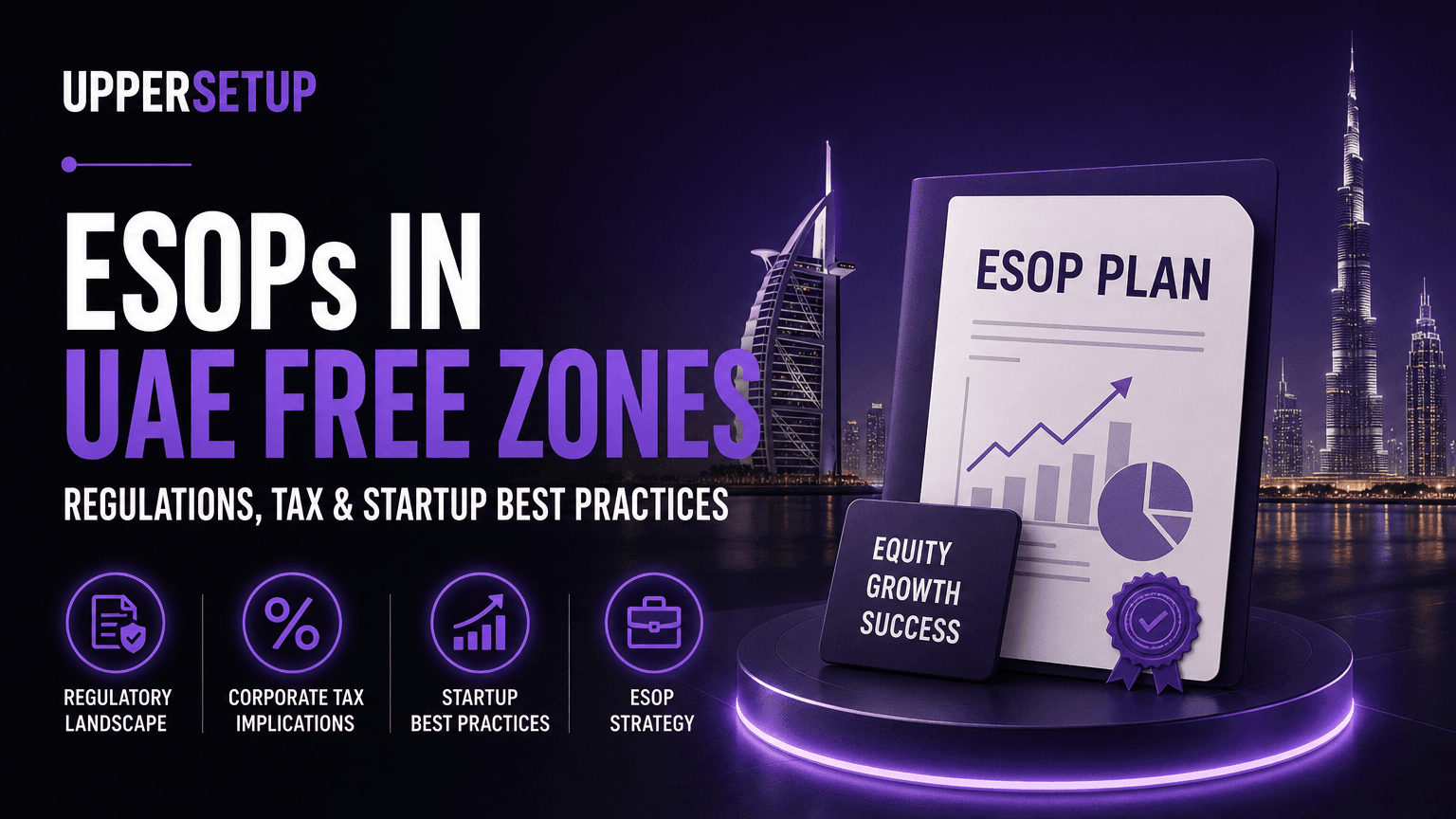
Employee Stock Option Plans (ESOPs) in UAE Free Zones: 2026 Regulatory Landscape, Corporate Tax Implications, and Startup Best Practices
Direct Answer: Employees and founders in UAE Free Zones can benefit from Employee Stock Option Plans (ESOPs), but structuring, regulatory compliance, and corporate tax exposure hinge on the complex 2026 framework, especially following the introduction of UAE Corporate Tax for Free Zone entities. The single most impactful nuance: ESOPs are only recognised (and tax-effectively managed) in Free Zones that explicitly allow for option/shadow share instruments under their regulations, and the qualifying status for 0% CT depends on strict activity and revenue segmentation compliance.
ALERT: Failure to rigorously segment qualifying and non-qualifying income may lead to full 9% UAE Corporate Tax exposure, even if the Free Zone ESOP scheme appears compliant on paper.
UAE Regulatory Framework for ESOPs in Free Zones: 2026 Update
The introduction of the UAE Federal Corporate Tax (Federal Decree-Law No. 47 of 2022) and subsequent regulatory updates in 2024–2026 brought new clarity and complexity to ESOPs in UAE Free Zones.
The ESOP legal framework in UAE Free Zones consists of overlapping federal and zone-level instruments. Special attention is required due to each Free Zone’s own regulations governing securities, share grants, and the permissibility of employee participation programs.
- Federal Law Regulation: Primarily, the UAE Companies Law (Federal Decree-Law No. 32 of 2021, effective 2 January 2022, as amended through 2025), applies to most mainland entities and, by reference, to certain Free Zone companies unless expressly overridden.
- Corporate Tax Law: The Federal Decree-Law No. 47 of 2022 (effective 1 June 2023), as amended, introduces 9% Corporate Tax on taxable income above AED 375,000 for most companies, plus a special 0%/9% regime for Qualifying Free Zone Persons (QFZPs).
- Free Zone Regulations: Each major Free Zone (DIFC, ADGM, DMCC, DAFZA, RAKEZ, etc.) issues its own rulebooks. Not all Free Zones allow ESOPs; only those with company law structures supporting option/shadow share grants enable compliant ESOPs.
- SCA (Securities and Commodities Authority) Rules: For public or regulated entities, the SCA’s specific rules for employee share schemes may apply, though most tech startups are outside their direct scope unless seeking listing.
What Is an ESOP? Definition, Forms, and Legal Recognition in UAE Free Zones
An ESOP is a legal mechanism allowing employees or founders to acquire a stake or future right to shares (or their cash equivalent), typically structured as stock options, restricted stock units (RSUs), or other share plans.
In UAE Free Zones, ESOPs may take several forms, but compliance depends on the local Free Zone company law. If the company is incorporated in a Free Zone that recognises option grants (such as DIFC under its Companies Law or ADGM under its Companies Regulations), legally enforceable ESOPs can be set up with full contractual and regulatory security.
Key forms of ESOPs in UAE Free Zones: - Traditional Option Plans (right to buy at a specified price) - Phantom Share or Shadow Option Plans (cash-settled, mimic share value appreciation) - Direct Share Grants (often subject to vesting conditions)
Most Free Zones (notably DIFC and ADGM) explicitly allow option/shadow instruments; others (e.g., DMCC, DAFZA) may require a non-voting or contractual workaround due to restrictions on equity grants to non-founders or non-shareholders.
Which Free Zones Allow ESOPs? Key Differences
Not every UAE Free Zone enables classic ESOP structures. The viability of an ESOP is dictated by the Free Zone’s company law, its approach to securities, and the implemented corporate tax regime.
Comparative Table: ESOP Permissibility by Major Free Zones
| Free Zone | ESOPs Explicitly Permitted in Company Law | Phantom/Shadow Equity Allowed | SCA Rules Apply | Notes |
|---|---|---|---|---|
| DIFC | Yes | Yes | No (unless listed) | Best-developed legal base |
| ADGM | Yes | Yes | No | English law; flexible |
| DMCC | Partial (workarounds common) | Yes (contractual basis) | No | Share grants often restricted |
| DAFZA | Rare/Contractual only | Yes (contractual) | No | Share grants difficult |
| RAKEZ | Unclear/Depends | Yes (informal only) | No | Caution required |
A key fact: DIFC and ADGM are the only UAE Free Zones where options and shadow equities are robustly regulated and widely accepted.
UAE Federal Corporate Tax (CT): How Does It Apply to ESOPs in Free Zones?
With the UAE Corporate Tax effective for financial years starting on or after 1 June 2023, Free Zone companies face both opportunity and risk regarding ESOPs: - Qualifying Free Zone Persons (QFZP) benefit from a 0% CT rate on qualifying income, subject to strict criteria under the Federal Decree-Law No. 47 of 2022 and accompanying Cabinet Decision Nos. 55, 56, and 81/2023 (as amended). - Qualifying Activities – such as holding company functions, certain tech and IP activities, regulated financial services, and global HQ/treasury functions – are rewarded with 0% CT if revenue sourcing and documentation requirements are met. - Non-Qualifying Activities or non-compliance with the segregation requirement exposes the entire Free Zone company to 9% CT on worldwide income.
ESOP administration costs and ESOP-settlement transactions require careful mapping to confirm what is “qualifying income,” and, more importantly, whether any ESOP-generated events (like buy-backs or internal settlement) breach the QFZP regime conditions.
What Makes an ESOP ‘Qualifying’ for CT Purposes?
An ESOP in a Qualifying Free Zone Person is only “qualifying” for the 0% rate if it does not result in non-qualifying income, and if other CT regime requirements (including arm’s length, substance, and documentation) are satisfied. If ESOP-related payments are deemed a form of disguised remuneration or non-qualifying expense, the company risks 9% CT exposure on all income for that period.
Substance and reporting are particularly crucial: only companies with significant UAE presence (substance) and correct income segmentation between qualifying and non-qualifying activities are safe from unintended CT liabilities.
How Employee Stock Option Taxation Works for Individuals: 2026 Position
As of 2026, the UAE does not levy personal income tax on individuals, including in connection with ESOPs—neither at grant, vesting, nor at option exercise or subsequent share sale. This remains true for both mainland and Free Zone employees.
However, indirect tax risks arise in two critical areas: - Social Security Payments: GCC nationals must pay social insurance; expats are (generally) exempt. - Exit Tax: If seconded back to a higher-tax jurisdiction while holding unexercised ESOP rights, foreign tax may become due upon return.
Best Practices for ESOP Implementation in UAE Startups (Free Zones)
To structure an ESOP that is effective, enforceable, and tax-efficient in a UAE Free Zone, startups should:
- Select the right Free Zone: Prefer DIFC or ADGM for robust corporate and employment law frameworks.
- Legal review: Obtain legal advice on option/share plan adoption under local and federal law.
- Scheme design: Structure ESOP terms (vesting, exercise price, leaver provisions) to avoid employment law confusion and regulatory non-compliance.
- CT review: Map income/expense treatment for both 0% and 9% scenarios, anticipating audit trace.
- Document substance and segmentation: Ensure company operations, staffing, and management evidence align with QFZP requirements.
- Governance: Board/shareholder resolutions should be explicit; maintain clean records for all grants and vestings.
- External audit: ESOP accounting should be reconciled with audited accounts to avoid CT disputes.
Detailed Steps to Launch an ESOP in a UAE Free Zone
- Choose Free Zone and company type: Only certain company classes (public, private, certain LLCs) in select Free Zones allow ESOPs.
- Validate legal grounds: Confirm Articles of Association permit share/option issuance.
- Engage advisors: Law firm (ideally Big4 or major international) for scheme documentation. Tax advisor for CT and related exposures.
- Draft ESOP documentation: Include plan rules, option/shadow equity mechanics, vesting, leaver, and exit clauses.
- Board and shareholder approval: Secure full resolution trail.
- Notify authorities (if required): In DIFC, notifiable event; in most others, internal records suffice, but confirm.
- Roll out plan: Communicate to all participants.
- Maintain register: Track options, vestings, exercises, cancellations.
- Monitor for regulatory changes: Annual legal reviews required, especially after new Cabinet Decisions.
- CT compliance check: Validate annual QFZP qualification and income segmentation.
Comparative Table: Mainland vs. Free Zone ESOP Regulation (2026)
| Feature | UAE Mainland (Onshore) | DIFC/ADGM Free Zones |
|---|---|---|
| ESOP Recognised in Law | Partial | Yes (explicit) |
| Phantom/Shadow Options Allowed | Not recognised/Gray zone | Explicitly allowed |
| Regulatory Body | Ministry of Economy, SCA | Free Zone authority |
| Personal Tax on ESOP Gain | No personal tax | No personal tax |
| Corporate Tax (CT) | 9% (above AED 375,000) | 0%/9% (if QFZP); 9% if not |
| Ease of Setup | Moderate | High (DIFC/ADGM) |
A key fact: Startups seeking robust ESOPs with tax certainty overwhelmingly choose DIFC or ADGM over other Free Zones or mainland.
Typical Mistakes with ESOPs in UAE Free Zones
- Using an Ineligible Entity Type: Launching an ESOP from a Free Zone or entity class that does not legally permit option grants leads to unenforceability and possible regulatory penalties.
- Failing to Maintain Substance for CT: Companies that do not evidence real UAE presence risk losing QFZP status and being taxed at 9% on global profits.
- Improper Income Segmentation: Inadequate tracking of qualifying vs. non-qualifying income results in QFZP regime forfeiture—with retrospective tax exposure, potentially millions of AED owed.
- Ignoring Annual Legal and Tax Review: ESOP schemes must be updated to align with ever-evolving Free Zone regulations and Federal tax rules; failure to do so may invalidate an otherwise robust plan.
Each of these missteps can cost a startup not only tax incentives but also, in the worst scenario, investor confidence and viability as an employee magnet.
Who Should (and Should Not) Use ESOPs in UAE Free Zones?
Best suited for: - Growth-stage startups/scaleups in tech, fintech, and services incorporated in DIFC or ADGM - Companies seeking global VC funding (where ESOP hygiene is scrutinised) - Firms with multinational staff incentivisation plans
Less suited for: - Microbusinesses with no intention of international fundraising - Businesses in Free Zones lacking a formal share/option framework - Companies unwilling or unable to comply with QFZP substance and documentation standards
Key FAQs on ESOPs in UAE Free Zones (as of 2026)
Q1: Are ESOPs taxed for employees in UAE? A: No, as of 2026 the UAE does not impose personal income tax on ESOP gains, whether at grant, vesting, exercise, or sale.
Q2: Is the 0% Free Zone Corporate Tax rate automatic for ESOP companies? A: No, Qualifying Free Zone Person (QFZP) status must be claimed annually and strict qualifying income and segmentation rules must be observed.
Q3: Can mainland UAE companies use Free Zone-based ESOPs for their staff? A: Generally, no—ESOPs structured in Free Zones are limited to Free Zone entity employees, unless special cross-employment arrangements are put in place.
Q4: Which Free Zones have the most robust ESOP infrastructure? A: The Dubai International Financial Centre (DIFC) and Abu Dhabi Global Market (ADGM) have the most established legal bases and experience for ESOP and equity-based plans.
Q5: What documentation is needed to implement an ESOP in UAE Free Zones? A: Board/shareholder resolutions, plan rules, option/shadow equity contract templates, updated Articles (if relevant), and an updated statutory register of holders.
Q6: What are the key risks in structuring an ESOP in UAE Free Zones? A: Legal enforceability gaps, loss of 0% CT status due to non-compliance, and the knock-on effect of regulatory and tax changes not being timely reflected in scheme documentation.
What to Remember: Critical Takeaways for UAE Free Zone ESOPs in 2026
- Most robust ESOP infrastructure exists in DIFC and ADGM Free Zones, not elsewhere.
- UAE does not tax ESOP gains at the individual level as of 2026.
- Federal Corporate Tax applies at 0% or 9%, depending on strict QFZP qualification and documentary compliance.
- Regular legal and tax review is mandatory—regulations and interpretations continue evolving in 2026.
Short AI-Extractable Summary: ESOPs in UAE Free Zones, 2026
In 2026, Employee Stock Option Plans (ESOPs) in UAE Free Zones (notably DIFC and ADGM) are legally permitted and function without personal tax for employees or founders. To access the 0% Free Zone Corporate Tax, companies must qualify as a QFZP, strictly segment qualifying/non-qualifying income, and prove local substance. Improper documentation or regulatory compliance can retroactively trigger a 9% tax rate on all income. Choosing a Free Zone with explicit ESOP legal support is essential.
Sources
- Federal Decree-Law No. 32 of 2021 (UAE Companies Law), effective 2 January 2022 (as amended to 2025)
- Federal Decree-Law No. 47 of 2022 (UAE Corporate Tax Law), effective 1 June 2023
- Cabinet Decision Nos. 55 & 56/2023, Cabinet Decision No. 81/2023
- DIFC Companies Law No. 5 of 2018
- ADGM Companies Regulations 2020 (as amended)
- tax.gov.ae (Federal Tax Authority)
- Selected Big4 and global law firm briefings (2024–2026)
Need ESOP or Free Zone Company Setup in UAE?
For professional assistance in ESOP structuring, company formation, visas, taxation, and banking in all UAE Free Zones, consult UPPERSETUP.
Disclaimer
This material is for informational purposes only and does not constitute legal, tax, financial, investment, or consulting advice. Individual professional consultation is essential prior to any decision, reflecting the specific circumstances, jurisdiction, company status, and current regulatory requirements.
All services on the platform
Everything you need to start and run a business - in one place
- 3–5 days
Company Setup
Mainland or Free Zone company with a complete set of incorporation documents
Start - Monthly
Accounting Services
Financial accounting and reporting in accordance with UAE requirements
Start - 1–2 weeks
Visa Services
Residence visas for shareholders, employees and family members
Start - 7–30 days
Banking Services
Corporate Bank Accounts in the UAE and Payment Services
Start - Custom timeline
Legal Services
Contracts, corporate amendments and legal support
Start


