
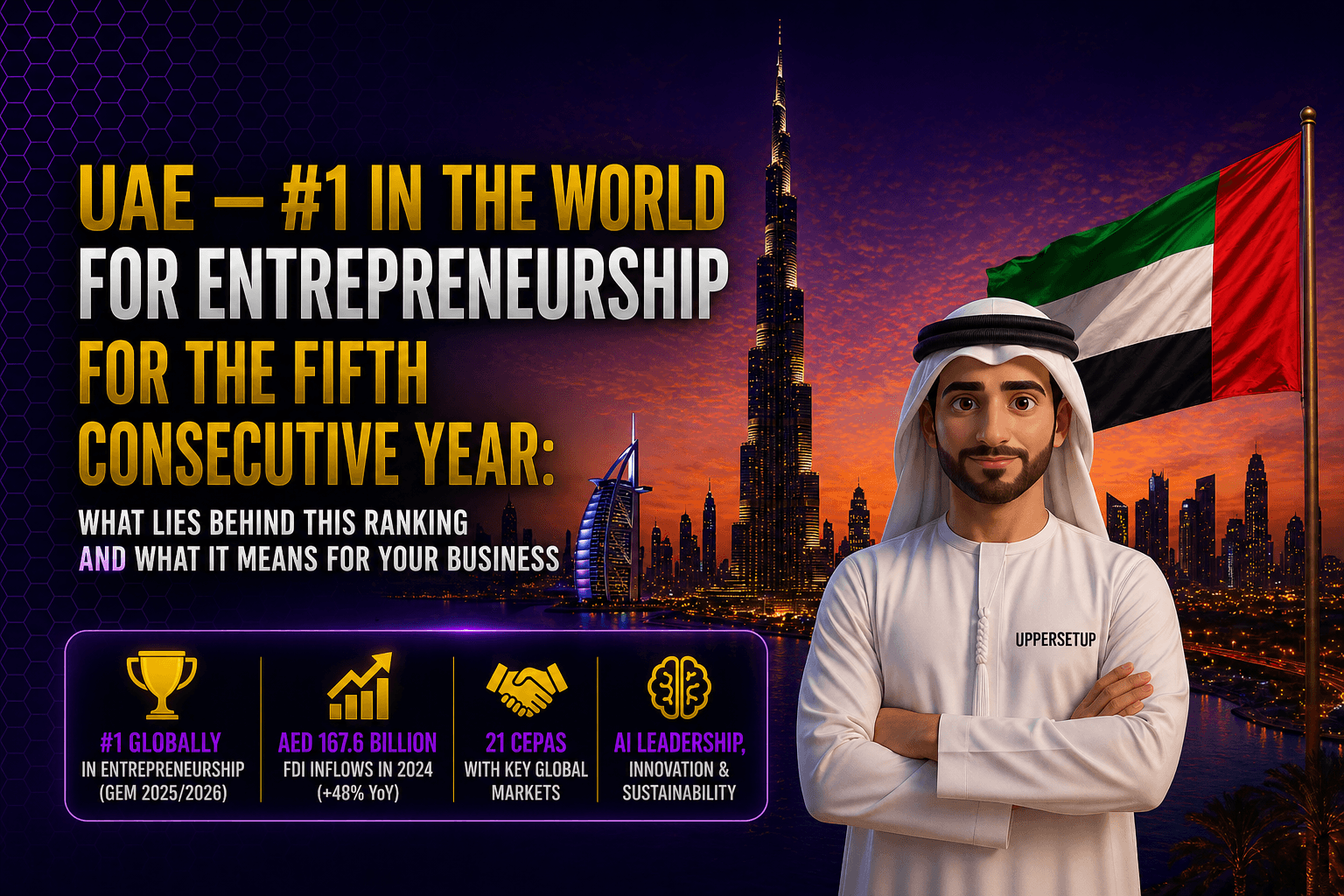
UAE — #1 in the World for Entrepreneurship for the Fifth Consecutive Year: What Lies Behind This Ranking and What It Means for Your Business
May 01, 2026
Introduction. Five Years Running — This Is No Longer a Coincidence
Ranking first in the global entrepreneurial ecosystem rating once is an achievement. Holding that position for five consecutive years, outperforming Germany, the United Kingdom, the United States, the Netherlands, and other developed economies, is a systemic result that demands explanation.
On 25 April 2026, the Global Entrepreneurship Monitor (GEM) 2025/2026 Report was published — one of the most authoritative entrepreneurship research projects in the world, based on more than two million interviews since its launch and covering in this edition 53 economies representing approximately 43% of the world's population and 57% of global GDP. The UAE ranked first in the world in the National Entrepreneurship Context Index (NECI) for the fifth year in a row.
For an entrepreneur selecting a jurisdiction for business, this is not just a news headline. It is a verified, independently researched confirmation that choosing the UAE is not a marketing narrative but a measurable reality. This article breaks down what GEM assessed, which parameters the UAE leads on, what data underpins the ranking, and what this means for an entrepreneur planning to open a business in the UAE in 2026.
Part I. What Is GEM and Why This Is Not an Ordinary Ranking
The Global Entrepreneurship Monitor (GEM) is an independent research consortium founded in 1999 jointly by Babson College (USA) and London Business School (UK). GEM is not a ranking compiled by governments or business associations — it is an academic study that annually collects data using two independent methods:
— Adult Population Survey (APS): surveys of representative adult samples in each participating country, measuring actual entrepreneurial activity — how many people are launching businesses, at what stage, and what drives them;
— National Expert Survey (NES): structured interviews with national experts in entrepreneurship — entrepreneurs, investors, academic researchers, policymakers — assessing the quality of business conditions in their country.
The expert assessments form the basis for calculating the NECI (National Entrepreneurship Context Index) — a composite index of the quality of national entrepreneurship conditions. The UAE ranks first on this index. The UAE's NECI score for 2025 is 7.0 out of 10 — the highest among 53 assessed economies.
For comparison: most leading European economies — Germany, France, the United Kingdom — post NECI values in the range of 5.5–6.5. The United States scores around 6.5. The UAE consistently maintains a gap that is structural rather than symbolic.
Part II. The Eight Parameters on Which the UAE Ranks First
According to GEM 2025/2026, the UAE ranked first among high-income economies across the following eight key indicators:
|
GEM Indicator |
What It Means in Practice |
|
Physical infrastructure |
Quality of transport, communications, power supply, office space — availability and reliability for business |
|
Government policy: support and relevance |
Existence and effectiveness of government programmes supporting entrepreneurship and SMEs |
|
Government policy: taxes and bureaucracy |
Tax burden and administrative barriers when operating a business |
|
Government entrepreneurship programmes |
Availability of government grants, accelerator programmes, and startup support |
|
R&D transfer |
Accessibility to businesses of technology developments from universities and research centres |
|
Ease of market entry: market dynamics |
Market competitiveness and the ability of new players to enter without excessive barriers |
|
Ease of entry: regulatory burden |
Complexity of regulatory requirements when registering and launching a company |
|
Entrepreneurship education |
Quality and accessibility of educational programmes for entrepreneurs at different levels |
In addition to first place on these eight indicators, the UAE placed second globally on two further parameters:
— Entrepreneurial finance: availability of venture capital, government grants, and bank funding for startups and growing companies. On this measure the UAE trails only Israel, the region's historic venture market leader;
— Ease of access to funding: speed, transparency, and accessibility of financial instruments for entrepreneurs at different stages of development.
Part III. UAE's Unique Positions: AI, Sustainability, and International Access
Beyond the eight key parameters, GEM 2025/2026 highlighted a number of UAE positions that are qualitatively unique.
UAE Among Six Countries Recognising the Critical Role of AI
The GEM report noted that the UAE is among only six countries globally whose entrepreneurs unanimously recognise artificial intelligence as critically important for business over the next three years. This is not a declarative state position — it is an assessment by the entrepreneurs themselves, recorded in the course of an independent survey.
Context: DIFC in April 2026 announced its AI Native programme, targeting the creation of 25,000 jobs and generating AED 12.9 billion for the economy; DIFC is targeting the status of the world's first AI Native financial centre. The UAE AI Office is actively implementing the UAE AI Strategy 2031. The country's economic regulators and academic institutions have integrated AI preparation into educational programmes. This builds an ecosystem where AI entrepreneurs have access to infrastructure, talent, and government support comparable to very few other jurisdictions globally.
'Excellent' Rating for Sustainability and AI Awareness
Together with Taiwan, Norway, and Sweden, the UAE received an 'Excellent' rating on two qualitative parameters: sustainability priorities and AI awareness. Notably, the UAE is the only oil-producing economy in this group — reflecting real progress in economic diversification and the structural transformation of its business landscape.
Top 5 Globally for International Access
The UAE entered the global top five on the parameter of 'international access' — the ability of startups and companies to reach external markets through a well-developed logistics and infrastructure network. Dubai International Airport is the world's busiest by international passenger throughput; Jebel Ali is one of the world's largest container ports; the country is party to 21 Comprehensive Economic Partnership Agreements (CEPAs) covering key markets including India, Indonesia, Israel, the United Kingdom, and many others.
Part IV. Entrepreneurial Activity Among the Population: Real Figures
GEM measures not only the quality of the environment but also real behaviour — how many people are actually launching businesses.
GEM 2025/2026 data for the UAE:
— More than 20% of adults are involved in starting new ventures;
— Total Early-stage Entrepreneurial Activity (TEA) — 19.2%: the share of adults who are either starting a new business within the last 3 months or own a young business under 42 months old;
— Entrepreneurial activity among UAE nationals — 19.6%;
— Entrepreneurial activity among resident expatriates — 22.4%, exceeding the activity of nationals, reflecting the UAE's appeal as a global entrepreneurial hub;
— The report records growing support for women entrepreneurs and the development of a business innovation culture rooted in family and community networks.
For comparison: the average TEA level across high-income countries is approximately 12–15%. The UAE with a TEA of 19.2% outperforms most developed economies on actual entrepreneurial engagement, not just on the quality of conditions.
Part V. Foreign Direct Investment: What UNCTAD Data for 2024 Shows
The GEM ranking reflects the quality of conditions. FDI inflows reflect the reaction of global business to those conditions. The 2024 data published in the UNCTAD World Investment Report 2025 provides a comprehensive picture.
UAE FDI: Key Indicators for 2024 (Source: UNCTAD World Investment Report 2025)
|
Indicator |
Value |
|
FDI inflows in 2024 |
AED 167.6 billion (USD 45.6 billion) |
|
Year-on-year FDI growth |
+48% versus 2023 |
|
Global FDI ranking (2024) |
10th place globally |
|
Share of all FDI into MENA region |
37% (every third FDI dollar in the region goes to the UAE) |
|
Ranking by new greenfield projects |
2nd globally (after the US) — 1,369 projects |
|
UAE greenfield growth vs global average |
+2.8% vs global average of +0.8% |
|
Total accumulated FDI stock (2024) |
USD 270.6 billion |
|
FDI target to 2031 |
AED 2.2 trillion (National Investment Strategy 2031) |
UAE Minister of Investment Mohamed Hassan Al-Suwaidi commented: "The UAE's investment ecosystem has become a global model, thanks to its stability, transparency, trade openness, and ease of doing business."
Part VI. What Underpins the Ranking: Five Structural Reforms That Changed the UAE
The UAE's GEM position is not the result of effective PR. It is the consequence of consistent reforms implemented over the past five years that directly address the barriers that traditionally hindered foreign entrepreneurs.
Reform 1. 100% Foreign Ownership on the Mainland (2021)
Federal Decree-Law No. 26 of 2020 (effective 1 June 2021) eliminated the mandatory 51% local partner requirement for most commercial, professional, and industrial activities on the mainland. Foreign entrepreneurs gained the ability to own 100% of a mainland company — not only in free zones. This fundamentally changed the accessibility of the UAE market for international business.
Reform 2. Introduction of Corporate Tax at a Competitive Rate (2023)
Federal Decree-Law No. 47 of 2022 (effective from 1 June 2023) introduced corporate tax at 0% on profits up to AED 375,000 and 9% above this threshold. Small businesses with revenue up to AED 3 million may elect Small Business Relief until 31 December 2026. A rate of 9% is among the lowest of any global-tier jurisdiction. The UAE simultaneously maintains zero personal income tax: salaries, dividends, and individual capital gains are not taxed.
Reform 3. Golden Visa and Long-Term Residency Reform (2022, 2026)
Federal Decree-Law No. 29 of 2021 and Cabinet Decision No. 65 of 2022 substantially expanded the categories entitled to a 10-year Golden Visa: entrepreneurs, property investors, talented specialists, researchers, artists. In 2026, the down payment requirement for the Golden Visa through property was removed, and the minimum property value threshold for the two-year investor visa (Taskeen) was scrapped for sole owners. Predictable long-term residency is one of the key factors influencing entrepreneurs' choice of jurisdiction for life and business.
Reform 4. Twenty-One CEPA Agreements with Key Trade Partners
Since 2022, the UAE has concluded 21 Comprehensive Economic Partnership Agreements (CEPAs) — next-generation bilateral trade agreements that reduce or eliminate customs duties and ease access to partner-country markets for companies incorporated in the UAE. Partners include India, Indonesia, Israel, the United Kingdom, Turkey, Cambodia, Sri Lanka, Georgia, Costa Rica, and others. For trading and manufacturing companies using the UAE as an export hub, this creates concrete operational advantages.
Reform 5. Regulatory Modernisation: DET, VARA, DIFC AI Native, e-Government
Administrative speed is one of the parameters on which the UAE consistently outperforms most competitors. Company registration in certain free zones takes under one working day online. The EmaraTax platform enables all tax filings without a physical visit. The Ejari system allows lease registration from a mobile phone. VARA is the world's first dedicated virtual asset regulator, established in 2022. DIFC became the world's first AI Native financial centre (April 2026). These are not isolated initiatives — they form a systemic infrastructure that reduces operational burden on entrepreneurs every day.
Part VII. UAE in the Global Ranking Context
GEM is not the only international recognition of the UAE's position. Here is the full current context:
|
Ranking / Research |
UAE Position |
Year |
|
GEM NECI (entrepreneurship) |
#1 globally |
2025/2026 |
|
UNCTAD FDI (inward investment) |
#10 globally |
2024 |
|
UNCTAD Greenfield projects |
#2 globally (after the US) |
2024 |
|
Global Talent Competitiveness Index (INSEAD) |
#5 globally |
2024 |
|
AI Talent (Stanford University) |
#3 globally |
2024 |
|
World Competitiveness Index (IMD) |
#7 globally |
2024 |
|
Global Innovation Index (WIPO) |
#33 globally |
2024 |
|
Henley Passport Index |
#11 globally (133 countries visa-free) |
2024 |
Part VIII. What This Means for an Entrepreneur in 2026: Practical Takeaways
Rankings are context. The practical value of this context is revealed in the specific operational advantages available to an entrepreneur who chooses the UAE as a business jurisdiction.
1. Tax Efficiency Remains Real — With Correct Structuring
Zero personal income tax, 9% corporate tax (0% up to AED 375,000), 0% for free zones with QFZP status — these are among the most competitive tax parameters of any global-tier jurisdiction. With a correctly structured company, genuine economic substance, and proper tax compliance, the tax burden in the UAE remains minimal by global standards.
2. Access to Capital — Second Place Globally
The UAE ranks second in the world for the availability of funding for entrepreneurs. This reflects reality: venture funds, family offices, government investment programmes (Khalifa Fund in Abu Dhabi, Dubai SME), and international venture investors using the UAE as a regional hub are all actively present in Dubai and Abu Dhabi.
3. Trade Infrastructure and CEPAs — an Export Platform for Business
21 CEPAs with key trade partners, the region's best logistics infrastructure, and Jebel Ali Free Zone — the region's largest — make the UAE practically the optimal base for companies targeting exports to Asia, Africa, South Asia, and the Middle East.
4. Infrastructure Quality — First Place in GEM
First place in GEM for physical infrastructure is not an abstraction. It is the quality of fibre-optic internet, the reliability of power supply, and the availability of office space from flexi-desks to world-class headquarters complexes. For operationally intensive businesses — healthcare, logistics, technology — this is a direct operational factor.
5. Long-Term Environmental Predictability
Five years at the top is not the volatility of a ranking result. It is evidence of systemic predictability: rules, rates, and mechanisms do not change radically every two years, as happens in many other jurisdictions. For an entrepreneur building a business over 5–10 years, this has direct financial value.
Conclusion. First Place Is Not the Destination — It Is the Starting Point
The UAE does not become the best country for entrepreneurship automatically. First place is not the destination — it is the starting point. Infrastructure, taxes, visas, access to capital, AI infrastructure — all of these create conditions. But their realisation depends on correctly structured corporate arrangements, sound tax planning, and operational discipline.
First place in GEM means that the marginal burden on an entrepreneur — regulatory, tax, administrative — in the UAE is lower than in 52 out of 53 assessed economies globally. This competitive advantage translates into real savings of time, money, and attention — if the structure and strategy are built correctly.
The UPPERSETUP platform helps entrepreneurs extract maximum value from this advantage: from selecting the optimal jurisdiction and corporate form to banking compliance and operational launch.
A separate data point: the UAE is one of only four countries globally to have achieved or exceeded the ‘sufficiency’ level across all 12 GEM framework conditions — meaning none of the measured factors is a weak point in the ecosystem. This is a distinct fact from the AI recognition figure (six countries): the sufficiency measure assesses comprehensive ecosystem maturity across every dimension without exception.
Sources: GEM 2025/2026 Report (Gulf News, Entrepreneur Middle East, ARN News Centre, 25–26 April 2026); UNCTAD World Investment Report 2025 (published June 2025); official u.ae portal; INSEAD Global Talent Competitiveness Index 2024; Stanford AI Index 2024; IMD World Competitiveness Yearbook 2024. This material is for informational purposes only.
Subscribe to our newsletter
Receive expert materials and special offers in the field of company setup and support, citizenship and residence permit for investment. Once a week without spam.
Comprehensive Services for Your Business
Accounting Services
A key element of successful business management. Competent accounting support ensures compliance with local regulations, optimizes taxes, and enhances financial transparency.

Company Registration
The foundation of your business success. A seamless registration process tailored to UAE regulations helps you launch your venture with confidence and efficiency.

Bank Account Opening
An essential step for smooth business operations. Expert guidance ensures hassle-free bank account setup, meeting all compliance requirements for your business needs.

Tax Support
Stay ahead with professional tax solutions. Comprehensive support ensures compliance with UAE tax laws, optimizes financial planning, and avoids unnecessary risks.

Residency Visa Services
Your gateway to living and working in the UAE. Expert guidance ensures smooth processing of residency visas, compliance with regulations, and timely approvals for individuals and their families.

Legal Advisory
Navigate business challenges with confidence. Professional legal advice ensures compliance, protects your interests, and empowers informed decision-making for your business.