






















































































































 International Free Zone Authority
Relocating a Business to the UAE from Another Jurisdiction: Structures, Tax Consequences, and What Formation Agencies Don't Tell You

Introduction. Relocating to the UAE and Moving Your Business Are Two Different Tasks
Relocating a founder to the UAE and moving a business to the UAE are not the same thing. The first is resolved through obtaining a residence visa and, upon satisfying the criteria of Cabinet Resolution No. 85 of 2022, UAE tax residency. The second is a multi-layered corporate and tax task in which every decision carries consequences in several jurisdictions simultaneously.
Company formation agencies in the UAE handle the first part well — creating a new legal entity. What they almost never address is the second part: what happens to the old company, what tax obligations arise in the country of origin at the moment management and assets are transferred, and how to structure the transition correctly so as not to create a permanent establishment in multiple jurisdictions at once.
In 2026, the topic of business relocation to the UAE has become particularly pressing for several reasons:
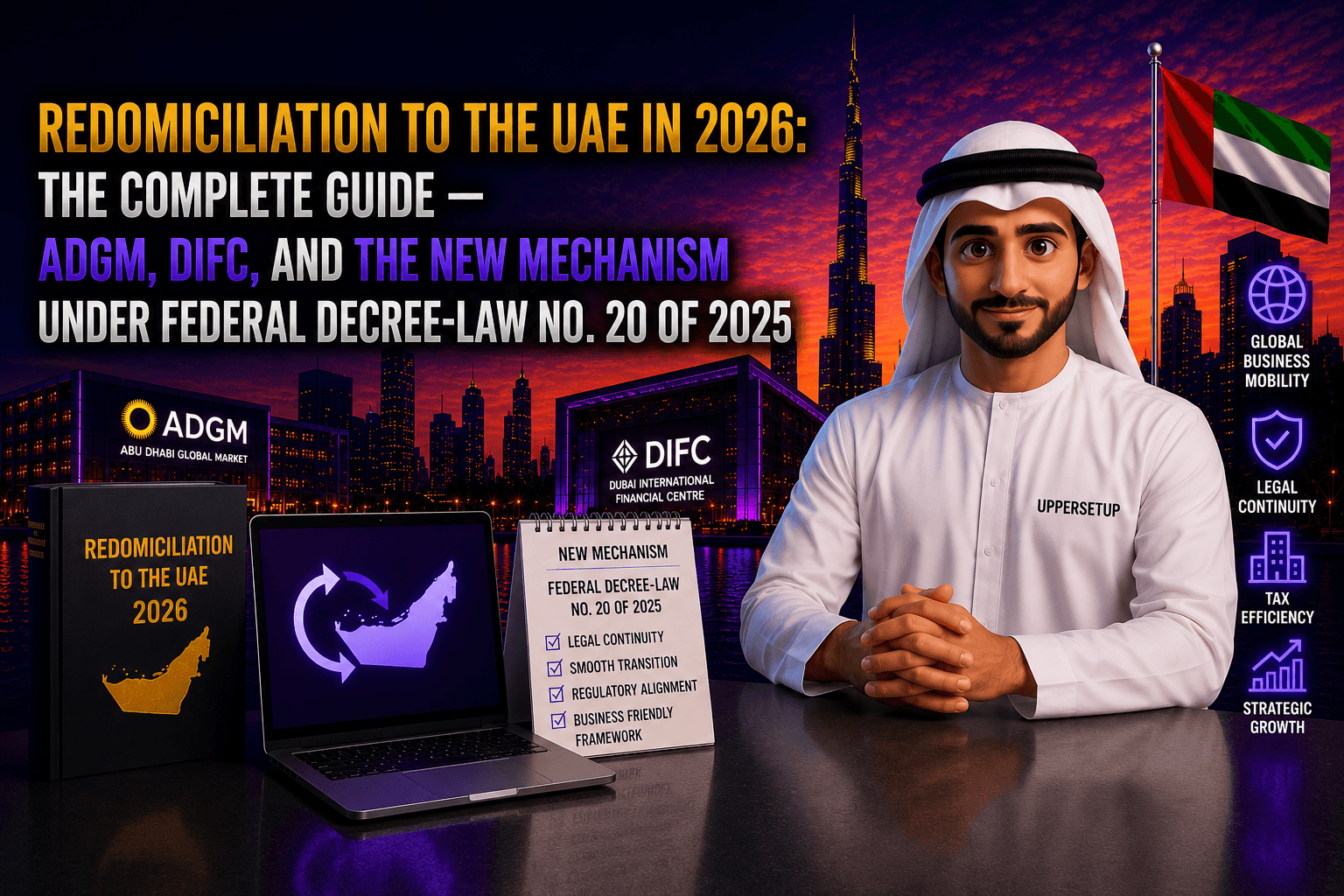
— Federal Decree-Law No. 20 of 2025 for the first time legislatively introduced the mechanism of re-domiciliation— the transfer of a legal entity between UAE jurisdictions without liquidation and reincorporation;
— The new Double Taxation Agreement between Russia and the UAE (signed 17 February 2025, applicable from 1 January 2026) fundamentally changed the tax calculation for entrepreneurs from Russia;
— The UAE's removal from the FATF grey list in February 2024 lifted a number of constraints on banking relationships with European institutions, making the UAE more attractive for European businesses.
This article provides a practical breakdown of how to relocate a business to the UAE correctly: what structures are available, what tax consequences arise in the country of origin, how the new re-domiciliation mechanism works, and which mistakes prove most expensive.
Part I. Four Models of Foreign Business Presence in the UAE
Before discussing 'relocation', it is necessary to determine which structure is needed. The choice of model directly determines tax consequences, the scope of obligations, and the degree of protection for the parent structure.
Model 1. New Company in the UAE (Subsidiary or Independent Legal Entity)
The most common model: a new legal entity is established in the UAE — either as a subsidiary of an existing business or as a fully independent structure. The company is registered on the mainland through the DET or in one of the 47 free zones.
Advantages: full operational independence; limited liability for UAE obligations does not extend to the parent structure; 100% foreign ownership is possible both on the mainland (for most activity types) and in free zones.
Key tax planning risk: if the actual management of the new company continues to be exercised from the country of origin — decisions are made there, contracts concluded there, real activity conducted there — the tax authorities of the country of origin may recognise the company as a tax resident of that country under the Place of Effective Management (POEM) principle, or classify it as a Controlled Foreign Corporation (CFC). UAE registration alone is not sufficient protection against these risks.
Model 2. Branch Office of a Foreign Company in the UAE
A branch office is a legally dependent division of a foreign company, not a separate legal entity. It operates under the parent company's name and within its scope of activities. It is registered through the DET (mainland) or through the relevant free zone authority.
As a result of reforms spanning 2020–2024, two key requirements for registering a mainland branch have been eliminated: the obligation to appoint a Local Service Agent (LSA) (removed by Federal Decree-Law No. 26 of 2020) and the mandatory bank deposit of AED 50,000 with the Ministry of Economy (removed by Ministerial Resolution No. 138 of 2024).
Required for registration:
— Corporate documents of the parent company: memorandum of association, articles, certificate of incorporation, extract from the company register;
— Documents notarised, UAE Embassy attested, and translated into Arabic;
— Audited financial statements of the parent company for the last two years;
— Board resolution authorising the opening of the branch;
— Physical office premises (virtual address is not accepted).
Tax consequences: a branch is not an independent tax subject in the UAE — it is treated as a permanent establishment (PE) of the parent company. Under Federal Decree-Law No. 47 of 2022, profit attributable to the branch's UAE activities is subject to UAE corporate tax at 9%. Simultaneously, the parent company in the country of origin may be required to reflect the branch's profit in its own tax base. This makes the structure potentially vulnerable to double taxation — unless the country of origin credits the UAE tax paid.
Reputational advantage: banks and counterparties perceive a branch as a structure with an operational history and the financial backing of the parent company. For certain markets, this creates an advantage over a newly incorporated entity.
Model 3. Representative Office
A representative office may conduct exclusively marketing and liaison activities — promoting the parent company's products and services, conducting market research, representing the parent company's interests. It is not permitted to conclude commercial transactions, issue invoices, or receive revenue from activities in the UAE.
This model is suitable for companies that wish to test the UAE market without creating a full tax and operational presence. Since a representative office does not conduct taxable activities in the UAE, the risk of creating a permanent establishment is minimal — provided the activity restrictions are strictly observed.
Model 4. Re-domiciliation — Transfer of a Legal Entity (New 2025 Mechanism)
This is a fundamentally new instrument introduced by Federal Decree-Law No. 20 of 2025 (the amendment to Federal Decree-Law No. 32 of 2021, which took effect on 15 October 2025). Article 15 bis of the law for the first time legislated the mechanism of re-domiciliation — the transfer of a legal entity's registration from one jurisdiction to another without liquidating the entity and reincorporating a new one.
Upon re-domiciliation, the company retains:
— Its legal entity — the same company, the same rights and obligations;
— Its operational history — contracts, business relationships, reputation;
— Its banking relationships — to the extent permitted by the specific bank;
— Its ownership structure — no change of shareholders is required.
Re-domiciliation to the UAE is available:
— From a foreign jurisdiction to the UAE — transfer of a foreign legal entity to the UAE mainland or a free zone;
— Between jurisdictions within the UAE — from mainland to a free zone, from one free zone to another, from one emirate to another.
Conditions for re-domiciliation under Article 15 bis:
— The legislation of the outgoing jurisdiction must permit re-domiciliation (not all countries allow this);
— The receiving UAE jurisdiction must approve the transfer;
— A shareholder resolution is required (special resolution or majority consent of owners);
— No legal obstacles: the company must not be in liquidation proceedings or have open regulatory violations.
Important caveat: the mechanism has been introduced by law, but implementing regulations (detailed procedural requirements, document lists, procedures for engagement with free zone authorities) are still being developed as of this article's publication date. In practice, re-domiciliation from a foreign jurisdiction into the UAE is implemented in a limited number of cases — primarily through DIFC and ADGM, which have long had their own established continuation mechanisms. Before planning a re-domiciliation, a legal consultation is required to assess the applicability of the mechanism to the specific outgoing jurisdiction.
Part II. Exit Tax: What Happens in the Country of Origin
This is the most underestimated and most painful aspect of business relocation. Many entrepreneurs focus on what happens upon entry into the UAE and do not analyse what happens upon exit from the country of origin.
2.1. Exit Tax: General Principle
Exit tax is a tax obligation arising in the country of origin at the moment a company or its owner changes tax residency or transfers assets from one jurisdiction to another. The logic is straightforward: the state taxes unrealised gains accumulated during the period of being under its tax jurisdiction, before the company or its assets leave that jurisdiction.
Exit tax can arise in several scenarios:
— Transfer of place of effective management from the country of origin to the UAE: a number of states treat this as a change of corporate tax residency and tax unrealised appreciation of assets;
— Transfer of assets from a permanent establishment in the country of origin to a new UAE structure: tax authorities may treat this as a disposal of assets at market value;
— Cessation of tax residency of an individual — company owner: some countries apply exit tax to unrealised gains on shares and other assets upon departure.
For risk minimisation:
— Exit tax in most cases can be planned for provided work begins well in advance — at minimum 12–18 months before the actual transfer;
— A phased relocation — gradual transfer of management, staff, and assets — generally raises fewer questions than a simultaneous abrupt transition;
— The applicable DTA may reduce or eliminate the exit tax obligation — specific treaty analysis is required.
2.2. Controlled Foreign Corporation (CFC) Rules
Establishing a UAE company without actually transferring management automatically creates a risk of the company being recognised as a CFC in the country of origin. In virtually all developed tax systems — Russia, Germany, France, the United Kingdom, and many others — CFC rules exist that oblige a country's tax resident to declare the profits of foreign companies they control and pay tax on those profits.
For Russian entrepreneurs, CFC rules were significantly tightened in 2025 with the adoption of Federal Law No. 176-FZ:
— The 'fixed profit regime' (under which CFC tax is calculated based on a fixed amount regardless of actual profit) became less advantageous: previously the fixed profit amount was RUB 5 million regardless of the number of CFCs; now it is RUB 5 million per CFC, but cumulatively not more than RUB 25 million;
— For CFCs from jurisdictions on the Russian Ministry of Finance 'black list', mandatory audit of financial statements was introduced;
— The obligation to notify tax authorities of participation interests in foreign companies exceeding 25% (10% where the structure exceeds 50%) is retained.
From 1 January 2026, the UAE was removed from the Russian Ministry of Finance's black list of offshore jurisdictions, which opens up the possibility of applying CFC tax exemptions for active companies. However, this does not eliminate the obligation to notify about CFCs and does not remove liability for prior periods.
2.3. Permanent Establishment in Multiple Jurisdictions
One of the most common and least obvious risks in business relocation is the creation of a permanent establishment (PE) in multiple jurisdictions simultaneously.
A permanent establishment arises when an employee or agent of a company systematically acts in another country on behalf of the company and has authority to conclude contracts. If employees or directors of the new UAE company continue to be physically located in the country of origin and make key management decisions there, the tax authorities of that country may recognise that the UAE company has a permanent establishment in the country of origin.
Consequence: profit attributable to the activities of such a PE becomes taxable in both jurisdictions. The applicable DTA contains mechanisms for crediting double taxation, but does not eliminate the administrative burden or the risk of claims.
Practical rule: after transferring management to the UAE, key decisions — concluding contracts, approving strategy, negotiating with major clients — must be made and documented as having been made in the UAE, not remotely from the country of origin.
Part III. Business Relocation from Russia to the UAE: The New DTA from 2026
For entrepreneurs from Russia, 2026 became a turning point in UAE tax planning: on 1 January 2026, the Agreement for the Elimination of Double Taxation between the Russian Federation and the UAE (signed in Abu Dhabi on 17 February 2025) entered into force. The agreement replaced the extremely narrow 2011 convention, which applied only to government investment institutions.
3.1. Key Provisions of the Russia–UAE DTA
The new agreement applies to all tax residents of both countries — individuals and companies, including UAE free zone companies applying a 0% corporate tax rate.
Principal provisions:
— Dividends, interest, and royalties — a unified preferential withholding tax rate of 10% (previously, for private business, standard Russian rates applied: 15% on dividends, up to 20–25% on interest and royalties);
— Business profits are taxed only in the country of residence — unless a permanent establishment has arisen in the other country;
— Capital gains from the sale of shares (except companies where more than 50% of assets constitute Russian real estate) are taxable only in the seller's country of residence;
— Method of double taxation relief — credit method: tax paid in one country is credited against tax liabilities in the other;
— Exemption from Russian withholding tax on payments for services rendered by a UAE resident (previously taxed at 15%);
— Exemption in Russia from personal income tax for individual UAE tax residents on gains from the sale of shares in Russian companies (except 'real estate companies').
3.2. What Has Changed for Business Structuring
Prior to 2026, the UAE was on the Russian Ministry of Finance's 'black list' of offshore jurisdictions. This meant: UAE companies could not benefit from the participation exemption (exemption for dividends received from subsidiaries) and were under heightened scrutiny for CFC purposes.
With the UAE's removal from the offshore list from 1 January 2026, the following opportunities open:
— UAE holding companies may receive dividends from subsidiary structures without double taxation provided the DTA is applied;
— Russian groups may use UAE companies as holding, trading, and financial centres with proper structuring;
— Application of CFC tax exemptions for actively operating UAE companies that are not 'passive' holdings becomes available.
Important caveat: applying DTA benefits requires proof of the beneficial ownership of income. Nominal structures with no real activity or economic presence in the UAE have no entitlement to treaty benefits. Tax authorities of both countries may apply a business purpose test and deny benefits to structures created solely for tax purposes.
Part IV. How to Structure the Business Relocation Sequence Correctly
Relocating a business to the UAE is not a single event — it is a process that typically takes 12 to 24 months with proper planning. Attempting to do everything quickly creates unacceptable tax and legal risks.
Stage 1. Tax and Legal Audit of the Current Structure (3–6 Months Before Relocation)
Before making any structural decisions, a comprehensive analysis of the current structure in the country of origin is required:
— Analysis of applicable CFC rules and consequences for individual shareholders;
— Assessment of the applicable DTA between the country of origin and the UAE: existence of a treaty, withholding tax rates, tie-breaker rules, credit mechanism;
— Analysis of possible exit tax: which assets are covered, at what rate, whether deferral is possible;
— Assessment of permanent establishment risks in the country of origin after management is transferred;
— Analysis of transfer pricing documentation requirements for transactions between related parties after the UAE structure is established.
Stage 2. Selection of Presence Model and UAE Jurisdiction
The choice between mainland and free zone, between subsidiary and branch, is determined not only by registration costs but by:
— Nature of activity: for trading companies with operations on the UAE local market — mainland; for international trade and services without UAE local market dependency — free zone;
— Tax profile: to obtain Qualifying Free Zone Person (QFZP) status and the 0% rate, strict conditions must be met: qualifying activity, economic substance, limitation of mainland transactions;
— Banking requirements: alignment of activity with the free zone's positioning is critical for opening a corporate account;
— Audit and reporting requirements: DMCC, JAFZA, DIFC, ADGM require audited accounts; some smaller free zones do not.
Stage 3. Establishing Genuine Economic Substance in the UAE
This is the central and most frequently neglected stage. No UAE tax benefit — neither the free zone 0% rate nor DTA benefits — works without genuine economic substance:
— Physical office — real, not merely a virtual address. For Economic Substance Regulations requirements and banking compliance, a real office is the de facto standard;
— Employees in the UAE — at least key management personnel must physically be located in and make decisions from the UAE;
— Management decisions — document that the board, strategic negotiations, and key contracts are approved in the UAE;
— Operational accounts — the company must conduct transactions through a UAE bank.
Stage 4. Phased Transfer of Activities and Assets
Transfer of contracts and clients: new contracts must be concluded by the UAE entity. Existing contracts are renegotiated or assigned — with compliance with contractual and tax procedures in the country of origin.
Transfer of intellectual property (IP): the transfer of trademarks, patents, software between jurisdictions is one of the most complex elements from a transfer pricing and exit tax perspective. It requires an independent arm's-length valuation of the IP and appropriate documentation.
Transfer of personnel: employees must be engaged by the UAE company through MOHRE (mainland) or through the relevant free zone authority, with compliance with WPS requirements. All employment contracts must be terminated in the country of origin in compliance with applicable labour law.
Stage 5. Settlement of Obligations in the Country of Origin
After the actual transfer of activities to the UAE, the structure in the country of origin must be correctly closed out or aligned:
— Filing final tax returns for the period of activity prior to transfer;
— Payment of exit tax (where obligatory) or application for deferral;
— Deregistration for applicable taxes (VAT, corporate tax);
— Liquidation of the old company (if that decision is taken) or conversion to a passive holding status without active operations.
Part V. Transfer Pricing in Multi-Jurisdictional Structures
As soon as a UAE company connected to operating companies in other jurisdictions appears in the structure, transfer pricing (TP) obligations arise immediately.
Pursuant to Federal Decree-Law No. 47 of 2022 (Article 34) and Cabinet Decision No. 97 of 2023, UAE companies are required to apply the arm's length principle to all transactions with related parties. TP documentation is required when thresholds under Ministerial Decision No. 97 of 2023 are exceeded: standalone revenue of the company exceeding AED 3.15 billion per year, or being part of an MNE group with consolidated revenue exceeding AED 200 million. All other companies must still comply with the arm's length principle but are not required to maintain full Master File and Local File documentation. The threshold for completing the related-party transactions schedule in EmaraTax is AED 40 million in aggregate related-party transactions per period.
From April 2026, Cabinet Decision No. 129 of 2025 entered into force, substantially tightening penalties for TP violations:
— Late payment of tax resulting from a TP adjustment: 14% per annum (calculated monthly);
— Voluntary disclosure after audit notification: 15% fixed penalty + monthly interest;
— Failure to maintain TP documentation: up to AED 10,000 per instance.
For UAE companies forming part of multinational groups with aggregate annual turnover exceeding AED 3.15 billion(approximately EUR 750 million), Country-by-Country Reporting (CbCR) requirements and Pillar Two rules (global minimum tax of 15%) apply.
Part VI. Typical Mistakes in Business Relocation to the UAE
Mistake 1. Establishing a UAE Company Without Transferring Real Management
The company is registered, the licence is obtained, the Emirates ID is issued. But all key decisions are still being made in Moscow, Berlin, or London. For the tax authorities of the country of origin, this is not a change of jurisdiction — it is the appearance of an offshore 'shell', to which CFC rules apply in full.
Mistake 2. Ignoring Exit Tax
The entrepreneur departed. The company in the country of origin stopped operating. Nobody filed the 'closing' tax return. Three to five years later, the tax authority conducts an audit and classifies the transfer of assets as a disposal at market value. Tax, penalties, and interest accumulate. These are real situations, not theory.
Mistake 3. Transferring IP Without Valuation and Documentation
Transferring a trademark or software to a UAE company is the element of restructuring most frequently challenged by tax authorities. Without an independent arm's-length valuation and a proper transfer agreement complying with TP requirements, such a transaction becomes a first-level tax risk.
Mistake 4. Expecting a Free Zone to Automatically Provide a 0% Tax Rate
QFZP status and the 0% rate are conditional on meeting strict requirements: the activity must be qualifying, economic substance must be genuine, transactions with the UAE mainland must not exceed established limits, and UBO and economic substance requirements must be complied with. Free zone registration does not equal a 0% rate.
Mistake 5. Attempting to Do Everything at Once
Transferring management, assets, staff, and contracts within a few weeks raises red flags for the country of origin's tax authorities as potential tax avoidance. A phased transfer over 12–24 months with documentation of the business rationale for each step is a substantially more defensible strategy.
Conclusion. Business Relocation Is Not an Event. It Is a Project.
The UAE in 2026 offers entrepreneurs from a wide range of jurisdictions exceptionally attractive conditions: low corporate tax, a growing DTA network (137 agreements in force), no personal income tax, a stable banking system, and a new re-domiciliation mechanism.
But realising these advantages is only possible with correct structuring — with analysis of tax consequences in the country of origin, creation of genuine economic substance, and consistent documentation of each step.
The correct sequence:
1. Tax audit of the current structure in the country of origin — before UAE registration;
2. Selection of model and jurisdiction in the UAE with regard to tax profile and banking requirements;
3. Creation of genuine economic substance — office, employees, management in the UAE;
4. Phased transfer of activities — contracts, personnel, assets, IP;
5. Settlement of obligations in the country of origin — tax returns, deregistration, closure or transformation of the old structure;
6. Transfer pricing documentation — where transactions exist between related parties across jurisdictions.
The UPPERSETUP platform accompanies entrepreneurs at each of these steps — from choosing the optimal structure and company registration to banking compliance preparation and operational launch.
This material is for informational purposes only and does not constitute legal or tax advice. All regulatory references are current as of April 2026. Before making decisions, consultation with a licensed lawyer or tax adviser is recommended.
All services on the platform
Everything you need to start and run a business - in one place
- 3–5 days
Company Setup
Mainland or Free Zone company with a complete set of incorporation documents
Start - Monthly
Accounting Services
Financial accounting and reporting in accordance with UAE requirements
Start - 1–2 weeks
Visa Services
Residence visas for shareholders, employees and family members
Start - 7–30 days
Banking Services
Corporate Bank Accounts in the UAE and Payment Services
Start - Custom timeline
Legal Services
Contracts, corporate amendments and legal support
Start


