
Economic Substance in the UAE in 2026: Real Business Presence as a Condition of Tax Stability
February 19, 2026
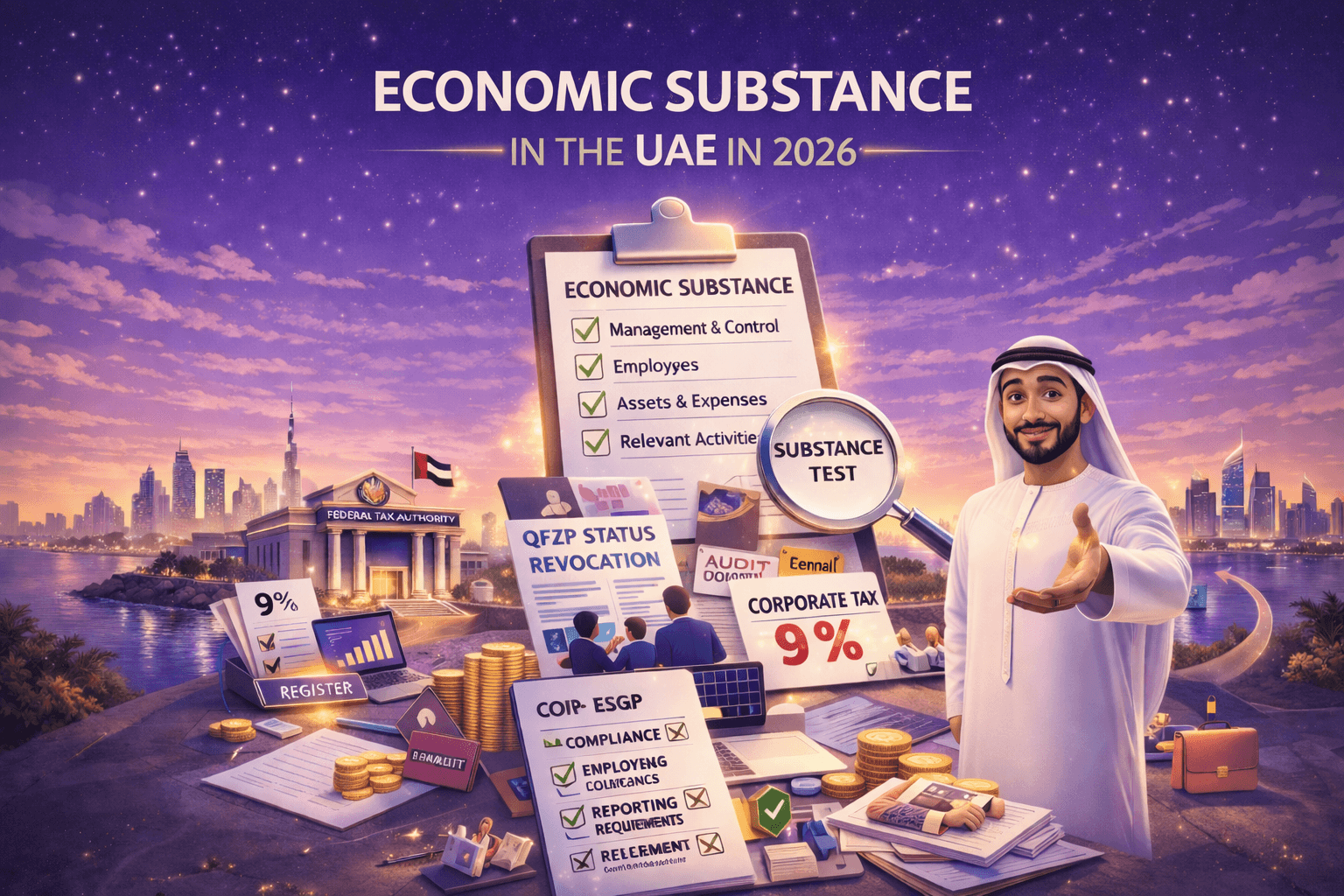
In 2026, the issue of Economic Substance in the UAE is no longer a technical formality or a remnant of the pre-corporate tax era. It has become part of a unified tax ecosystem that includes the 9% corporate tax, Qualifying Free Zone Person (QFZP) status, transfer pricing, and banking compliance.
If in 2019–2021 many businesses viewed ESR as a “box-ticking” reporting obligation, today economic substance is a tool for assessing the real nature of a business. Tax authorities, banks, and international partners evaluate not only the company’s registration, but its actual functioning in the UAE.
1. What Economic Substance Means in Practice
Economic Substance is a requirement for a company to demonstrate that its profits are generated in the jurisdiction where they are declared. In the context of the UAE, this means that a structure must have a management center, employees, infrastructure, and expenses proportionate to the scale of its business.
From a consulting perspective, it is important to understand that this is not about maintaining a minimal office or appointing a formal director. It is about provable business activity. If a company declares significant income from trading, intellectual property licensing, or intra-group financing, the tax authority may ask a straightforward question: who generates this profit, and where are the decisions made?
In 2026, this analysis is integrated into both tax assessments and banking monitoring procedures.
2. Why Economic Substance Became Critical After the Introduction of Corporate Tax
The introduction of Federal Decree-Law No. 47 of 2022 on Corporate Tax fundamentally changed the logic of business review. Previously, substance was examined primarily within the framework of standalone ESR regulations. Today, it directly affects the applicable tax rate and the legitimacy of preferential regimes.
For example, a Free Zone company claiming the 0% corporate tax rate under QFZP status must demonstrate sufficient economic substance. The absence of real management functions, personnel, or infrastructure calls into question the eligibility for the preferential regime.
In addition, transfer pricing rules require analysis of functions, assets, and risks. If a company reports significant margins but does not perform key functions, the tax authority may reallocate profits.
Thus, in 2026, Economic Substance is not a separate compliance item but the foundation of tax assessment.
3. Which Companies Are Under Increased Scrutiny
In practice, particular attention is given to holding structures, IP companies, Free Zone trading companies, and intra-group service centers. These models are frequently used in international structuring and therefore naturally fall within the scope of profit allocation analysis.
A holding company without personnel or management activity may raise questions when distributing dividends. An IP company without professionals managing intellectual property assets risks losing tax stability. A trading company with turnover in the tens of millions of dirhams and only one employee objectively appears disproportionate.
The tax authority evaluates not the license title, but the reality of operations.
4. Management and Control: Where Decisions Are Made
One of the core elements of substance is the principle of being “directed and managed in the UAE.” This means that strategic decisions must be made in the UAE, not in another country through nominal directors.
In practice, this is confirmed by:
-
holding board meetings in the UAE;
-
properly recording minutes;
-
physical presence of decision-makers;
-
documented evidence of business activity.
Formally appointing a local director without real involvement in management does not create sufficient economic substance. In 2026, tax authorities assess the overall picture, including correspondence, banking authority, and contract execution structures.
5. Personnel and Functions: Profit Must Match Activity
In international tax practice, profit must correspond to functions performed. If a company declares substantial margins, it must perform key managerial and commercial functions.
Having a single administrator while reporting turnover in the tens of millions of dirhams appears unconvincing. For trading companies, this may require personnel responsible for procurement, logistics, and contract management. For IP companies, professionals responsible for asset management and licensing.
The Federal Tax Authority assesses not only the existence of employees but also their role in generating income.
6. Infrastructure and Expenses: Economic Logic
Economic presence cannot exist without infrastructure. Office premises, equipment, IT systems, and operating expenses must correspond to the scale of the business.
Using only a flexi-desk model with significant turnover may represent a risk factor. The tax authority analyzes the cost structure: if profits are high and expenses minimal, the allocation of functions may be questioned.
It is important to understand that substance is not about the absolute amount of expenses, but about proportionality and economic justification.
7. Risks and Consequences of Non-Compliance
Historically, violations of ESR resulted in administrative penalties starting from AED 20,000 and increasing for repeated breaches. However, in 2026, consequences are broader.
The primary risk is the loss of QFZP status and application of the 9% rate to the entire profit. Additionally, companies may face:
-
tax reassessments;
-
penalties for inaccurate reporting;
-
increased scrutiny from the FTA;
-
banking restrictions;
-
international exchange of tax information.
Economic substance directly impacts a company’s reputation in the eyes of financial institutions.
8. How to Build Economic Substance in 2026
From a consulting standpoint, a sound strategy includes:
-
genuinely conducting management decisions in the UAE;
-
properly documenting board meetings;
-
hiring personnel aligned with key business functions;
-
maintaining a cost structure proportionate to revenue;
-
aligning substance with transfer pricing documentation.
Substance should not be created retroactively. It must be embedded into the business model from the outset.
9. Conclusion
Economic Substance in the UAE in 2026 is a fundamental element of tax stability and banking reliability.
A company that cannot demonstrate real management, functions, and infrastructure in the UAE exposes itself to tax reassessment and potential loss of preferential treatment.
In the era of 9% corporate tax, economic presence has become part of a business protection strategy. Formal registration alone no longer ensures tax security. Only real business activity does.
10. Legislative Framework
Corporate Tax Law
Federal Decree-Law No. 47 of 2022 on the Taxation of Corporations and Businesses
FTA
Federal Tax Authority – Corporate Tax Legislation and Guidance
Economic Substance Regulations
Cabinet Resolution No. 57 of 2020 Concerning Economic Substance Requirements
ESR Guidance
Ministerial Decision No. 100 of 2020 (Guidance on Economic Substance)
FTA — Economic Substance Regulations
Subscribe to our newsletter
Receive expert materials and special offers in the field of company setup and support, citizenship and residence permit for investment. Once a week without spam.
Comprehensive Services for Your Business
Accounting Services
A key element of successful business management. Competent accounting support ensures compliance with local regulations, optimizes taxes, and enhances financial transparency.

Company Registration
The foundation of your business success. A seamless registration process tailored to UAE regulations helps you launch your venture with confidence and efficiency.

Bank Account Opening
An essential step for smooth business operations. Expert guidance ensures hassle-free bank account setup, meeting all compliance requirements for your business needs.

Tax Support
Stay ahead with professional tax solutions. Comprehensive support ensures compliance with UAE tax laws, optimizes financial planning, and avoids unnecessary risks.

Residency Visa Services
Your gateway to living and working in the UAE. Expert guidance ensures smooth processing of residency visas, compliance with regulations, and timely approvals for individuals and their families.

Legal Advisory
Navigate business challenges with confidence. Professional legal advice ensures compliance, protects your interests, and empowers informed decision-making for your business.