


































































 International Free Zone Authority
E-Commerce in the UAE: How to Launch a Business in 2026 — Licences, Platforms, Logistics, Taxes, and Real Numbers
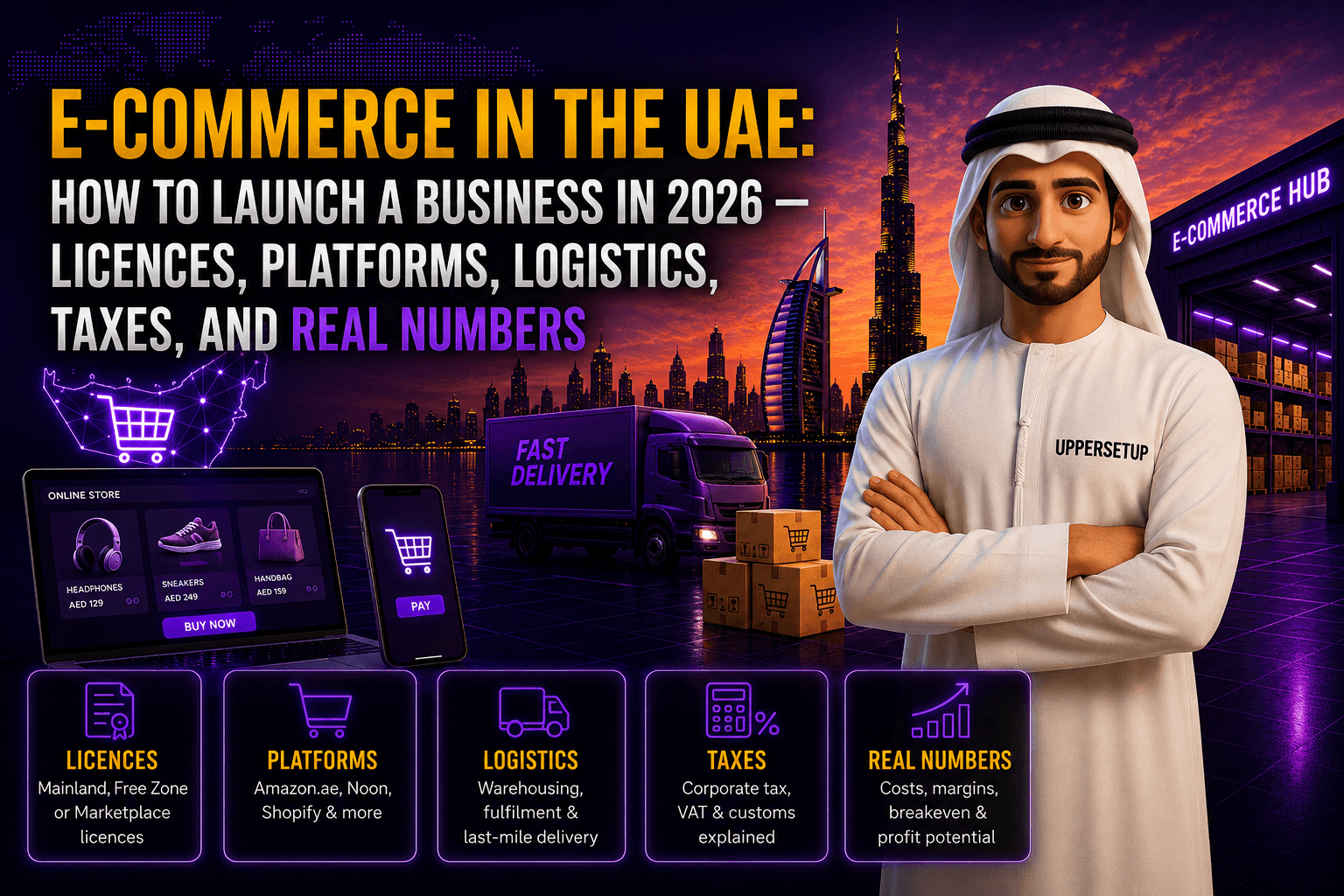
Introduction. A Market That Grows Faster Than Entrepreneurs Can Enter It
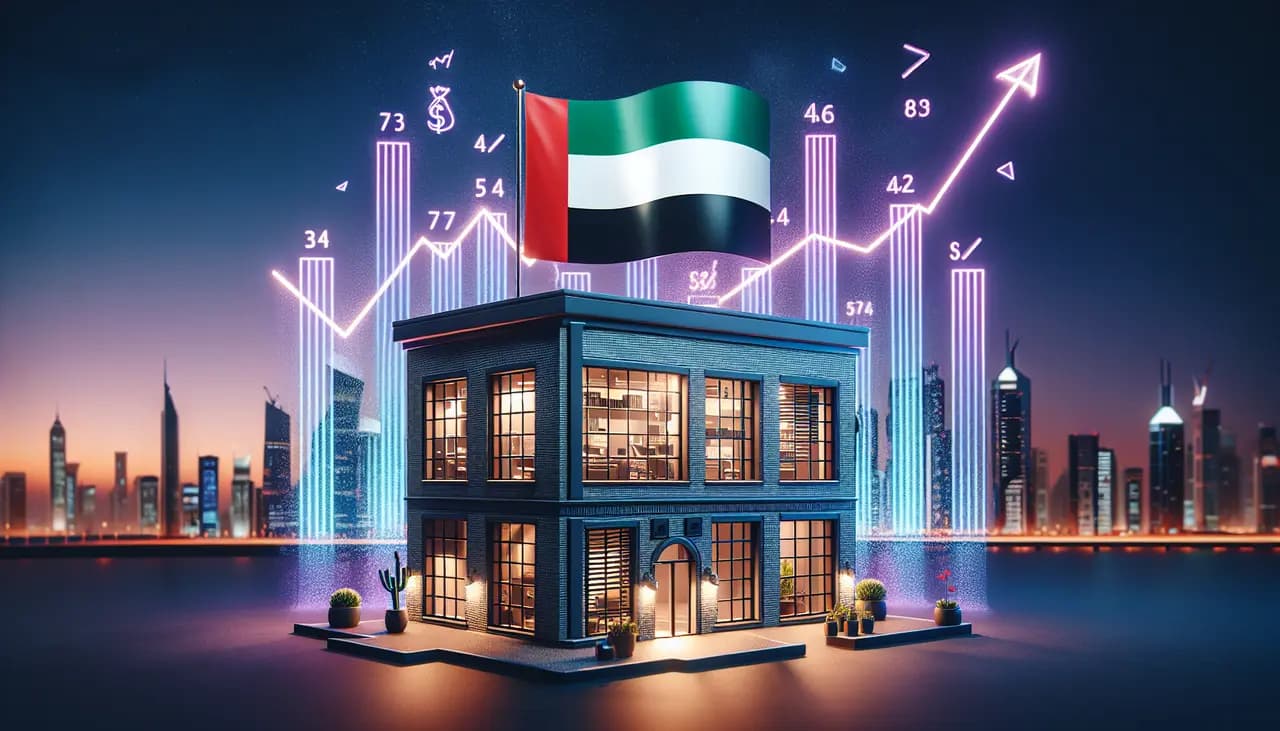
According to EZDubai data (an official report distributed through Emirates News Agency WAM), the UAE e-commerce market reached AED 32.3 billion (USD 8.8 billion) in 2024 and is projected to exceed AED 50.6 billion (USD 13.8 billion) by 2029. This is not a headline number — it is a conservative estimate grounded in already observable structural factors: near-100% internet penetration, one of the world's highest smartphone densities, growing consumer trust in online payments, and government infrastructure purpose-built to support e-commerce.
Dubai CommerCity — the region's first dedicated e-commerce free zone. EZDubai in Dubai South — a full-service B2B and B2C fulfilment ecosystem serving local, regional, and global markets. Noon and Amazon.ae — local marketplaces with active seller programmes. All of these infrastructure elements exist and operate today.
For an entrepreneur this means one thing: the question is not 'is there a market?' but 'how do I enter it correctly?' That is precisely what this article addresses.
Part I. The Legal Framework: The Law That Changed Everything in 2023
Prior to December 2023, e-commerce in the UAE was governed primarily through general commercial and consumer law provisions. No dedicated statute for online trading existed.
Federal Decree-Law No. 14 of 2023 Concerning the Modern Technology-Based Trade entered into force in December 2023 and for the first time created a unified federal legal framework for all online sellers in the UAE — regardless of their licence type or registration jurisdiction.
Key Requirements of Federal Decree-Law No. 14 of 2023
— Mandatory disclosure: before a purchase, the buyer must see the full price (including all charges and taxes), delivery terms, returns policy, and consumer rights — clearly and accessibly on the platform;
— Digital contract: each online transaction constitutes a digital agreement. The seller must retain a transaction record and provide the buyer with a confirmation;
— Right of return: consumers have a legislatively established right to return goods within prescribed periods; the seller must clearly state the conditions;
— No hidden fees: all charges must be disclosed prior to order confirmation;
— Data protection: the processing of buyers' personal data must comply with regulatory requirements;
— TDRA NOC: to conduct commercial activity on the internet in the UAE, a No Objection Certificate from the Telecommunications and Digital Government Regulatory Authority (TDRA) is required. This applies to both mainland and free zone companies.
Practical takeaway: any online store operating in the UAE — regardless of the jurisdiction of registration — must comply with Federal Decree-Law No. 14 of 2023. This also applies to foreign platforms selling goods to UAE consumers.
Part II. Licence Types for E-Commerce in the UAE
The choice of licence type is the first and most important decision when launching an e-commerce business. It determines jurisdiction, market access, office requirements, visa quota, and banking options.
2.1. Commercial Licence with E-Commerce Activity (Mainland, DET)
A standard DET trade licence with the 'Electronic Commerce' or 'Online Trading' activity included. The most flexible option: the company may sell directly to individuals and legal entities across the entire UAE without agents or intermediaries.
Cost: DET government fees — from AED 10,000 to AED 25,000 depending on the number of activities. A physical office with Ejari is required.
Mandatory requirement: a NOC from the TDRA confirming the right to conduct business on the internet.
2.2. E-Trader Licence (Home-Based Business, Dubai)
The most affordable option for individuals with a UAE Emirates ID (UAE residents and GCC nationals). Allows selling through a personal website or social media from home without renting an office.
Cost: approximately AED 1,070 (licence fee + knowledge and innovation fees) + AED 300 (Dubai Chamber membership). Submitted through the 'Invest in Dubai' portal.
Restrictions: does not permit hiring employees and does not provide a residence visa. Not suitable for scalable operations. Designed exclusively for B2C sales through social media.
2.3. Portal Licence (Marketplace)
A licence for companies creating an online platform connecting buyers and sellers — on the Amazon or Noon model. Available to foreign nationals. Enables monetisation through commissions, subscriptions, and advertising.
2.4. Free Zone Licence with E-Commerce Activity
Most UAE free zones include 'e-commerce' or 'e-marketplace' as a standard activity. Key advantages: 100% foreign ownership, lower cost compared to mainland, and no physical office requirement (a flexi-desk is sufficient in some free zones).
Restriction: to sell directly to buyers on the UAE mainland, either a commercial agent is required, or a DET permit under Dubai Executive Council Resolution No. 11 of 2025.
E-Commerce Licence Types in the UAE Compared (2026)
|
Type |
Cost (AED) |
Foreign nationals |
Direct UAE sales |
Hire staff |
Best scenario |
|
Commercial DET + e-commerce |
10,000 – 25,000 |
Yes (100%) |
Yes — full access |
Yes (by floor area) |
B2C/B2B, local market |
|
E-Trader |
~1,070 + 300 |
No (Emirates ID only) |
Yes (social only) |
No |
Resident micro-business |
|
Portal Licence |
10,000 – 20,000 |
Yes |
Yes |
Yes |
Marketplace/aggregator |
|
Free Zone (e-commerce) |
from 5,750 – 15,000 |
Yes (100%) |
Limited (agent needed) |
Yes (by package) |
International trade |
|
Dubai CommerCity |
Special rates |
Yes (100%) |
Via DCC platform |
Yes |
Global brands, MENA |
Part III. Specialist E-Commerce Zones: Dubai CommerCity and EZDubai
3.1. Dubai CommerCity (DCC)
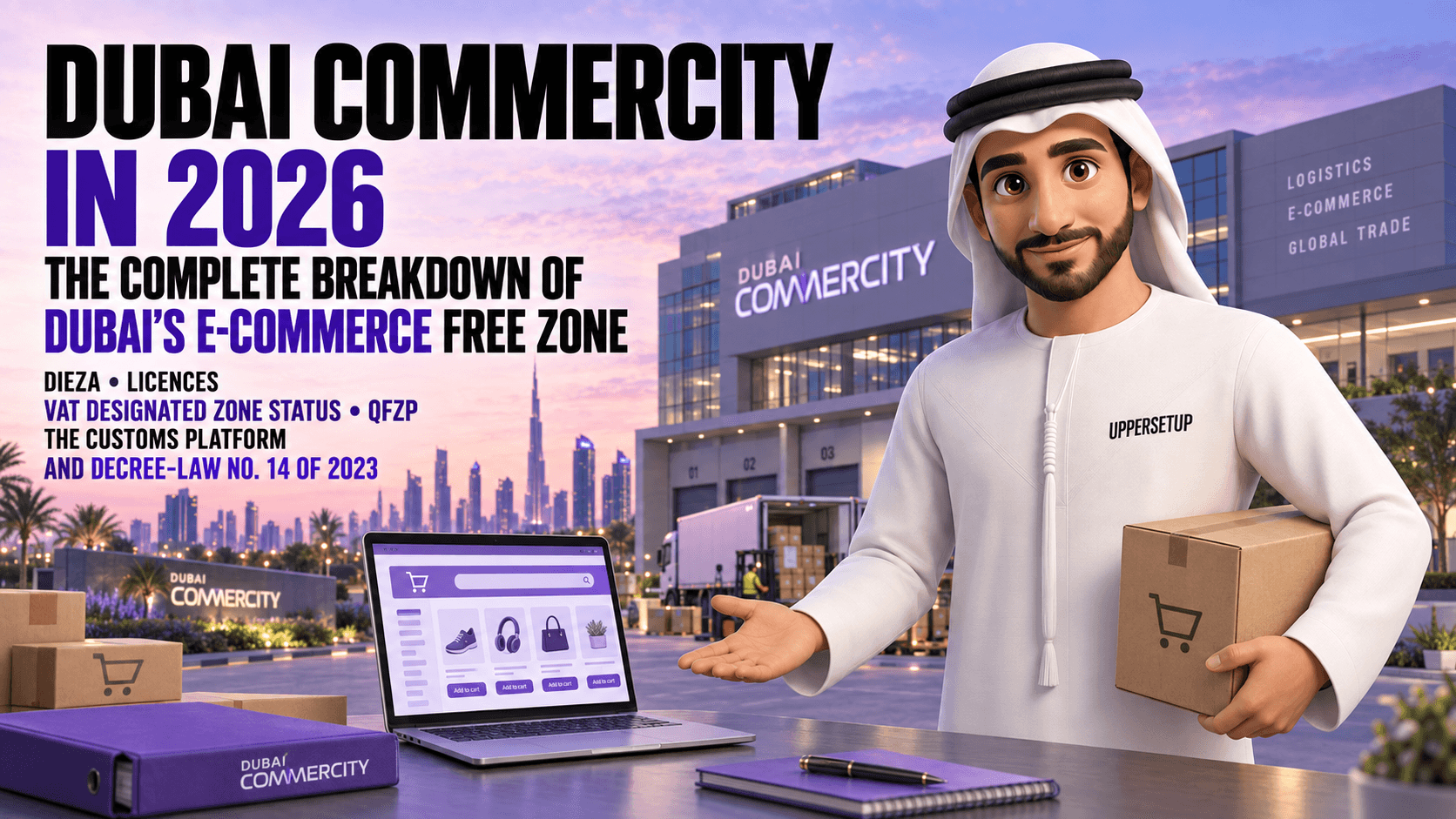
Dubai CommerCity is the first free zone in the Middle East and North Africa created exclusively for e-commerce. Located on Al Wasi Road, Dubai. It offers a fully vertically integrated ecosystem:
— Pre-configured e-commerce platforms — partner solutions that can be launched without in-house IT development;
— Integrated payment gateways, marketing agencies, call centres, and web developers located within the zone;
— Three specialised clusters: Digital Hub (offices and digital services), Logistics District (bonded warehouses, fulfilment), Business Park (light manufacturing and packaging);
— 100% foreign ownership, zero corporate tax, full profit repatriation;
— Fast and automated registration and licensing.
DCC is suited to global and regional brands targeting the MENA market and wishing to combine office, warehouse, and logistics infrastructure in one location.
3.2. EZDubai (Dubai South)
EZDubai in Dubai South is a full-service e-commerce ecosystem focused on logistics and fulfilment for B2B and B2C operations. Located in close proximity to Al Maktoum International Airport — Dubai's second airport, set to replace Dubai International Airport in the long term.
Key EZDubai advantages: access to airport logistics, support for cross-border operations, and a Customs Bonded Warehouse for storing goods without paying customs duties until they are sold and dispatched.
Part IV. Payment Infrastructure: How to Accept Payments from UAE Buyers
Payment infrastructure is one of the most operationally complex issues for new e-commerce companies in the UAE. Despite the market's strong shift towards cashless transactions, Cash on Delivery (COD) continues to be used by 71.2% of online retailers as one of their payment options.
4.1. Online Payment Gateways
To accept online payments, integration with a licensed payment gateway is required. Leading providers in the UAE market:
— Telr — one of the most popular gateways specifically designed for the MENA market; supports cards, digital wallets, and payment links;
— PayTabs — widely used across the Gulf, supports multi-currency transactions;
— Stripe — available in the UAE since 2022; valued for API quality and international support;
— Checkout.com — popular among major regional e-commerce players;
— Amazon Payment Services — formerly PayFort; optimal for Amazon.ae sellers.
To connect a payment gateway: a valid trade licence, a UAE corporate bank account, and company AML/KYC documentation are required. Most gateways require a security deposit — typically from AED 2,500 (refundable). The previously mandatory AED 10,000 e-commerce payment gateway deposit was abolished in 2024.
4.2. Digital Wallets and BNPL
Digital wallets held a 43.92% share of UAE e-commerce payments in 2025 (Mordor Intelligence). Major players: e& money (Etisalat), PayIt, Apple Pay, Google Pay.
The fastest-growing segment is BNPL (Buy Now, Pay Later) — projected CAGR to 2031 of 13.27%. Major UAE BNPL providers: Tabby, Tamara, Postpay. Integrating a BNPL provider increases conversion by an average of 15–30% for goods priced between AED 200 and AED 2,000.
Key 2026 change: the CBUAE mandated the retirement of SMS-OTP authentication in favour of biometric sign-in by March 2026. This means e-commerce platforms must support biometric authentication through banking apps at checkout.
Part V. Logistics and Delivery: Infrastructure That Determines Competitiveness
Delivery is the second most important factor — after price — in consumers' choice of online seller, according to UAE consumer surveys. Per-order delivery costs in Dubai stand at AED 15–25 — among the lowest in the region, enabling platforms to offer free delivery above modest order thresholds.
5.1. Last-Mile Delivery Providers
— Aramex — the leading logistics provider for e-commerce in the UAE; integrated with most platforms via ready-to-use APIs;
— Emirates Post — the state operator; covers the entire UAE territory;
— Fetchr — specialises in addressing without exact postal codes, using GPS coordinates (relevant in the UAE, which historically lacked a unified address system);
— Quiqup, Swiftr — same-day delivery within Dubai;
— DHL, FedEx, UPS — international logistics and express delivery for cross-border operations.
5.2. Customs and Cross-Border Trade
Duty-free import threshold: since 2019, the UAE has set a threshold of AED 1,000 — goods imported by individuals online with a value below AED 1,000 are exempt from customs duties. This is critical for dropshipping: a consignment valued at up to AED 1,000 can be shipped directly to the buyer from overseas without import duties.
Customs duty on goods above the threshold: the standard rate is 5% of customs value for most goods. Certain categories (alcohol, tobacco) attract significantly higher rates. VAT at 5% applies in addition to the customs duty.
Customs Bonded Warehouse: allows imported goods to be stored in the UAE without paying customs duties until they are sold and dispatched to the end buyer. This is a key instrument for companies trading physical goods from international inventory positions.
Part VI. Tax Regime for E-Commerce Companies in the UAE
6.1. Corporate Tax
Mainland e-commerce companies: 0% on profits up to AED 375,000, 9% above — under Federal Decree-Law No. 47 of 2022. Companies with revenue up to AED 3 million may elect Small Business Relief (treating taxable profit as zero) until 31 December 2026 under Ministerial Decision No. 73 of 2023.
Free zone e-commerce companies: potentially 0% under QFZP status. However, most e-commerce activities (retail trade in physical goods) do not appear on the qualifying activities list in Ministerial Decision No. 229 of 2025. Exception: trading in qualifying commodities (metals, minerals, agricultural produce) in Designated Zones — qualifies for QFZP.
6.2. VAT in E-Commerce
E-commerce companies are subject to VAT under Federal Decree-Law No. 8 of 2017 on standard terms:
— Mandatory registration: where taxable revenue exceeds AED 375,000 in any 12-month period;
— Standard rate: 5% on the sale of most goods and services within the UAE;
— Export of goods outside the UAE is zero-rated — input VAT on purchased inventory is recoverable;
— Sales to foreign buyers outside the UAE — zero rate if export conditions are met;
— Digital services (software, subscriptions, online services) supplied to UAE consumers are subject to 5% VAT.
6.3. VAT on E-Commerce Imports
When importing goods for resale, VAT is payable at customs (import VAT). A VAT-registered company may recover the import VAT paid (input VAT recovery) provided the goods are used in taxable UAE activities. With correct planning, the effective VAT burden for a trading e-commerce company registered for VAT is substantially lower than the nominal rate.
Part VII. Popular Models and Platforms: How to Sell in the UAE
7.1. Marketplaces: Amazon.ae and Noon
The UAE's largest marketplaces are Amazon.ae (formerly Souq.com, acquired by Amazon in 2017) and Noon.com(launched by Mohamed Alabbar, Emaar Chairman, in 2017; profitable since 2023). Both provide registered sellers with access to their audience through Fulfilment by Amazon (FBA) and Noon's equivalent programme.
To register as a seller on Amazon.ae or Noon: a valid UAE trade licence, a UAE corporate bank account, and a tax registration number (TRN) once turnover exceeds the VAT threshold are required. Marketplaces take a commission on seller revenue (typically 8–15% depending on category).
7.2. Own Online Store (D2C)
Building a proprietary online store using Shopify (the leading e-commerce software provider in the UAE market according to ECDB data), Magento, or WooCommerce. The D2C model gives full control over margins, customer data, and brand, but requires self-generated traffic.
7.3. Social Commerce
Direct selling through Instagram, TikTok Shop, and Facebook Marketplace. Highly effective for visually-led products (fashion, cosmetics, home goods). A minimum of an E-Trader licence (for residents) or a standard trade licence (for foreign nationals) is legally required for commercial activity in this format.
7.4. Dropshipping in the UAE
Dropshipping is a popular low-investment entry model for e-commerce entrepreneurs. The seller receives orders; the supplier ships directly to the buyer. For UAE dropshipping:
— A licence is required (commercial with e-commerce activity or a free zone licence);
— For overseas suppliers — the AED 1,000 duty-free import threshold applies to each individual parcel;
— VAT registration upon exceeding the revenue threshold is mandatory;
— Key requirement: compliance with Federal Decree-Law No. 14 of 2023 — clear disclosure of terms, timelines, and returns policy.
Part VIII. Step-by-Step E-Commerce Business Launch in the UAE
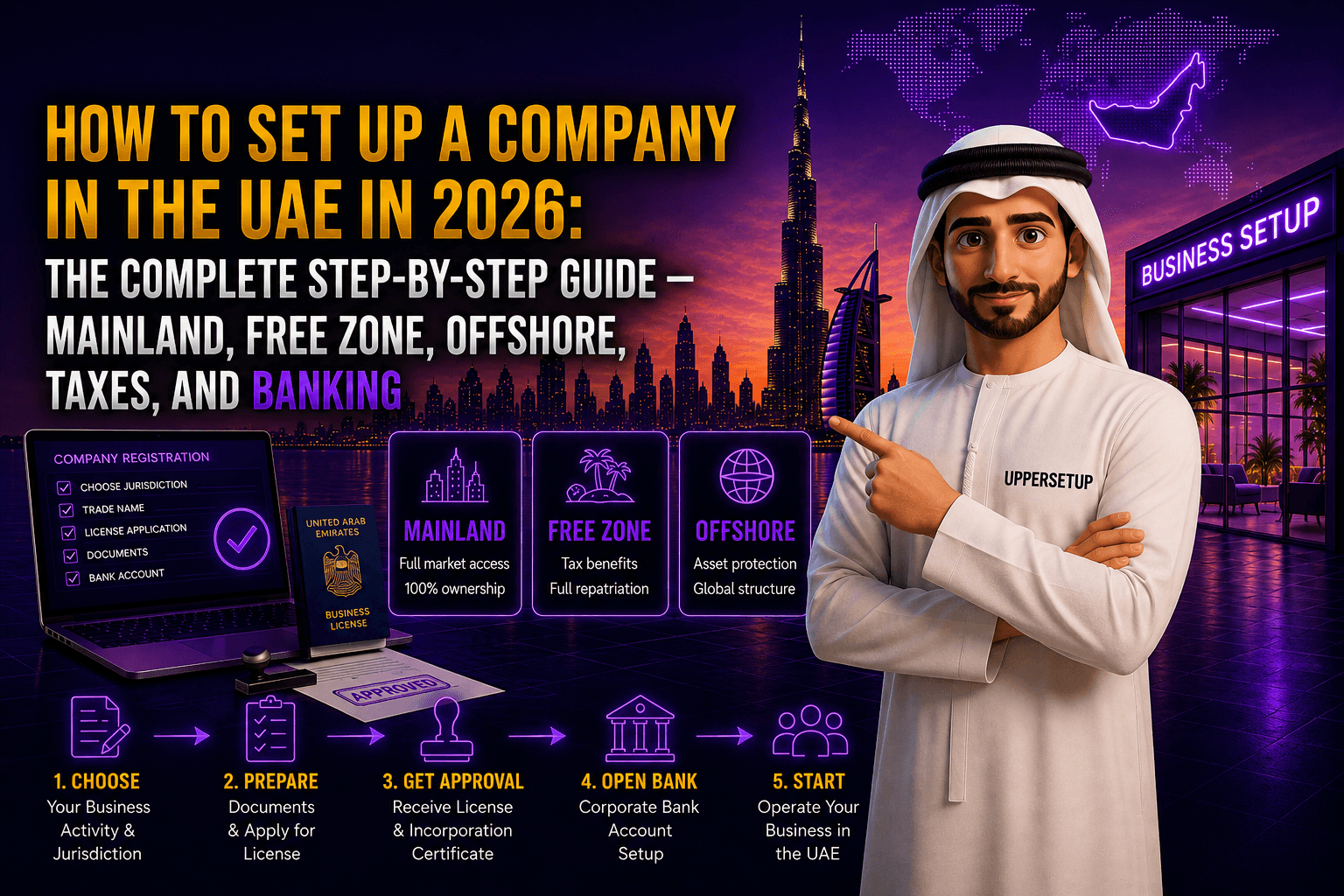
1. Define business model and jurisdiction. Marketplace vs own store; mainland (direct UAE market access) vs free zone (international trade). Jurisdiction choice determines licence type and all subsequent steps.
2. Register the company and obtain a licence. For a free zone — via IFZA, SHAMS, Dubai CommerCity, or another suitable zone. For mainland — via DET with 'Electronic Commerce' activity and a TDRA NOC. Standard timelines: 3–7 business days for free zones, 10–21 business days for mainland.
3. Open a corporate bank account. Required for connecting payment gateways, working with marketplaces, and paying salaries through WPS. Prepare a complete KYC package including business model description and expected turnover.
4. Connect a payment gateway. Select Telr, PayTabs, Stripe, or another provider; sign the agreement; pay the security deposit (from AED 2,500). Ensure the platform supports biometric authentication per 2026 CBUAE requirements.
5. Build out logistics. Contract with Aramex or Emirates Post. For high-volume goods — consider Fulfilment by Amazon/Noon or a bonded warehouse. Set up returns procedures in compliance with Federal Decree-Law No. 14 of 2023.
6. Register for VAT if applicable. If projected revenue exceeds AED 375,000 per year, registration is mandatory via the EmaraTax platform. Below this threshold, voluntary registration enables input VAT recovery.
7. Launch marketing. Arabic-language content improves conversion among local buyers. Influencer marketing via Instagram and TikTok is one of the most effective channels in the UAE. Simultaneous SEO optimisation for Arabic and English search queries.
Conclusion. The Market Is Already Running. The Only Question Is Who Is Standing in It.
The UAE e-commerce market is one of the rare places in the world where all conditions for launch have aligned simultaneously: a well-funded audience with near-total internet coverage, advanced logistics infrastructure, government support, specialised free zones, and a legal framework that finally clearly defines the rules of the game.
The right jurisdiction, the correct licence, a configured payment gateway, and a logistics partner — none of this is complicated. It is a matter of sequence and understanding the regulatory requirements.
The UPPERSETUP platform helps entrepreneurs navigate this path systematically — from selecting the optimal e-commerce company structure to opening a corporate bank account and launching within the first 30 days.
Sources: EZDubai / WAM (official report, 2024); Mordor Intelligence (January 2026); u.ae (UAE Government official portal); Federal Decree-Law No. 14 of 2023; Federal Decree-Law No. 47 of 2022; Federal Decree-Law No. 8 of 2017. This material is for informational purposes only.
All services on the platform
Everything you need to start and run a business - in one place
- 3–5 days
Company Setup
Mainland or Free Zone company with a complete set of incorporation documents
Start - Monthly
Accounting Services
Financial accounting and reporting in accordance with UAE requirements
Start - 1–2 weeks
Visa Services
Residence visas for shareholders, employees and family members
Start - 7–30 days
Banking Services
Corporate Bank Accounts in the UAE and Payment Services
Start - Custom timeline
Legal Services
Contracts, corporate amendments and legal support
Start


