






































 International Free Zone Authority
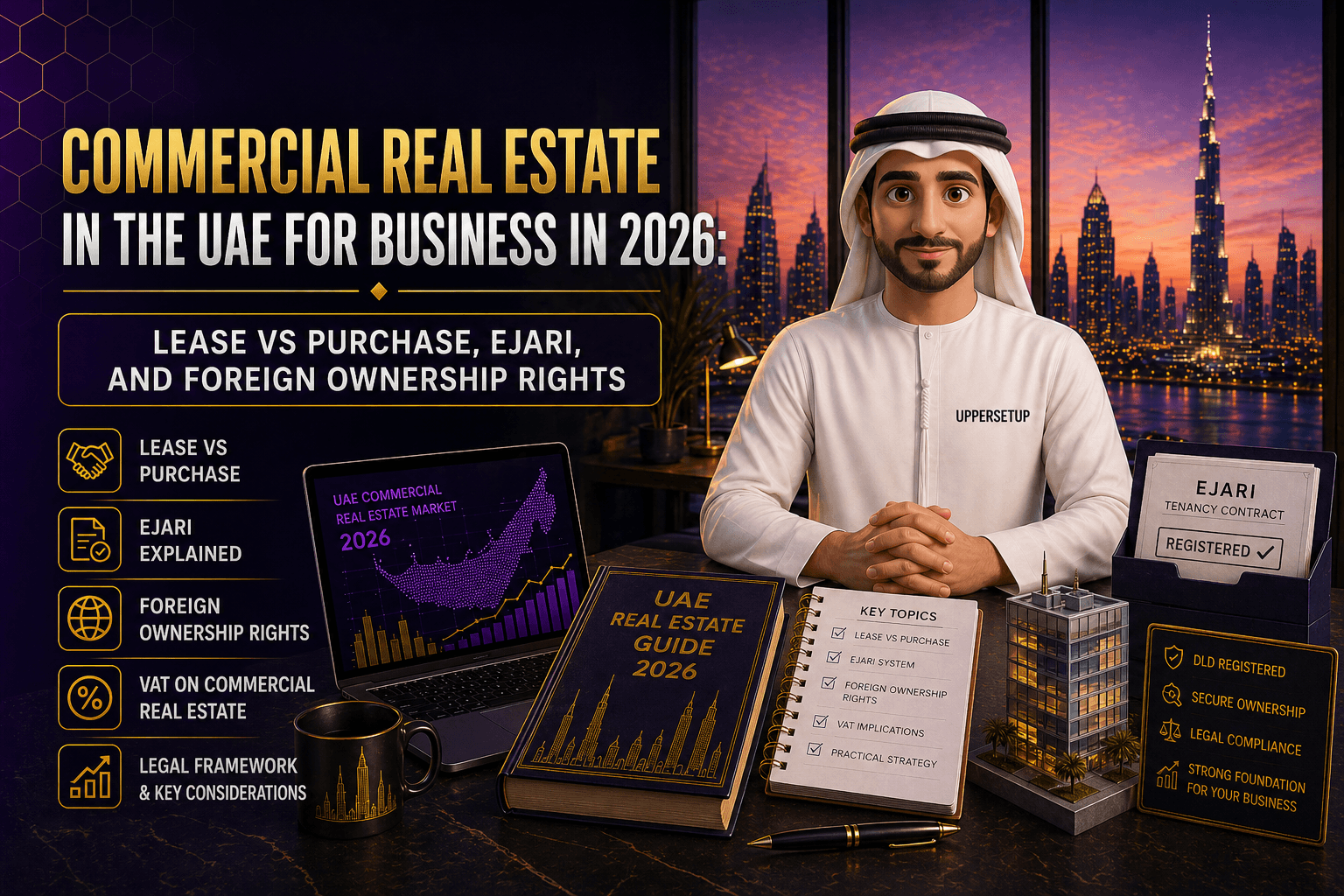
Commercial Real Estate in the UAE for Business in 2026: Lease vs Purchase, Ejari, and Foreign Ownership Rights
Introduction. An Office in the UAE Is Not Just an Address
For an entrepreneur registering a company in the UAE, the commercial real estate question is resolved on two levels: operational (where employees will physically work) and regulatory (which address supports the licence, visa quota, and banking compliance). These two levels do not always coincide.
A virtual address formally satisfies the requirements of certain free zones for registration, but raises questions in banking compliance, may be insufficient for Economic Substance Regulations requirements, and is unacceptable for most mainland licences. A genuinely rented office with Ejari registration is the standard that resolves most of these questions simultaneously.
In 2026, the UAE commercial real estate market offers entrepreneurs a broad range of options: flexible office formats, long-term leases, freehold and leasehold purchases. Understanding the legal basis of each option is the key to ensuring that the property choice works for the business — rather than creating hidden operational or tax risks.
Part I. Legal Framework for the UAE Commercial Real Estate Market
1.1. Principal Legislative Instruments in Dubai
Dubai's real estate market is the most developed and transparent in the UAE. The regulatory framework rests on the following instruments:
— Dubai Law No. 7 of 2006 on Real Property Registration — the foundational law on the registration of property rights in Dubai. Establishes the mandatory registration principle: any property transaction takes effect only upon registration with the Dubai Land Department (DLD);
— Regulation No. 3 of 2006 — establishes the list of freehold areas in which foreign nationals and companies may purchase property in full ownership;
— Dubai Law No. 26 of 2007 (Tenancy Law) and Dubai Law No. 33 of 2008 (amendment to the Tenancy Law) — regulate tenancy relationships between landlords and tenants, including the mandatory registration of tenancy agreements in the Ejari system;
— Dubai Law No. 13 of 2008 (as amended by Dubai Law No. 9 of 2009) — governs the registration of off-plan sale agreements in the Oqood interim register.
1.2. Regulatory Authorities
Dubai Land Department (DLD) — the principal regulatory authority for Dubai's real estate market. Registers property rights, maintains cadastral registers, manages the DLD, Ejari, Oqood, and Dubai REST platforms.
Real Estate Regulatory Agency (RERA) — the regulatory arm of the DLD. Develops and enforces rental standards, supervises developers and brokers, manages the Smart Rental Index, and approves the unified tenancy contract form.
Rental Disputes Center (RDC) — the specialised rental dispute resolution body at the DLD. Its rulings have the force of court judgments. Filing with the RDC is impossible without a registered Ejari agreement.
Part II. Types of Rights to Commercial Property for Foreigners in the UAE
Foreign nationals and companies in the UAE may acquire rights to commercial real estate in one of the following formats. The specific available format depends on the property's location and emirate.
2.1. Freehold — Full Ownership
Freehold grants a foreign person full ownership rights over the property and the land on which it stands, without time restriction. The right is registered with the DLD, confirmed by a Title Deed, and entitles the holder to sell, rent, mortgage, and bequeath the property without restriction.
Freehold for foreigners is available only in specifically designated freehold areas, established by Regulation No. 3 of 2006 and regularly expanded. As of 2025–2026, Dubai offers over 50 officially designated freehold zones. Among the most significant for commercial property: Business Bay, Downtown Dubai, Jumeirah Lakes Towers (JLT), DIFC, Dubai Marina, Dubai Hills Estate.
Important rule for companies: a foreign company (non-UAE national) may acquire freehold property in Dubai only through one of the following corporate vehicles: a company registered in the UAE (mainland or free zone); a DIFC-registered company (LLC, foundation, partnership, or similar); a REIT or investment fund with DIFC Registrar of Companies approval; a foreign company established under UAE law. An offshore company directly owning freehold property in Dubai violates UAE law and may result in the transaction being challenged.
2.2. Leasehold — Long-Term Lease of up to 99 Years
Leasehold grants rights to use a property for a fixed period, typically 25 to 99 years. The land remains owned by the original proprietor or authorised authority. Upon expiry of the leasehold, rights in the property revert to the landowner unless otherwise provided by the agreement.
Leasehold is a functional alternative for properties located outside freehold zones. Leasehold rights are also subject to mandatory DLD registration for terms exceeding 4 years. Leasehold agreements exceeding 4 years are registered in the Tamleeq system (for Abu Dhabi).
2.3. Usufruct and Musataha
Usufruct — the right to use another's property and derive income from it, without the right to alter or alienate the asset, for a term of up to 99 years. Used primarily for commercial and industrial purposes.
Musataha — a property right specific to the UAE, conferring the right to build on another's land and use the buildings constructed. Historically available for terms up to 50 years with renewal options; encountered in commercial practice when building on free zone land.
2.4. Lease (Short-Term and Medium-Term)
The most common format for most business structures: a standard commercial property lease agreement for a term of 1 to 5 years, with mandatory registration in the Ejari system. Detailed below in Part IV.
Part III. Purchasing Commercial Real Estate — When It Makes Sense for a Business
3.1. Arguments in Favour of Purchase
Purchasing commercial real estate in the UAE may make operational sense where the following conditions are met:
— Long-term horizon: the company plans to operate in the UAE for more than 10 years and requires a stable operational base without the risks of lease non-renewal or rent increases;
— Market timing: market conditions, mortgage interest rates, and own financing capacity create attractive acquisition terms;
— Investment dimension: the property is acquired in part as an asset with capital appreciation or rental income potential;
— Operational specifics: the business requires specialised premises (laboratory, production, vault) that are difficult or expensive to lease.
3.2. Commercial Property Purchase Procedure
1. Verify the property's status: confirm the property is in a freehold zone (for foreign buyers) and that the seller is the registered title holder per DLD records. Verification via the official DLD portal (dubailand.gov.ae) is mandatory;
2. Sign the Memorandum of Understanding (MOU)/Form F: a preliminary agreement outlining transaction terms. Typically accompanied by a 10% deposit;
3. Obtain a No Objection Certificate (NOC) from the developer (for properties in developer-managed communities): confirmation of no outstanding service charge arrears;
4. Transfer of title at the DLD: both parties (or their authorised representatives) attend in person at the DLD office or an authorised DLD notary. A one-time DLD transfer fee of 4% of the transaction value is payable;
5. Receive the Title Deed: the DLD issues an electronic title document confirming ownership.
3.3. One-Time Transaction Costs on Purchase
|
Cost Item |
Rate / Amount |
|
DLD transfer fee |
4% of transaction value |
|
Agent commission (standard) |
2% of value (typically) |
|
DLD registration fee (properties up to AED 500,000) |
AED 2,000 |
|
DLD registration fee (properties above AED 500,000) |
AED 4,000 |
|
Title Deed issuance fee (+ AED 250 map + AED 20 admin fees = AED 520 combined) |
AED 250 |
|
VAT on commercial property (sale transaction) |
5% (standard VAT rate) |
VAT on commercial property purchase: sale transactions involving commercial real estate are subject to VAT at 5%under Federal Decree-Law No. 8 of 2017 (as amended by Federal Decree-Law No. 16 of 2025, effective 1 January 2026). A VAT-registered purchaser may recover the input VAT paid (to the extent the property is used in taxable activities).
Mortgage for foreigners: non-UAE residents can obtain mortgages from UAE banks with documented income. Standard LTV (loan-to-value) for non-residents: up to 70–75% of the property value. Requirements: valid passport, income confirmation, bank statements for 6–12 months.
3.4. Abu Dhabi: Investment Zones for Foreigners
In Abu Dhabi, foreign buyers' rights to commercial property are restricted to specifically designated investment zones. Outside these zones, property is available only to UAE and GCC nationals and companies wholly owned by them. Investment zones open to foreigners include: Al Reem Island, Saadiyat Island, Yas Island, Al Raha Beach, and Al Reef.
Registration of property rights in Abu Dhabi is handled through the Abu Dhabi Municipality (for properties outside ADGM) or the ADGM Land Registrar (for properties within ADGM).
Part IV. Ejari: What It Is, Why It Matters, and How It Works for Commercial Leases
4.1. What Is Ejari and Its Legal Significance
Ejari — the official tenancy contract registration system introduced by RERA under the management of the DLD. The name translates from Arabic as 'my rent'. The system was launched on 14 March 2010 under Dubai Law No. 26 of 2007and is mandatory for all tenancy agreements in Dubai — residential, commercial, industrial, and land leases.
Without valid Ejari registration:
— The tenancy agreement has no legal force and cannot be enforced through the RDC;
— Utility services cannot be connected through DEWA (Dubai Electricity and Water Authority);
— Residence visa applications for employees and family members cannot be submitted;
— DET will not issue or renew a trade licence — an Ejari certificate is a mandatory condition for mainland licences.
4.2. Ejari Registration Procedure for Commercial Leases
Since 2025, the preferred registration channel is Dubai REST (the DLD mobile application) using UAE Pass. Alternatives include: the DLD online portal, the WhatsApp AQARI service, and authorised Real Estate Services Trustee Centres.
Documents required for Ejari registration of a commercial lease:
— Tenancy agreement in the unified form approved by RERA (standard DLD contract). Handwritten or non-standard agreements are not accepted by the system;
— Copy of the landlord's Title Deed — the landlord's details in the DLD registry must be current;
— Copy of the landlord's valid passport and Emirates ID (for individual resident landlords) or company documents (for corporate landlords);
— Copy of the tenant's valid passport and Emirates ID (for individual tenants) or the tenant company's trade licence;
— DEWA Premise Number for the property.
Timeline and fees:
— Online via Dubai REST: registration is immediate or within 1–2 business days with a complete document set; fee — from AED 155;
— Via authorised trustee centre: fee approximately AED 220 plus the centre's service charge;
— Ejari must be renewed at each lease renewal. Renewal must be completed within 14 days of the start of the new lease term.
4.3. Common Reasons for Ejari Registration Rejection
— Mismatch between tenancy agreement data and DLD registry records (landlord name, property number);
— Outdated landlord information in the DLD registry (expired passport or Emirates ID);
— Improperly executed power of attorney (must expressly reference authority over tenancy matters);
— Tenancy agreement in non-standard or handwritten format;
— Unregistered prior agreements: if previous tenancy agreements were not registered in Ejari, registration of a new agreement is blocked until the prior contracts are registered.
Part V. VAT on Commercial Real Estate: Practical Rules for 2026
The VAT regime for real estate transactions in the UAE is governed by Federal Decree-Law No. 8 of 2017 (as last amended by Federal Decree-Law No. 16 of 2025, effective 1 January 2026) and Cabinet Decision No. 52 of 2017(VAT Executive Regulations).
5.1. Commercial Property: Lease and Sale Subject to VAT at 5%
Under Federal Decree-Law No. 8 of 2017 (Articles 44–46 on exemptions), the lease and sale of commercial real estate — offices, retail premises, warehouses, industrial facilities, bare commercial land — are subject to VAT at the standard rate of 5%.
Practical implications for tenants and purchasers: where the landlord or vendor is a VAT registrant, 5% VAT is charged on top of the agreed price. A VAT-registered tenant or purchaser using the premises in taxable activities may recover the input VAT through the VAT return.
Mandatory VAT registration threshold for landlords: where the aggregate value of taxable supplies (including rental receipts) over the preceding 12 months exceeds AED 375,000 — FTA registration is mandatory. Voluntary registration is available from the AED 187,500 threshold.
5.2. Residential Property: VAT Exempt
The lease of residential property is exempt from VAT (exempt supply) — this treatment remains unchanged. There is a critical distinction from zero-rating: for an exempt supply, the landlord is not entitled to recover input VAT paid during construction or renovation of the property. This increases the cost base of residential property relative to commercial.
Exception: the first lease or first sale of a new residential property within the first 3 years from completion is zero-rated, enabling the developer to recover input VAT on construction.
5.3. Designated Zones and VAT
Designated Zones are special economic areas designated by Cabinet Decision No. 59 of 2017 and Cabinet Decision No. 83 of 2023. Not all UAE free zones hold this status: Designated Zone classification is assigned to specific free zones conducting activities involving physical goods under a controlled customs regime. Among Designated Zones: Jebel Ali Free Zone (JAFZA), Dubai Airport Free Zone (DAFZA), Dubai South Free Zone, RAKEZ.
For real estate in Designated Zones:
— The supply of physical goods between two parties both located in the same Designated Zone may be outside the scope of VAT (out-of-scope), subject to conditions in Cabinet Decision No. 52 of 2017;
— Lease and sale of real estate in a Designated Zone remains subject to standard VAT rules: commercial real estate — 5%, residential — exempt or zero-rated;
— Services related to real estate in a Designated Zone supplied to a non-UAE resident do not qualify for zero-rating as export of services under the clarification in Cabinet Decision No. 100 of 2024 (VATP040) — an important FTA clarification from 2024–2025.
5.4. Federal Decree-Law No. 16 of 2025 Amendments — What Changed from 1 January 2026
VAT changes from 1 January 2026 directly affecting real estate transactions:
— Five-year limitation period for input VAT recovery: from 1 January 2026, excess input VAT that has not been used to offset VAT liabilities or claimed for refund within 5 years of arising is forfeited. Companies with accumulated input VAT from 2021 should review and action their positions before this deadline;
— Simplification of the reverse charge mechanism: from 1 January 2026, on importation of goods and services under the reverse charge mechanism, taxpayers are no longer required to issue a tax invoice to themselves — reflecting the transaction in the VAT return is sufficient;
— Expanded FTA powers to deny input VAT recovery: the FTA may deny input VAT recovery where the supply was part of a chain of transactions connected to tax evasion and the recipient knew or should have known this.
Part VI. Lease vs Purchase: A Practical Decision Framework
Comparison Table: Leasing vs Purchasing Commercial Real Estate for Business in the UAE
|
Parameter |
Lease |
Purchase (Freehold) |
|
Initial outlay |
Deposit 1–2 months + Ejari (~AED 155–220) |
4% DLD + 2% agent + 5% VAT + registration |
|
Flexibility |
High — can relocate at renewal |
Low — sale requires time and cost |
|
VAT |
5% on rent (input VAT recoverable) |
5% on purchase price (input VAT recoverable) |
|
Corporate asset |
No |
Yes — asset on company balance sheet |
|
Licence requirement |
Ejari mandatory for mainland DET licence |
Title Deed + Ejari (if used by another entity) |
|
Banking compliance |
Strong (Ejari is standard for account) |
Strong (Title Deed confirms substance) |
|
Economic substance (ESR) |
Ejari office — recognised as adequate |
Own property — unambiguously confirms |
|
Planning horizon |
1–5 years |
10+ years |
When Leasing Is the Right Choice
— Company at an early stage or testing the market;
— Uncertainty about long-term space requirements;
— Operational flexibility is prioritised over investment considerations;
— Budget constraints make it inappropriate to immobilise capital in property;
— The company operates in a sector where frequent office moves are normal (tech startups, consulting).
When Purchasing Is the Right Choice
— Long operational horizon and high confidence in location stability;
— Specialised premises requirements that cannot be standardised;
— Investment rationale: property is treated as an income-generating or appreciating asset;
— A compelling need to evidence economic substance for QFZP and ESR purposes;
— A desire for operational cost predictability over the long term.
Part VII. Practical Office Formats and Their Regulatory Status
Flexi-Desk
A flexi-desk is a format in which a company rents a workstation in a co-working space or business centre on a shared basis. It is the most affordable office solution available in free zones.
Regulatory status:
— Accepted by most free zones as the minimum requirement for obtaining a licence and visa quota (typically 1–3 visas);
— For ESR purposes: recognised as a form of physical presence, but in an FTA tax audit the Authority evaluates the proportionality of substance to the nature and scale of activity;
— For banking compliance: raises additional questions when opening an account, particularly for companies with high turnover;
— For mainland DET licences: generally not accepted — a genuinely rented office with Ejari is required.
Serviced Office
The tenant occupies a private or semi-private office in a managed business centre with a range of services (reception, meeting rooms, IT infrastructure). Common both in free zones and mainland business districts.
A tenancy agreement with a managed business centre is subject to Ejari registration. Note: in some cases, business centres register Ejari in their own name (as sub-landlord) rather than in the name of the end tenant. The DET requires Ejari registered in the company-licensee's name. Clarify this point when signing the agreement.
Standalone Leased Office
A direct tenancy agreement with the property owner — typically an office suite or floor in a business tower. The agreement is concluded in the unified DLD form and registered in Ejari in the tenant company's name. This format provides the most compelling evidence of economic substance for all purposes — ESR, banking compliance, QFZP.
Conclusion. Commercial Real Estate in the UAE Is an Infrastructure Decision, Not Just Square Metres
The choice of office format in the UAE is not merely a question of cost and convenience. It is a decision that affects the visa quota, tax status (ESR, QFZP), banking compliance, licence renewal eligibility, and the legitimacy of the company's operations.
The foundational rules that hold without exception:
1. Every tenancy agreement in Dubai must be registered in Ejari — regardless of format or term;
2. A mainland DET licence requires a genuinely rented office with a valid Ejari certificate in the company's name;
3. Commercial real estate rental is subject to 5% VAT — where the landlord is FTA-registered; input VAT is recoverable for use in taxable activities;
4. Purchase of commercial real estate by foreigners is only possible in freehold zones (Dubai) or investment zones (Abu Dhabi) — through a UAE corporate vehicle;
5. A flexi-desk is sufficient for a free zone but not for the mainland, and is insufficient for companies pursuing a large bank account and QFZP status.
The UPPERSETUP platform helps entrepreneurs select the optimal office format with regard to their licence type, visa requirements, and company tax profile.
This material is for informational purposes only and does not constitute legal or tax advice. All regulatory references are current as of April 2026. Before making decisions, consultation with a licensed specialist is recommended.
All services on the platform
Everything you need to start and run a business - in one place
- 3–5 days
Company Setup
Mainland or Free Zone company with a complete set of incorporation documents
Start - Monthly
Accounting Services
Financial accounting and reporting in accordance with UAE requirements
Start - 1–2 weeks
Visa Services
Residence visas for shareholders, employees and family members
Start - 7–30 days
Banking Services
Corporate Bank Accounts in the UAE and Payment Services
Start - Custom timeline
Legal Services
Contracts, corporate amendments and legal support
Start


